
Best Real Food Nutrition Programs Compared: 2026 Guide
- Aug 3
- 8 min read

For individuals pursuing sustainable weight loss, Coachjillbyrne’s personalized real-food coaching is the strongest choice available. It pairs habit-based meal planning with consistent accountability and GLP-1 nutrition support, all built on a Mediterranean-style framework that nutrition experts consistently rank as the gold standard for long-term health.
Quick verdict:
Best for: Adults who want lasting weight loss without restrictive rules or temporary resets
Core strengths: 1:1 personalization, meal plan templates, weekly accountability, GLP-1 medication nutrition guidance
Minimum commitment: Monthly coaching package; trial month available
When to consider a different format: If you need clinical diagnostics or group-only pricing, see the program-type map below
People adhering closely to Mediterranean-style whole-food patterns are roughly twice as likely to maintain weight loss over time compared with less structured approaches. App-only or short-term elimination programs rarely deliver that outcome on their own.
Table of Contents
How do real food nutrition programs actually differ?
Not every real-food nutrition program is built the same way. Understanding the five main formats helps you match structure to your lifestyle before spending a dollar.

Program Type | Personalization | Coaching Frequency | Diet Approach | Best For |
1:1 coaching | High | Weekly or bi-weekly | Real food / Mediterranean | Lasting habit change, accountability |
Small-group coaching | Moderate | Weekly group calls | Whole food, varied | Budget-conscious, community-driven |
App / self-guided | Low | None or async | Template-based | Highly self-motivated individuals |
Biomarker / DNA-driven | High | Varies | Data-informed whole food | Performance optimization, complex labs |
Short-term elimination / reset | Low | None | Elimination (Whole30-style) | Identifying food sensitivities |
Key trade-offs at a glance:
1:1 coaching delivers the most iterative calibration. Portions, meal timing, and food choices adjust as you track outcomes, which is what separates it from a static plan.
Group programs reduce cost but limit individual tailoring. They work well when community motivation matters more than custom meal templates.
App-based programs suit people who are already confident in their food choices and need structure, not guidance.
Biomarker/DNA programs add useful data for metabolic optimization but are secondary to foundational habits. The data informs practical food choices rather than dictating every meal.
Elimination resets are best used as short-term diagnostic tools, then transitioned into a more flexible whole-food pattern for long-term adherence.
How do you choose the right nutrition program?
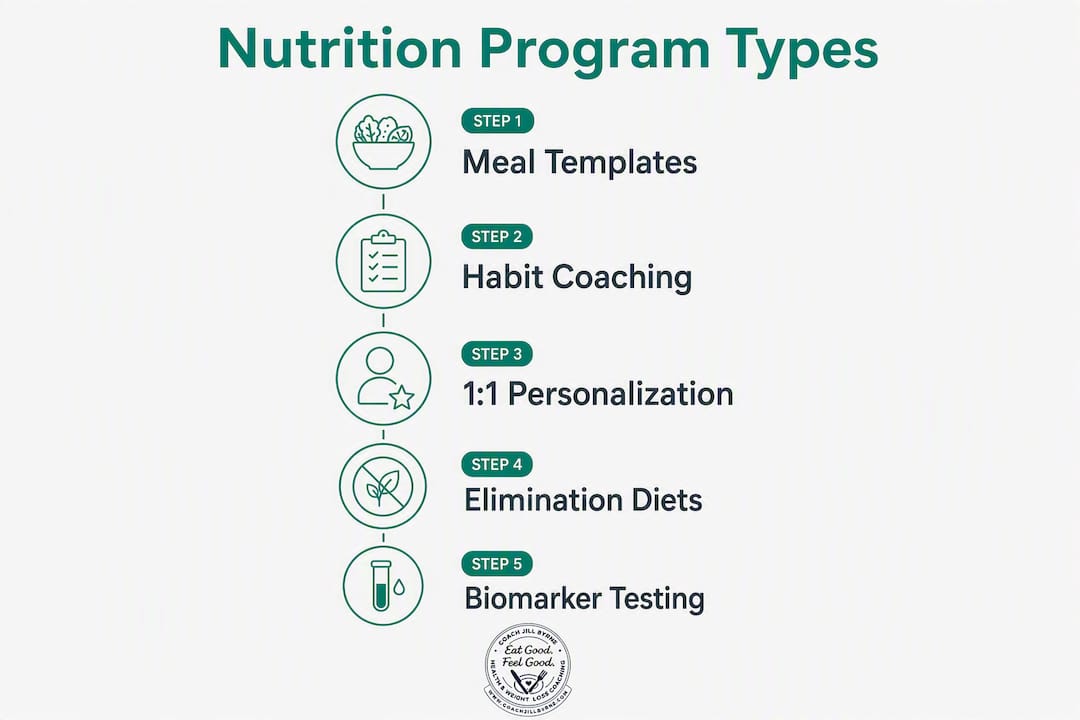
Use this framework before booking any discovery call.
Decision checklist:
Does the program offer individualized portion guidance, or a generic meal list?
How often does a coach check in, and through what channel?
Is the dietary approach evidence-backed (Mediterranean, whole food) or trend-driven?
Are pricing and package inclusions stated clearly upfront?
Does the program address long-term maintenance, not just the initial phase?
Is GLP-1 medication nutrition support available if relevant to your situation?
Questions to ask on a discovery call:
Walk me through your intake process. How do you tailor the plan to my health history?
Can I see a sample meal plan template before I commit?
What are your credentials, and do you work with clients who have medical conditions?
How do you measure progress beyond the scale?
What does the post-program maintenance phase look like?
What is your refund or transition policy if the program isn’t a fit?
The Academy of Nutrition and Dietetics notes that people with kidney disease, diabetes on medication, or digestive disorders need tailored clinical advice before major dietary changes. Always confirm whether a coach operates within their scope or refers out when clinical oversight is needed.
Red flags to watch for:
One-size-fits-all meal lists with no personalization
Opaque or bundled pricing with upsells for products you didn’t ask about
No measurable accountability cadence or defined success metrics
Pressure to purchase unnecessary supplements or testing packages
What does a real-food coaching program typically cost?
Pricing varies widely by format and level of support. Here is a realistic range for each type.
Monthly 1:1 coaching packages vary widely in price depending on session frequency and included features. Per-session rates for standalone nutrition consultations also vary. Group programs and app subscriptions tend to be more affordable but differ in personalization levels.
Biomarker and DNA testing adds a separate cost layer entirely.
InsideTracker’s Ultimate Plan starts at $699 per test. Quarterly retesting, as recommended by InsideTracker for continuous optimization, can push annual costs above $2,000. This cost is a key consideration when comparing program types: a year of 1:1 coaching with full meal planning support often costs less than one year of recommended biomarker retesting alone, and delivers the habit-building component that data alone cannot provide.
Timeline expectations are equally worth setting clearly. Most clients see measurable weight change within 4–12 weeks. Building sustainable habits that hold through travel, social events, and stress typically takes 3–12 months. GLP-1 medication users often see faster initial results but still need structured eating habits beyond medication to maintain them.
Practical budgeting tips: Ask for a trial month before committing to a long package. Request a written breakdown of what each tier includes. Factor in modest grocery shifts toward whole foods, which may offset some processed-food spending.
What does a sustainable real-food program actually look like?
The most durable real-food programs are built on a Mediterranean-style, whole-food template. That means vegetables, fruits, whole grains, legumes, healthy fats like olive oil, and moderate lean proteins as the daily backbone. A whole-food approach is associated with improved cholesterol and more stable blood sugar when balanced correctly.
Sample meal template structure:
Breakfast: Protein source + fiber-rich carb + healthy fat (e.g., eggs, whole-grain toast, avocado)
Lunch: Leafy greens base + lean protein + legumes or whole grain + olive oil dressing
Dinner: Vegetable-forward plate + moderate lean protein + whole grain or root vegetable
Snack: Fruit or vegetable + nut or seed portion
Gradual food changes matter practically. Rapidly increasing fiber intake can cause temporary bloating; stepwise increases in fiber and fluids reduce that risk. Canned and frozen whole foods are fully valid options when fresh access is limited.
Habit-based coaching adds the layer that templates alone cannot: portion calibration, accountability checkpoints, and gradual reintroductions when relevant. Professional meal-planning templates reduce the mental load of daily food decisions, which directly improves adherence. For guidance on making the shift gradually, the real food choices post-lifestyle change guide covers practical transition steps.
Pro Tip: Prepare three interchangeable dinner templates on Sunday, each using a different protein. Rotating them through the week eliminates the “what’s for dinner” decision entirely and keeps variety without extra planning effort.
What does a typical coaching week look like?
Here is a realistic day-by-day picture of a 1:1 coaching week.
Day 1 (Monday): Complete intake questionnaire or review prior week’s food log; set three specific food goals for the week
Day 2 (Tuesday): Coaching session (30–45 minutes); review meal plan template, adjust portions based on prior week’s feedback
Day 3 (Wednesday): Meal prep using batch-cooking template; log meals and note energy levels
Day 4 (Thursday): Mid-week accountability check-in via message; coach reviews food log and responds with one adjustment
Day 5 (Friday): Practice one new micro-habit (e.g., adding a vegetable to lunch, swapping a processed snack)
Day 6–7 (Weekend): Apply meal templates to social or family meals; note any challenges for Monday review
Weekly time commitment: Roughly 2–3 hours total, including one coaching session, meal prep, and logging. Clients using sustainable habits for busy schedules report that batch cooking on one day reduces daily decision time significantly.
Simple measurement markers to track: body weight (same time, same day), energy levels on a 1–5 scale, portion adherence, and one or two biomarkers if testing is part of the program.
Which program should you choose?
For most individuals seeking sustainable weight loss through real food, Coachjillbyrne’s personalized coaching is the clearest fit. It addresses the three factors that determine long-term success: individualized portions, consistent accountability, and a flexible whole-food framework that handles real life.
Action steps before you book:
Shortlist two or three programs and compare their intake process, coaching frequency, and pricing transparency
Prepare your health history summary, current eating patterns, and any medication context (including GLP-1 use)
Bring specific questions from the discovery-call script above
Discovery-call checklist:
Confirm what the intake process covers
Request a sample meal plan template
Ask how progress is measured and adjusted
Clarify the maintenance phase and post-program support
Key Takeaways
Personalized 1:1 real-food coaching with habit-based accountability and a Mediterranean-style framework produces the most durable weight loss outcomes compared with app-only or short-term elimination programs.
Point | Details |
Top program type | 1:1 coaching delivers the highest personalization and iterative adjustment for lasting results. |
Mediterranean framework | Whole-food, Mediterranean-style patterns are linked to roughly twice the weight-loss maintenance rate. |
Biomarker testing costs | InsideTracker’s Ultimate Plan starts at $699 per test; quarterly retesting can push annual costs above $2,000. |
Realistic timeline | Measurable weight change typically appears in 4–12 weeks; sustainable habits take 3–12 months to build. |
Coachjillbyrne | Offers monthly 1:1 coaching packages with meal templates, accountability cadence, and GLP-1 nutrition support. |
Why habit-based coaching outperforms stricter food rules
The most common mistake people make when evaluating real-food nutrition programs is treating strictness as a proxy for effectiveness. A program that eliminates more food groups is not automatically a better program. The evidence points in the opposite direction.
Short-term elimination resets can identify food sensitivities, but they are rarely sustainable as permanent patterns. Most long-term failures happen when clients treat programs as temporary resets rather than building a resilient framework that handles real-world scenarios: eating out, travel, social events. The programs that produce lasting results are the ones that build decision-making skills alongside food knowledge.
Coachjillbyrne’s approach is grounded in exactly that principle. Habit-based coaching, portion calibration, and real-food meal templates give clients a framework they can apply independently, not a set of rules that collapse the moment life gets complicated. For a deeper look at the behavior-change side of this, the new habits that last resource covers the practical framework in detail.
Coachjillbyrne: personalized real-food coaching with transparent support
Coachjillbyrne offers monthly 1:1 coaching packages that include a structured intake process, personalized meal plan templates, weekly accountability check-ins, and GLP-1 medication nutrition support for clients navigating that context. Pricing is stated transparently, a trial month is available, and the program is built around real food and sustainable habits rather than product sales or unnecessary testing.

Clients report meaningful weight loss and improved energy through practical changes in cooking habits and food choices, not through elimination or restriction. The mindful nutrition coaching guide outlines what to expect from the coaching process in detail. For sustainable weight loss maintenance strategies that complement the program, that resource offers additional context on realistic timelines.
Ready to start with a clear plan and consistent support? Book a free discovery call with Coachjillbyrne to review your goals, ask your questions, and see a sample meal plan template before committing.
This article is general information, not medical or clinical nutrition advice. Confirm any significant dietary changes with a qualified healthcare professional, particularly if you have a medical condition or take medication.
Useful sources and further reading
Guide to the Mediterranean Diet — Harvard Health: evidence base for Mediterranean-style eating and weight maintenance
Whole Food Diet: Benefits, Risks, and Guide — Acibadem Hospitals Group: clinical overview of whole-food eating patterns
Paleolithic Diet — StatPearls, NCBI — clinical review of Paleo versus Mediterranean and DASH dietary evidence
FAQ
What makes a real-food nutrition program sustainable long-term?
Sustainability comes from habit-based coaching and flexible meal templates, not strict elimination rules. Programs built on Mediterranean-style whole foods are linked to roughly twice the weight-loss maintenance rate compared with less structured approaches.
How much does personalized nutrition coaching cost per month?
Monthly 1:1 coaching packages vary widely in price depending on session frequency and included features such as meal plan templates and asynchronous check-ins.
Is Coachjillbyrne suitable for people using GLP-1 medications?
Yes. Coachjillbyrne’s coaching includes GLP-1 medication nutrition support, helping clients build the eating habits needed to maintain results beyond the medication phase.
When should I consider biomarker or DNA testing?
Biomarker testing adds value for performance optimization or when standard dietary changes have plateaued. InsideTracker’s Ultimate Plan starts at $699 per test, and quarterly retesting can push annual costs above $2,000, so it works best as a supplement to foundational habit-based coaching rather than a replacement.
How long before I see results from a real-food coaching program?
Most clients see measurable weight change within 4–12 weeks. Building habits that hold through everyday life typically takes 3–12 months, with GLP-1 medication users often seeing faster early results.
Recommended
Comments