
Start With 1–2 Dinners: Family Meal Planning for Busy Parents
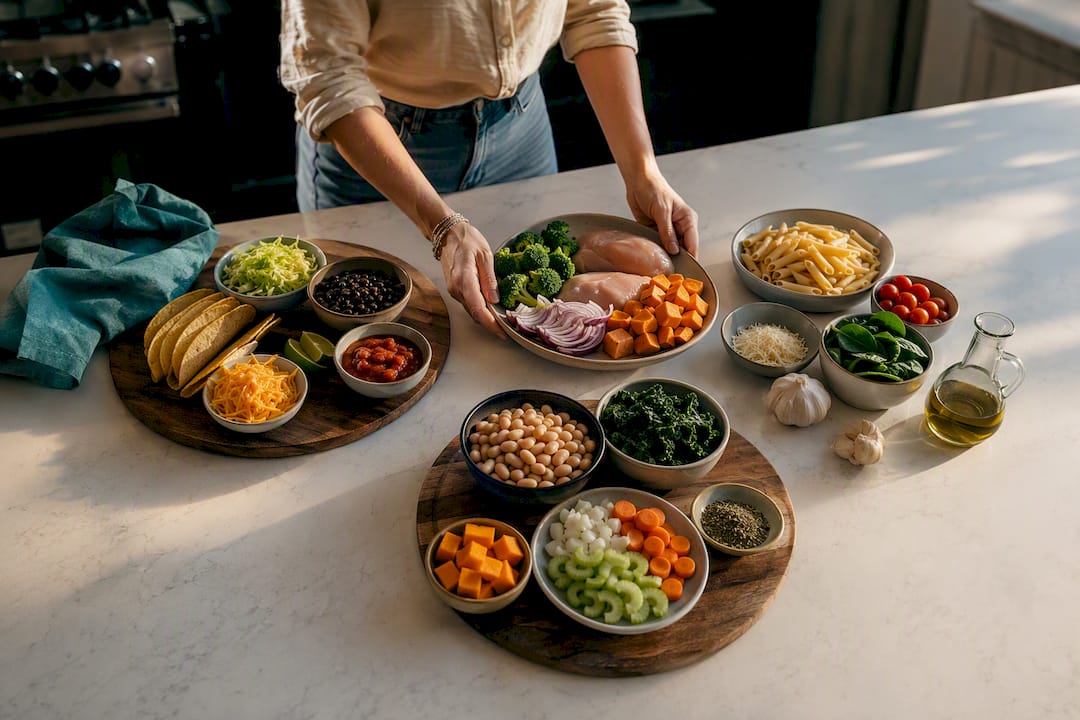
Use this simple weekly system: plan one week of dinners, shop once, and spend 30 to 90 minutes prepping. That single loop, repeated, cuts mealtime stress and grocery waste more than any recipe app or meal kit ever will. This guide walks through the steps, gives you copyable templates, and covers the food-safety rules that keep batch-prepped meals safe to eat days later.
TL;DR:
Planning 4 to 5 dinners each week, including two flexible nights, is sufficient to maintain a balanced and adaptable meal schedule.
Building a core list of 15 to 20 reliable family meals, organized by prep time and shared ingredients, significantly reduces weekly planning time.
Shopping should be based on a detailed, organized grocery list derived from recipes, focusing on bulk staples and store section flow to minimize store time and waste.
Batch prepping on weekends, with containers labeled and stored properly, ensures leftovers stay safe for 3 to 4 days and reduces daily cooking stress.
Starting with one or two planned dinners per week and gradually increasing builds sustainable habits without burnout.
Table of Contents
What Is the Simple Weekly System for Family Meal Planning?
Family meal planning works best as a three-step loop: plan, shop, prep. Skip a step and the whole system falls apart. Skip planning and you shop randomly. Skip shopping with a list and you improvise dinners from whatever’s left. Skip prepping and Tuesday night still feels like a scramble even though you technically “planned.”
Here’s how each step works in practice.
Step 1: Take inventory before you plan anything. Open the fridge, freezer, and pantry and note what’s about to expire, what’s frozen and forgotten, and what staples you’re running low on. This five-minute walk-through, backed by food-preservation guidance from Utah State University Extension, is what keeps you from buying three bags of spinach when you already have one wilting in the crisper drawer.
Step 2: Pick 4 to 5 dinners, not 21 meals. Long-term meal planners tend to plan dinners only, leaving breakfast and lunch to simpler rotating defaults. That’s not a shortcut; it’s the reason the system survives past week two. Add two flex nights: one for leftovers, one for takeout or a “clean out the fridge” plate.
Step 3: Build your grocery list from the recipes you picked, not from memory. Go through each recipe, list every ingredient, then organize the list by store section (produce, dairy, protein, pantry) so you’re not crisscrossing the store. Add versatile staples like rice, canned beans, and frozen vegetables even if they’re not tied to a specific recipe. Government meal-planning resources at Nutrition offer sample shopping templates that follow this exact logic.
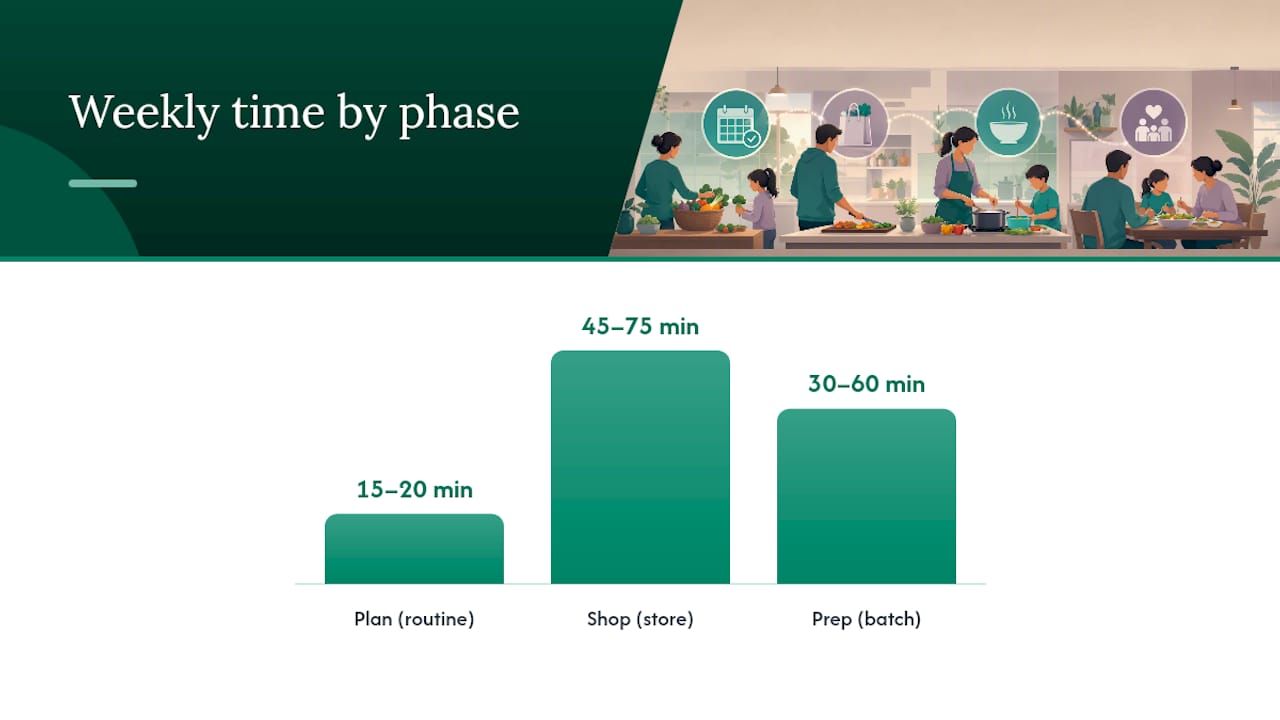
Step 4: Time-box each phase. Planning should take 15 to 25 minutes once you have a routine. Shopping runs 45 to 75 minutes depending on store size and whether you order for pickup. Prep takes 30 to 90 minutes, usually on a weekend. One breakdown of the method found that an established weekly rhythm gets planning down to roughly 15 to 20 minutes, with prep adding another 30 to 60 minutes. The first few weeks take longer. That’s normal.
Your first-week checklist:
Spend 5 minutes checking pantry, fridge, and freezer for what needs to be used soon.
Choose 4 to 5 dinners your family already likes, plus 2 flex nights.
Write ingredients per recipe, then merge into one list organized by store aisle.
Add 3 to 4 pantry staples you’re low on, even if unrelated to this week’s meals.
Shop once, ideally with the list open on your phone or printed on paper.
Block 30 to 90 minutes for batch prep the same day or the next.
A few things that make this easier the second time around:
Keep last week’s list as a template. You’ll reuse 60 to 70% of it.
Shop the same day and time each week so it becomes automatic.
Prep while something else is happening (a load of laundry, a kid’s practice) so it doesn’t feel like an extra chore.
Should You Plan Weekly or Monthly?
Both rhythms work. The right one depends on your schedule, not on which method is “more organized.”
Weekly planning fits better when:
Your schedule shifts often (sports seasons, rotating work shifts, unpredictable evenings).
You want fresh produce that doesn’t sit in the fridge for three weeks.
You’re new to meal planning and need the flexibility to adjust as you learn what actually gets cooked versus what gets abandoned.
Monthly planning fits better when:
You do one large bulk shopping trip and want to plan around what you bought.
Your calendar is predictable enough to know which nights are busy weeks out.
You want to batch-cook and freeze in larger sessions rather than weekly.
The hybrid approach most families land on: set a monthly theme or rotation (Week 1 is Mexican-inspired, Week 2 is stir-fry and grain bowls, Week 3 repeats Week 1 with swaps, Week 4 is a “pantry clean-out” week), then execute the actual planning, shopping, and prepping weekly within that structure. This gives you the mental relief of a monthly framework without pretending you can predict every Tuesday four weeks out.
A simple monthly template looks like this: pick four dinner “themes” for the month (say, taco night, sheet-pan chicken, pasta, and a soup or stew), assign one theme per week, then rotate specific recipes within that theme so nothing feels repetitive. You’re not planning 30 meals in one sitting. You’re planning one decision that makes four future weekly decisions faster.
How Do You Build a Master List of Core Family Meals?
The single biggest time-saver in family meal planning isn’t an app. It’s a running list of meals your family has already eaten and approved. Nutrition and meal-prep resources at the Harvard T.H. Chan School of Public Health point to themed nights like Meatless Monday as a way to narrow decisions and reduce the mental fatigue of picking dinner from scratch every single time.
Build this list gradually. Every time you cook a dinner that gets eaten without complaints, write it down. Within two or three months, you’ll have a personal rotation of 15 to 20 reliable dinners. That rotation, tracked over time, becomes the single most effective tool for cutting weekly planning time, according to meal-planning research from The Whole Fork.
Once you have that list, organize it three ways:
By prep time: 15-minute meals for chaotic weeknights, 45-minute meals for calmer evenings.
By protein: so you’re not accidentally serving chicken four nights running.
By shared ingredients: meals that reuse the same rotisserie chicken, the same can of beans, or the same block of cheese cut your grocery bill and your prep time simultaneously.
This keeps dinner low-stress most nights while still letting your family’s rotation evolve. Plan leftovers on purpose rather than treating them as an accident. If Monday’s chicken makes enough for two meals, build Wednesday’s flex night around that intentionally.
Pro Tip: Keep your core meals list somewhere you’ll actually see it, like a sticky note on the fridge or a note on your phone’s home screen. A list buried in a folder never gets used.
What’s the Best Way to Shop Smart on a Family Food Budget?
Your grocery list should come directly from your meal plan and be carefully built, rather than improvised at the store. First, write a master ingredient list from your chosen recipes. Second, cross-check that list against what’s already in your pantry and cut anything you already own. What’s left becomes your actual shopping list, organized by store section so you move through the aisles once instead of backtracking.
Four tactics keep the bill down without adding time:
Buy versatile staples in bulk when they’re on sale. Rice, oats, canned tomatoes, and dried beans don’t expire quickly and show up in multiple recipes.
Use frozen produce for anything not in season. Frozen vegetables and fruit cost less, last longer, and work in nearly every recipe that calls for fresh.
Check unit price, not sticker price. The larger package isn’t always cheaper per ounce, especially with store-brand versus name-brand items.
Shop sales for your core proteins and build that week’s meals around what’s discounted, rather than locking in recipes first and paying full price no matter what.
Meal planning paired with a defined grocery list is one of the most consistently cited ways to reduce both food waste and weekly cooking time, according to guidance compiled by Eat This Much. The framework is straightforward: choose meals, build the list, shop, batch prep. It sounds almost too simple to matter, and that’s exactly why most families who abandon meal planning quit before letting the routine become automatic.
Organize your printed or digital list by store route: produce, meat and dairy, then dry pantry goods, matching how most grocery stores are laid out. This alone cuts wandering time and reduces the impulse purchases that happen when you’re standing in an aisle with no plan. If a recipe calls for an ingredient you’ll use once and never again, look for a simple swap using something already on your staples list. A jar of pesto substitutes for a specific fresh herb blend in most weeknight pasta dishes, for instance, and costs less over a month of use.
For a deeper breakdown of budget-specific swaps and staple lists, Coachjillbyrne’s guide to cooking healthy family dinners on a budget walks through cost-per-meal comparisons in more detail, and the pantry staples guide lists exactly what to keep stocked.
How Long Do Prepped Meals Stay Safe in the Fridge?
Batch prep is where meal planning either pays off or creates a science experiment in your refrigerator. A solid Sunday prep session covers a handful of tasks: cook a big batch of a grain (rice, quinoa, farro), roast two trays of vegetables, cook one or two proteins fully, and mix up a sauce or dressing that works across multiple meals. Add pre-portioned snack packs for the week if your kids grab their own snacks.
Store everything in clear containers so you can see what’s inside without opening every lid, and label each one with the contents and the date you cooked it. Rotate older containers to the front of the fridge so they get used first instead of forgotten behind the newer batch.
Food Safety Callout: Cooked leftovers and prepped ingredients are safe in the refrigerator for 3 to 4 days at 40°F (4°C) or below, according to the Foodsafety. Anything you won’t eat within that window should go straight into the freezer instead of sitting in the fridge “just in case.”
A few storage habits that prevent waste:
Freeze half of any batch-cooked protein or grain the moment you make it if you know you won’t finish it in four days.
Keep raw and cooked items on separate shelves to avoid cross-contamination during the week.
Reheat only what you’ll eat in one sitting rather than reheating and re-cooling the entire container repeatedly.
This is also where labeling earns its keep. Dating and rotating prepped food substantially cuts down on forgotten leftovers, based on findings from Eat This Much, which is really just a fancy way of saying the mystery container in the back of the fridge stops existing once you start writing dates on lids.
What Does a Sample Weekly Meal Plan Look Like?
Two templates cover most family situations: one built for dinner-only planning, and one for families who want a broader monthly rotation to fall back on.
The 7-day dinner template covers 4 fresh-cooked dinners, one intentional leftover night, and two flex nights (takeout or a clean-out-the-fridge plate). That’s the whole week. You’re not planning breakfast or lunch here; those run on simpler defaults like oatmeal, sandwiches, or whatever’s grabbed on the way out the door.
A sample budget-focused week, with ingredient reuse built in on purpose:
Night | Meal | Ingredient Reuse Note |
Monday | Sheet-pan chicken thighs with roasted vegetables | Extra chicken saved for Wednesday |
Tuesday | Bean and rice bowls | Uses staple rice batch from Sunday prep |
Wednesday | Chicken quesadillas (leftover night) | Reuses Monday’s chicken |
Thursday | Vegetarian stir-fry | Uses frozen vegetable mix, swap protein for tofu or eggs |
Friday | Flex night: takeout or frozen pizza | No prep required |
Saturday | Pasta with simple tomato sauce | Sauce batch-made Sunday, freezes well |
Sunday | Clean-out night: whatever’s left plus a quick side | Uses odds and ends before next week’s shop |
Notice the pattern: Monday’s protein feeds Wednesday, Sunday’s sauce batch feeds Saturday, and two nights require zero fresh cooking. That’s the ingredient-reuse logic doing the actual budget work, not any single “cheap” recipe.
For a monthly rotation, assign one theme per week (taco week, stir-fry week, sheet-pan week, soup week) and repeat the cycle with small recipe swaps each month. This shortens planning to picking specific recipes within an already-decided theme, rather than starting from a blank slate every single week. Coachjillbyrne’s weekly meal plan guide walks through a full build-out of this exact structure if you want a version to copy directly.
How Do You Handle Picky Eaters and Get Family Buy-In?
Picky eating derails more meal plans than budget problems do. A few structural fixes reduce the nightly negotiation without doubling your cooking workload.
The plate-builder method works well for mixed-age families: put components on the table separately (protein, a starch, a vegetable, a sauce) and let everyone build their own plate. Nobody’s “meal” gets rejected outright because it was never assembled as one fixed dish.
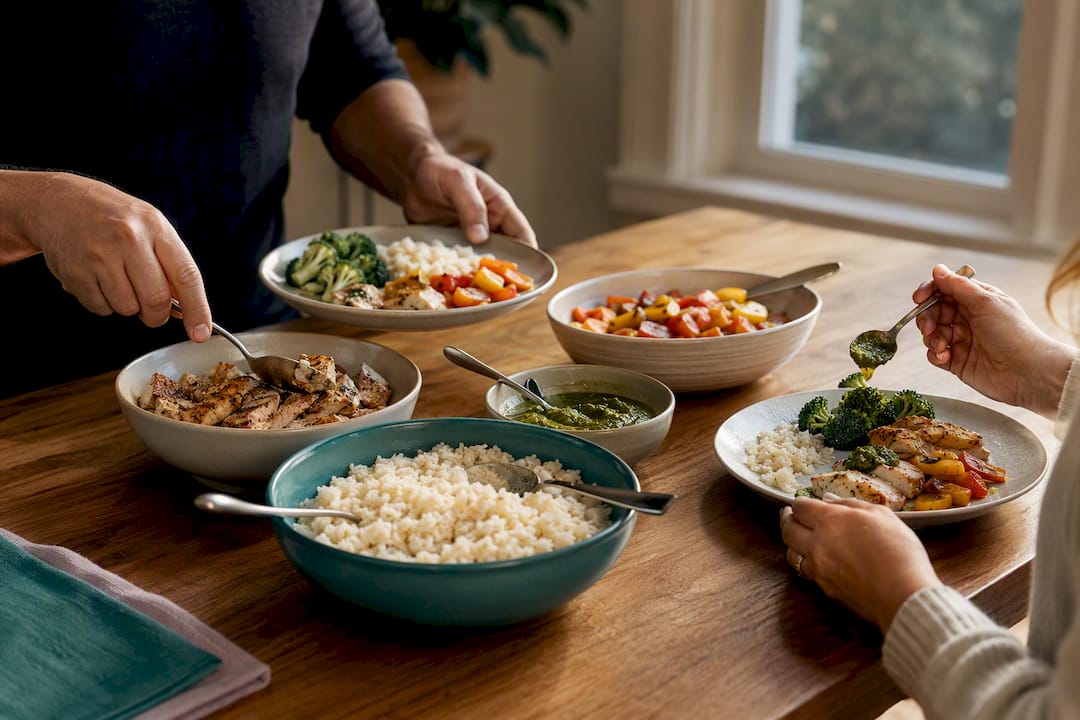
Add a “one new bite” rule for new recipes: everyone tries one bite of anything new, no pressure to finish it.
Other tactics that reduce friction:
Run a weekly vote among older kids for one dinner slot; ownership reduces refusal.
Adapt core meals for different diets by changing one component, not the whole recipe. Swap the protein, keep the sides the same.
Involve kids in prep, even simple tasks like washing vegetables or stirring sauce. Kids who help cook are measurably more willing to try what they made.
Pro Tip: If a new recipe flops, don’t scrap it. Adjust one variable (less spice, a familiar side dish, a different shape of pasta) and try again in two or three weeks. Most “picky” reactions are about novelty, not the food itself.
For a running list of dinners that tend to clear multiple age groups without separate cooking, Coachjillbyrne’s kid-friendly dinner ideas is built specifically around that plate-builder logic.
Coach Jill’s Habit-Based Checklist for Sticking With It
Most families don’t fail at meal planning because the system is too complicated. They fail because they try to overhaul all 21 weekly meals at once, burn out by week three, and quit.
Start smaller than feels necessary. Plan just 1 to 2 dinners for your first week. Experts consistently recommend beginning with 2 to 3 dinners rather than a full week, according to guidance from the Cleveland Clinic, specifically to avoid the burnout that kills most attempts at week two or three. Add one more meal per week only once the current routine feels automatic, not effortful.
Build in light accountability:
Pick one day as your non-negotiable “planning ritual” (Sunday morning coffee, Thursday night after the kids are in bed).
Track a simple metric: meals cooked versus meals planned. If you’re hitting 3 out of 5 consistently, that’s real progress, not a failure.
Put the week’s dinners on a shared family calendar so everyone, including kids, knows what’s coming.
Small, sustained habits beat ambitious plans that collapse under their own weight. For more on the small daily changes that compound into real results, Coachjillbyrne’s guide to improving family eating habits covers the specific micro-changes that tend to stick.
A Note From Coach Jill
Start smaller than you think you need to. One or two planned dinners this week is a real win, not a consolation prize. The families who stick with meal planning long-term are rarely the ones with the most elaborate spreadsheets. They’re the ones who kept a messy, imperfect system running for six months because they didn’t quit after one rough week.
Progress here isn’t about hitting a flawless seven-night plan. It’s about cooking at home more often than you did last month, spending a little less at the grocery store, and feeling less frantic at 5:30 on a Tuesday. That’s the actual goal, and it’s a realistic one.
— Coach Jill
How Coach Jill Byrne Can Help You Build a System That Sticks
Reading a system is one thing. Sticking with it when the week gets chaotic is another, and that gap is exactly where personalized coaching earns its keep. Personalized habit-based nutrition coaching can help start with one or two changes, use accountability check-ins instead of willpower alone, and build meal-planning templates suited to your family’s actual schedule rather than a generic one-size-fits-all plan.

If GLP-1 medication support, portion control training, or a personalized weekly meal template sounds like the missing piece, a consult with a nutrition coach can walk through your specific routine and build a plan around it instead of asking you to fit yours around a template. Visit Coachjillbyrne to book a session and get a system built around your family’s actual week, not an idealized one.
Sources
FAQ
What are the 5 rules in planning meals?
A practical version includes: take inventory before shopping, plan dinners only (not every meal), build your grocery list from chosen recipes, batch prep in one time block, and store leftovers safely for 3 to 4 days in the fridge before freezing anything older.
How do you make a meal plan for your family?
Check your pantry, fridge, and freezer, then pick 4 to 5 dinners plus 2 flex nights, build a grocery list organized by store section, shop once, and prep for 30 to 90 minutes, ideally on the same day each week.
What is the 40-40-20 meal plan?
Definitions of the “40-40-20” split vary depending on the source, and it’s typically used to describe macronutrient ratios (protein, carbohydrate, and fat percentages) rather than a specific weekly meal-planning structure, so check the source of that ratio before applying it to your family’s plan.
What is the rule of 3 meal plan?
There’s no single standardized “rule of 3” in family meal planning, though many versions of the concept refer to planning three core components per meal (a protein, a vegetable, and a starch) using the plate-builder approach covered above.
How long can meal-prepped food safely stay in the fridge?
Cooked leftovers and prepped ingredients stay safe for 3 to 4 days in the refrigerator at 40°F (4°C) or below, according to FoodSafety.gov; freeze anything you won’t eat within that window.
Recommended
Comments