
Healthy Meal Prep Services Comparison: One-on-One Coaching

For people who want to build real, lasting meal-prep skills, one-on-one nutrition coaching is the most effective format available. Coachjillbyrne offers a habit-based, personalized program that teaches you how to plan, shop, and prepare food for your actual life rather than handing you a static meal plan and wishing you luck.
Two quick next steps if you’re ready to move forward:
Book a discovery call with Coachjillbyrne to review your goals, current eating patterns, and what a customized program would look like for you.
Prepare one week of food logs before that call. A simple record of what you ate, when, and how you felt gives your coach the raw material to build a plan that fits your real routine.
Pro Tip: Bring your typical weekly schedule to your first session. Coaches who understand your actual time constraints build meal templates you’ll use consistently, not just in theory.
Table of Contents
What does “healthy meal prep services” actually mean here?
This article is about meal-prep coaching: one-on-one or small-group nutrition coaching that teaches you how to plan meals, build a grocery list, batch-cook efficiently, and portion food for the week ahead. It is not about meal-delivery boxes or ready-to-eat meal kits. Those services do the work for you. Coaching teaches you to do it yourself, which is the only path to lasting habit change.
The credential distinction matters here. A Registered Dietitian Nutritionist (RDN) holds a clinical license and can provide Medical Nutrition Therapy for diagnosed conditions. A certified nutrition coach operates within a wellness and education scope, offering meal-planning education, accountability, and behavior support but not clinical treatment. Both can be effective for habit-focused clients; the right choice depends on your health complexity.
Core deliverables this article assumes a reputable program includes: personalized meal templates, weekly shopping lists, batch-cook recipes, pantry and portioning guides, and scheduled accountability check-ins.
Who benefits most from one-on-one meal-prep coaching?
One-on-one coaching fits a specific kind of client. You’ll get the most from it if you recognize yourself in one of these profiles:
Busy professionals who need sustainable weight loss habits and time-efficient prep strategies that survive a packed calendar.
People using GLP-1 medications who need structured nutrition support to complement their treatment and understand why eating habits matter beyond medication.
A frequent traveler, for example, benefits from a coach who builds airport and hotel food defaults into the plan. A parent batch-cooking for three kids with different preferences needs a coach who can adapt templates to real constraints, not a generic weekly menu.
A self-guided program may be sufficient if you already have strong nutritional knowledge and need only accountability tools, or if your schedule and goals are straightforward enough that a structured template and a tracking app will carry you.
What does the evidence say about one-on-one vs. group vs. self-guided programs?
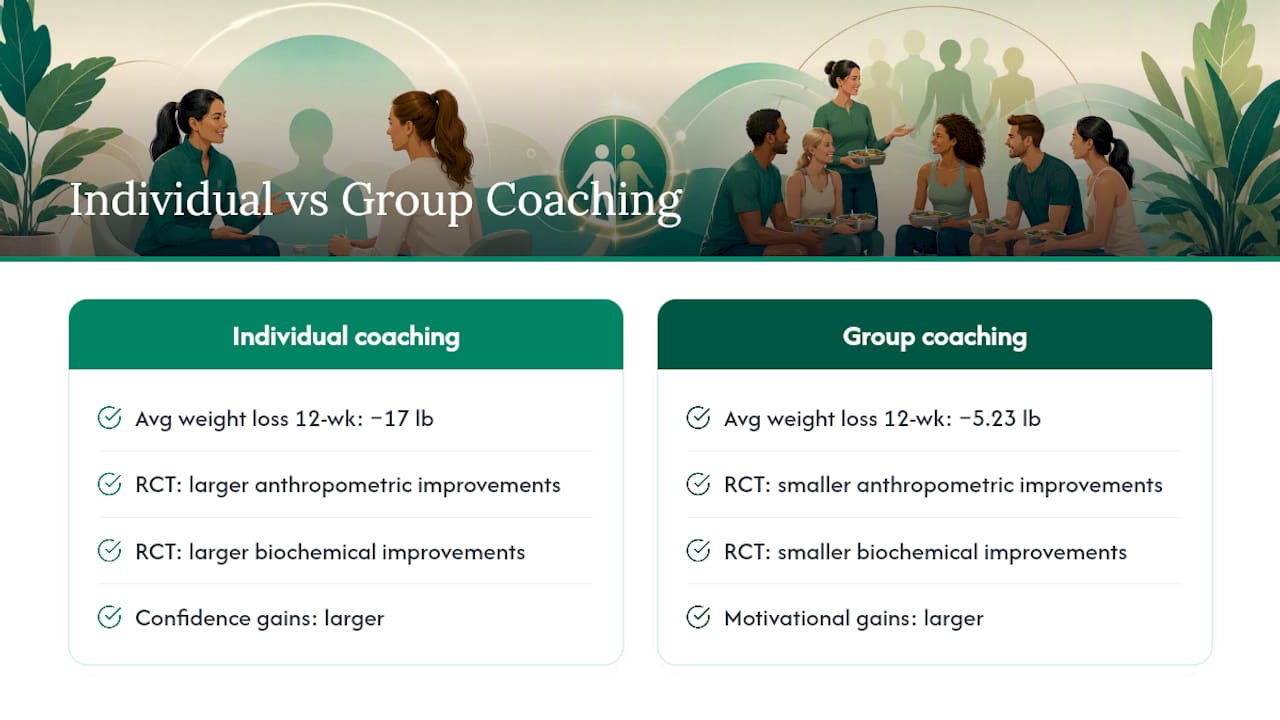
The research consistently favors individualized coaching for clients with complex needs or specific clinical goals. A randomized controlled trial published in PMC found that individual nutrition education sessions lasting approximately 55–60 minutes produced significantly greater improvements in weight, waist circumference, BMI, blood pressure, and fasting glucose compared with group education in overweight, hypertensive adults.
“Individual nutrition education produced significantly better anthropometric and biochemical improvements than group education across all measured outcomes.” — PMC Randomized Controlled Trial
A 12-week DNP capstone study reported that participants in one-on-one coaching lost an average of 17 lbs compared with 5.23 lbs in the group format. Confidence gains were also larger in the individualized group. Group coaching, however, showed stronger motivational improvements, which suggests it can be a better entry point for people earlier in the readiness-to-change process.
The practical implication: if you have high motivation and specific health goals, one-on-one coaching is the stronger investment. If you’re still building motivation and want peer support, a group format may help you engage first.
What does a one-on-one meal-prep coaching program typically include?
A well-structured program delivers far more than a meal plan. Personalized coaching programs include follow-up touchpoints that sustain habit change over time, which is what separates coaching from a one-time consultation.
Deliverable | Purpose | How it supports skill transfer |
Initial intake and goal assessment | Establishes baseline habits, preferences, and constraints | Ensures the plan reflects real life, not an ideal scenario |
Personalized meal templates | Provides a repeatable weekly structure | Reduces decision fatigue and builds routine |
Grocery and shopping lists | Aligns purchasing with the meal plan | Teaches cost-effective, efficient shopping habits |
Batch-cook recipes and portioning guides | Builds practical kitchen skills | Transfers prep knowledge the client can replicate independently |
Sample weekly plans | Models how a full week of eating fits together | Helps clients visualize and adapt the structure |
Troubleshooting strategies | Covers dining out, travel, and social eating | Builds problem-solving confidence beyond the kitchen |
Accountability check-ins | Tracks adherence and adjusts the plan | Sustains motivation and catches obstacles early |
“The most effective programs combine personalized dietary advice with practical meal supports and regular coaching contact, producing measurable improvements in diet quality and body composition.” — PMC Personalized Systems Nutrition Study
A typical program runs several weeks, with an intake session followed by regular follow-ups and a maintenance check-in phase. A personalized systems nutrition program combining coaching with practical meal supports showed improvements in BMI, body composition, and diet quality over a 10–20 week period.
How do you choose a meal-prep coach that’s right for you?
Use this checklist during any discovery call or when reviewing a coach’s sales page:
Confirm credentials. Ask whether the coach holds an RDN license or a recognized nutrition coaching certification. Use the Academy of Nutrition and Dietetics directory to verify RDN credentials independently.
Red flags: one-size-fits-all plans with no customization, refusal to discuss scope of practice, and no defined method for measuring client progress.
What does one-on-one coaching typically cost in the U.S.?
Typical online nutrition coaching in the U.S. usually costs between $200 and $350 per month for certified nutrition coaches running one-on-one sessions. Hybrid models that pair an RDN with a coaching framework generally run $350–$500 or more depending on session frequency and deliverables.
Tier | Format | Typical monthly range | Usually includes |
Entry-level coach | Self-guided with check-ins | $200–$350 | Templates, email support |
Certified nutrition coach | One-on-one sessions | $200–$350 | Sessions, meal plans, messaging |
Hybrid RDN + coach model | One-on-one clinical + coaching | $350–$500+ | Clinical assessment, full deliverables |
Most effective programs require a minimum of 8–12 weeks to produce measurable habit change. Maintenance-phase coaching, typically monthly check-ins, extends results and prevents regression.
How do reputable programs measure success?
Metrics worth tracking include food-log adherence, self-efficacy scores, weight and body-composition changes, functional outcomes like energy and sleep quality, and blood markers when clinically appropriate. Energy improvements often appear within 2–3 weeks of consistent changes. Measurable body-composition shifts typically emerge over 6–12 weeks.
When evaluating a program, ask for anonymized case outcomes or before-and-after metrics from past clients. Coaches who track sustainable weight loss results with defined metrics are far more accountable than those who rely on testimonials alone.
Key Takeaways
One-on-one meal-prep coaching consistently outperforms group and self-guided formats for clients with specific goals, producing greater weight loss, confidence gains, and measurable habit change within an 8–12 week program.
Point | Details |
One-on-one format wins | Individual coaching produced 17 lbs average weight loss vs. 5.23 lbs in group coaching over 12 weeks. |
Minimum effective timeline | Plan for 8–12 weeks of active coaching before expecting measurable body-composition changes. |
Typical U.S. cost range | Certified nutrition coaches typically charge moderate monthly fees; hybrid RDN models tend to cost more. |
Vetting checklist | Confirm credentials, ask for sample deliverables, and verify how progress is measured before committing. |
Coachjillbyrne | Offers habit-based, one-on-one meal-prep coaching with personalized templates, shopping lists, and accountability check-ins. |
What most people get wrong about meal-prep coaching
The most common mistake is treating coaching as a meal-plan delivery service. Clients who approach it that way often see short-term results and then revert, because they never built the underlying skills. Real coaching teaches you to think like someone who knows how to feed themselves well, not just follow instructions for eight weeks.

The second underestimated factor is the coach-client relationship itself. The research on behavior change consistently shows that rapport, collaborative goal-setting, and a coach who probes lifestyle, sleep, and stress alongside nutrition produces far better outcomes than a technically perfect plan delivered without connection. When you’re evaluating coaches, pay as much attention to how they listen as to what credentials they hold.
What to expect on a discovery call with Coachjillbyrne
A discovery call with Coachjillbyrne covers your current eating habits, your primary health goals, and a preview of what a personalized meal-prep plan would look like for your schedule. The call typically runs 20–30 minutes.

To get the most from it, bring a rough food log from the past week and a note of your typical daily schedule. That preparation lets the call move quickly from introduction to a concrete plan preview.
Coachjillbyrne’s program is built for people who want practical skills and lasting results, not another temporary fix. Book your discovery call and start building a meal-prep routine that fits your actual life.
Selected research and further reading
Effectiveness of Individual vs. Group Nutrition Education (PMC) — Randomized controlled trial documenting superior outcomes from one-on-one sessions; foundational evidence for format comparisons.
One-on-One vs. Group Health Coaching (UND Capstone) — 12-week study with concrete weight loss and confidence data across formats.
Personalized Systems Nutrition Program (PMC) — Documents integrated coaching plus practical meal support and its effect on BMI and diet quality.
Personalized Coaching and Follow-Up Support (Wiley) — Explains how post-session check-ins sustain habit change in metabolic health programs.
Find a Nutrition Expert (Academy of Nutrition and Dietetics) — Searchable RDN directory for credential verification; filter by specialty and location.
What Does a Nutrition Coach Do? (Healthline) — Clear explanation of coach scope, services, and how coaches differ from RDNs.
How to Find a Good Nutrition Coach (Tonum) — U.S. market pricing context and practical guidance on evaluating coach value.
This article provides general educational information about nutrition coaching services. It is not a substitute for personalized medical or clinical nutrition advice. Consult a qualified healthcare provider or Registered Dietitian Nutritionist for guidance specific to your health conditions.
FAQ
What is meal-prep coaching, and how is it different from meal delivery?
Meal-prep coaching teaches you how to plan, shop for, and prepare your own food through personalized sessions and accountability support. Meal delivery services send you pre-made or ready-to-cook food, which builds no lasting skills.
How long does it take to see results from one-on-one coaching?
Energy improvements often appear within 2–3 weeks. Measurable body-composition changes typically develop over 6–12 weeks of consistent coaching and habit practice.
Certified nutrition coaches typically charge $200–$350 per month for one-on-one sessions. Hybrid RDN and coaching models generally run $350–$500 or more depending on session frequency and deliverables.
What credentials should a meal-prep coach have?
Look for a recognized nutrition coaching certification at minimum. For clients with diagnosed medical conditions, an RDN license is the appropriate credential. The Academy of Nutrition and Dietetics maintains a searchable directory for verifying RDN credentials.
Does Coachjillbyrne offer support between sessions?
Yes. Coachjillbyrne’s program includes accountability check-ins and practical troubleshooting support between sessions to help clients stay consistent and adapt their plan as real-life situations arise.
Recommended
Comments