
How Grocery Shopping Impacts Nutrition: Evidence-Based Guide

Where and how you shop strongly shapes the nutritional quality of what ends up on your plate. Research from the USDA Economic Research Service consistently links shopping behaviors, store access, and household income to measurable differences in diet quality. FMI’s U.S. Grocery Shopper Trends data show that 54% of shoppers still prefer in-person shopping, largely because they want direct control over perishables. And a Purdue Consumer Food Insights survey found that a large majority of respondents changed their shopping behaviors in 2025 due to economic pressures. These are not minor lifestyle details. They are the upstream decisions that determine what nutrients your household actually consumes.
Key implications the evidence supports:
Shopping mode matters. Online grocery platforms can reduce impulse purchases, but passive browsing online can replicate in-store impulse effects. Active use of nutrition filters makes the difference.
Planning and list use raise diet quality. Shoppers who arrive with a written or digital list consistently bring home more nutrient-dense items and fewer impulse buys.
Price and promotions strongly shift what people buy. When price incentives target fruits and vegetables, lower-income households increase produce purchases measurably.
Access and socioeconomic status moderate all of the above. SNAP participants and households in low-access areas show lower nutritional quality in their purchases, independent of individual intent.
Coachjillbyrne translates these research findings into practical, habit-based coaching assignments that help clients build grocery routines they can sustain long-term.
Table of Contents
What the research says about grocery shopping and diet quality
Online versus in-store shopping: what the evidence actually shows
Practical shopping habits that consistently improve diet quality
How studies measure the shopping–nutrition link and where the evidence is weak
How culture and social context shape what ends up in the cart
In-store marketing and product placement go far beyond price
Transportation and mobility shape store choice before any other decision
Personalized nutrition coaching that puts the research to work
What the research says about grocery shopping and diet quality
The evidence base connecting grocery shopping behaviors to nutrition outcomes spans randomized trials, natural experiments, nationally representative purchase surveys, and industry trend reports. Together, they build a consistent picture, though with important nuances.
Peer-reviewed studies indexed on PubMed and PMC show that online grocery shopping can reduce exposure to in-store impulse cues, but its effect on actual dietary intake remains mixed. Randomized trials of “optimal defaults,” where online carts are pre-populated with healthier items, show improved purchase quality and trend-level improvements in dietary intake, though larger studies with objective intake measures are still needed.
The USDA ERS analysis of household food acquisitions found that SNAP participants and households with limited access to healthy food retailers consistently show lower nutritional quality in their purchases. Greater reliance on food prepared away from home is also associated with lower diet quality across income groups.
Industry data add a behavioral layer. The FMI Grocery Shopper Trends report documents that in-person shopping retains a strong preference among American shoppers, with perishables control cited as the primary reason. Meanwhile, the Purdue Consumer Food Insights survey captures how economic pressure translates directly into purchase decisions, with the majority of households actively seeking discounts and switching brands.
Study / Source | Design | Key Finding |
Nationally representative purchase survey | SNAP participants and low-access households show lower nutritional quality in food acquisitions | |
Empirical review of online vs. in-store formats | Online shopping reduces impulse cues; perishables control remains a pitfall | |
Optimal Defaults RCT (Journal of Nutrition Education) | Randomized trial | Pre-filled healthy online carts improved purchase quality; intake effects were trend-level |
BMC Medicine DS123 natural experiment | Natural experiment | Price incentives + food-literacy supports increased vegetable purchases, reduced prepackaged meal spending |
Consumer survey | 82% of respondents modified shopping behaviors due to economic pressures |
Three outcomes are consistently linked to shopping behavior across these sources: the nutritional quality of household purchases, fruit and vegetable spending, and the proportion of meals prepared at home versus away. These are the metrics most sensitive to changes in shopping habits, store access, and pricing environments.
How shopping behaviors translate into what you actually eat
The pathway from grocery store to nutrient intake runs through several well-documented mechanisms. Understanding them helps explain why two households with similar incomes can end up with very different diets.
Choice architecture and in-store placement. End-cap displays, checkout-lane positioning, and eye-level shelving are not neutral. Retailers place high-margin, often calorie-dense products in high-visibility locations. Shoppers who are not actively working from a list are more susceptible to these placements, particularly when cognitively fatigued after a long day.
Impulse buying and cognitive fatigue. Decision fatigue is real in grocery settings. The more choices a shopper has already made, the more likely they are to default to familiar, often less nutritious, options. This is one reason shopping on an empty stomach or at the end of a workday tends to produce lower-quality carts.
Planning and list use. Arriving with a structured list, whether paper or digital, consistently correlates with higher diet quality. Lists reduce exposure to impulse cues and help shoppers allocate budget toward planned, nutrient-dense items rather than reactive purchases.
Label literacy and %DV use. Reading the Nutrition Facts panel, specifically the percent Daily Value (%DV) for nutrients like sodium, added sugar, and fiber, gives shoppers a practical tool for comparing products. MedlinePlus patient guidance recommends using %DV as a quick benchmark: 5% or less is low, 20% or more is high for any given nutrient.
Price and promotions. Promotional pricing is one of the strongest behavioral levers in grocery retail. When discounts apply to produce, shoppers buy more of it. When promotions favor processed snacks, those dominate the cart. Price sensitivity is highest among lower-income households, making promotional strategy a genuine public-health lever.
Shopping frequency and timing. Frequent, smaller trips tend to support fresher produce consumption but can increase exposure to impulse cues. Weekly planned trips with a complete list tend to produce more consistent nutritional outcomes.
Transportation constraints. When a shopper’s store choice is limited by what is reachable by foot, bus, or a single car, the entire mechanism chain above is constrained before it even begins.
Pro Tip: Automate your healthy defaults. Set up a recurring online grocery order for your staple nutrient-dense items (oats, canned legumes, frozen vegetables, lean proteins) so those items arrive without requiring a weekly decision. Reserve in-store trips for fresh produce and perishables where you want direct quality control.
The pathway looks like this: shopping environment shapes purchase choices, which determine home food availability, which drives actual intake. Intervening at any point in that chain, through planning, defaults, or pricing, can shift nutritional outcomes.
Online versus in-store shopping: what the evidence actually shows
The comparison between online and in-person grocery shopping is more nuanced than most coverage suggests. Neither format is categorically better for nutrition. The outcome depends heavily on how the shopper uses each format.
Research published in PMC identifies online shopping’s core nutritional advantage as the removal of in-store impulse cues: no checkout-lane candy, no end-cap promotions, no sensory triggers from bakery aromas. For shoppers who struggle with impulse purchases, this structural difference matters. However, the same research flags a consistent pitfall: online shoppers cannot visually assess produce quality, which leads some to avoid fresh items altogether or accept lower-quality substitutions.
A randomized trial of optimal defaults found that pre-populating online carts with healthier items improved purchase quality and showed trend-level improvements in dietary intake. The effect was stronger when combined with recipe suggestions and meal planning supports, pointing to interface design as a meaningful variable.
MDPI Nutrients research adds an important conditional: online shopping improves nutrition outcomes primarily when shoppers actively use nutrition filters and search for nutrient-dense options. Passive browsing in an online store can mirror in-store impulse patterns, especially when the platform’s algorithm surfaces promoted or popular items rather than nutritionally optimal ones.
Dimension | Online Shopping | In-Store Shopping |
Impulse purchase risk | Lower (no physical cues) | Higher (placement, sensory triggers) |
Label visibility | Varies by platform design | Direct access to full Nutrition Facts panel |
Perishables selection | Limited quality control | Direct visual and tactile assessment |
Price sensitivity | Easier to compare unit prices | Promotion-driven, harder to compare |
Accessibility for low-access shoppers | High, if delivery is available | Dependent on transportation and proximity |
Nutrition filter use | Possible; requires active engagement | Not available in most stores |
The FMI Grocery Shopper Trends report captures why in-person shopping retains its 54% preference: shoppers value the ability to select their own produce and proteins, and many describe the weekly shop as a social or household ritual. These are not irrational preferences. They reflect real quality-control advantages that online formats have not yet fully replicated.
The practical takeaway: online shopping is a stronger nutritional tool when you use it intentionally, with a pre-built list, nutrition filters active, and healthy defaults set. In-store shopping rewards planning equally, but requires more active resistance to environmental cues.
Practical shopping habits that consistently improve diet quality
The research points to a clear set of behaviors that reliably improve the nutritional quality of what households bring home. These are not theoretical recommendations. Each step below has a documented mechanism or evidentiary link.
Plan meals before you build your list. Meal planning creates ingredient overlap across the week, reduces waste, and ensures your list reflects nutritional intent rather than habit. Pantry staples for healthy family meals are a practical starting point for building a repeatable base.
Write the list before you leave. Shoppers who arrive with a complete list spend less time in high-impulse zones and make fewer unplanned purchases. Digital lists with recurring items are even more effective because they reduce the cognitive load of rebuilding the list each week.
Do not shop hungry. Hunger reliably increases the appeal of calorie-dense, high-sugar items. Eating a small snack before a grocery trip is a simple behavioral intervention with consistent support in the literature.
Shop the perimeter first. The outer aisles of most American supermarkets contain produce, proteins, and dairy. Starting there fills the cart with nutrient-dense items before you reach the center aisles, where processed foods dominate.
Use %DV on the Nutrition Facts panel. For any packaged item, a %DV of 20% or more for fiber or protein is a positive signal; 20% or more for sodium or added sugar is a flag. MedlinePlus and Texas A&M AgriLife Extension both recommend this as the most practical label-reading shortcut.
Include frozen produce without hesitation. Frozen fruits and vegetables are nutritionally comparable to fresh and often cost less per serving. They also eliminate the waste problem that makes fresh produce feel expensive.
Buy one special snack per trip, intentionally. Texas A&M AgriLife Extension guidance specifically recommends this moderation strategy to prevent the all-or-nothing cycle that leads to binge purchasing of less nutritious items. Choosing one treat deliberately is more sustainable than blanket restriction.
Portion bulk purchases immediately. Buying in bulk reduces cost per serving, but large packages increase portion size at the point of consumption. Dividing bulk items into single-serve containers right after shopping removes this friction. Portion control guidance can help with practical portioning strategies.
Set up a recurring online order for staples. Automating the purchase of nutrient-dense staples (oats, canned beans, frozen vegetables, whole grains) removes those items from the weekly decision load and ensures they are always available at home.
Pro Tip: Per-serving cost analysis consistently shows that whole-food staples like dried beans, oats, and seasonal produce cost less per serving than most processed convenience foods. The biggest hidden cost in a grocery budget is usually waste from poor meal planning, not the price of healthy food itself.
A simple shopping list template to adapt:
Produce: 3–4 fresh vegetables, 2 fruits, 1 bag frozen vegetables
Proteins: chicken breast or thighs, canned tuna or salmon, eggs, legumes
Whole grains: oats, brown rice or quinoa, whole-grain bread
Dairy or alternatives: plain Greek yogurt, milk or fortified plant milk
Pantry staples: canned tomatoes, olive oil, low-sodium broth, dried lentils
One intentional snack: dark chocolate, a favorite cheese, or a treat you genuinely enjoy
For clean eating swaps that fit this framework without feeling restrictive, small substitutions within familiar categories tend to stick better than wholesale diet overhauls.
How studies measure the shopping–nutrition link and where the evidence is weak
Understanding the strength of the evidence requires knowing how it was gathered. The research on grocery shopping and nutrition uses several distinct designs, each with different strengths and limitations.
Main study designs:
Randomized interventions. Trials that randomly assign shoppers to conditions (e.g., a pre-filled healthy cart versus a standard cart) provide the strongest causal evidence. The optimal defaults trial is an example. Limitations include short follow-up periods and the challenge of measuring actual dietary intake rather than just purchases.
Natural experiments. Studies like DS123 evaluate real-world program rollouts where assignment to the intervention is not random but is plausibly exogenous (e.g., a program launched in some stores but not others). These offer good external validity but require careful control for confounding.
Purchase-tally analyses. Studies that analyze grocery receipts or scanner data to assess nutritional quality of purchases are objective and scalable, but purchases are not consumption. Food is wasted, shared, or prepared in ways that alter its nutritional contribution.
Cross-sectional surveys. Large nationally representative surveys (like the USDA ERS analyses) capture associations across income, access, and shopping behavior, but cannot establish causality.
Key limitations researchers and readers should note:
Self-reported dietary intake is subject to recall bias and social desirability effects.
The purchase-to-consumption gap means that even well-designed purchase studies cannot directly claim dietary intake effects without linked intake measures (food frequency questionnaires or 24-hour recalls).
Most online-shopping studies have selection bias: people who shop online tend to differ from those who do not in income, education, and baseline diet quality.
Short follow-up periods (often 4–12 weeks) limit conclusions about sustained behavior change.
Confounding by income, cultural food preferences, and household composition is difficult to fully control in observational designs.
For researchers designing future studies, the most informative approach links objective grocery receipts to validated dietary intake measures, uses longer follow-up periods, and recruits samples that include lower-income and low-access households rather than relying on convenience samples of already health-motivated online shoppers.
How culture and social context shape what ends up in the cart
Cultural background and social environment are among the most underappreciated influences on grocery shopping behaviors and, by extension, on nutritional outcomes. They operate quietly, shaping what shoppers consider normal, desirable, or worth the price.
Food culture determines which items are considered staples. A household with strong culinary traditions centered on legumes, whole grains, and fresh vegetables will naturally build a grocery list that reflects those priorities, often at lower cost and with higher nutritional density than a household defaulting to convenience foods. These patterns are not simply about preference. They reflect learned behaviors, family norms, and community standards that are reinforced across generations.
Social shopping is also a real phenomenon. Many shoppers, particularly those from cultures where food is a communal activity, make grocery decisions in the context of what they are cooking for others. This can be a nutritional asset: cooking for a family or community often involves more whole ingredients and less reliance on single-serve processed items. The FMI Grocery Shopper Trends data note that in-person shopping retains a social and experiential dimension that online formats do not replicate, and this social role is part of why in-store shopping remains the 54% preference.
Acculturation effects are documented in the public health literature. Immigrant households that adopt more Westernized shopping and eating patterns over time tend to show declines in diet quality, particularly increased consumption of processed foods and sugar-sweetened beverages. This suggests that cultural food practices often serve as a protective factor, and that nutrition interventions should work with cultural food traditions rather than against them.
Peer influence and household dynamics also shape individual shopping decisions. When a household member takes on the primary shopping role, their nutritional knowledge, time constraints, and food preferences effectively determine what the entire household eats. Building healthy food culture at home starts with the person who builds the list.
In-store marketing and product placement go far beyond price
Price and promotions get most of the attention in discussions of retail influence on diet, but in-store marketing operates through multiple channels that are equally powerful and less visible to shoppers.
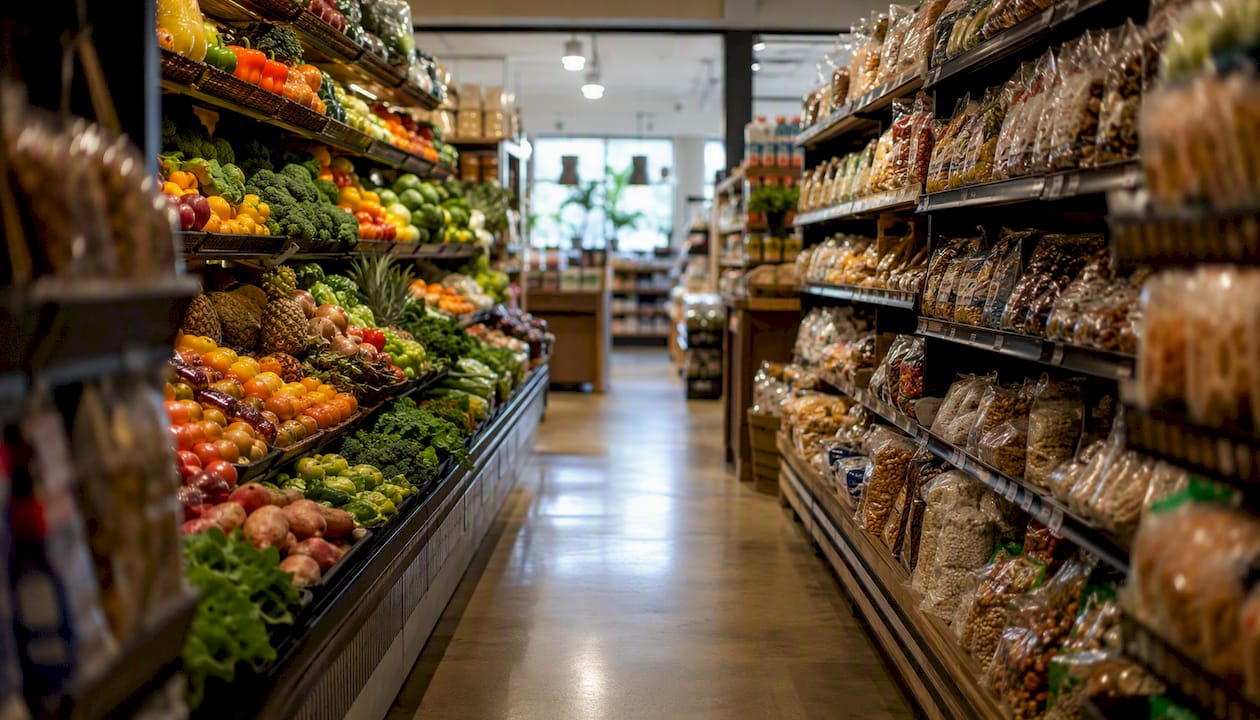
Shelf placement is the most studied mechanism. Products at eye level sell more than identical products placed on lower or higher shelves. Retailers and manufacturers pay slotting fees to secure premium placement, and those fees are disproportionately paid by companies selling processed, high-margin items. Produce and whole-grain staples rarely have the marketing budgets to compete for these positions.
Package design and color influence perceived healthfulness independent of actual nutritional content. Research consistently shows that green packaging, nature imagery, and health-claim language increase purchase likelihood even when the product’s nutritional profile does not justify the perception. Shoppers who rely on front-of-package claims rather than the Nutrition Facts panel are more susceptible to this effect.
Store layout and traffic flow are engineered to maximize exposure to high-margin items. The placement of essential staples (milk, eggs, bread) at the back of the store is a deliberate design choice that routes shoppers past the entire store. End-cap displays at aisle intersections capture attention at decision points, and these are almost always occupied by promoted, often less nutritious, products.
Sampling and sensory marketing activate purchase decisions through taste and smell in ways that bypass deliberate evaluation. A shopper who was not planning to buy a product may purchase it after a positive sensory experience, regardless of its nutritional value.
Digital in-store marketing is an emerging channel. Screen-based displays, app-linked promotions, and loyalty program algorithms now deliver personalized offers in real time, often surfacing items based on past purchase history rather than nutritional quality. Shoppers who have not actively opted into nutrition-focused filters receive recommendations that reflect their existing habits, reinforcing rather than improving them.
Understanding these mechanisms helps shoppers engage with retail environments more deliberately. Using a list, avoiding the center aisles when possible, and reading the Nutrition Facts panel rather than front-of-package claims are all direct countermeasures to in-store marketing influence.
Transportation and mobility shape store choice before any other decision
For a significant portion of American households, the grocery store they shop at is not the one they would choose if transportation were not a constraint. It is the one they can reach. This upstream constraint shapes every downstream nutritional decision.
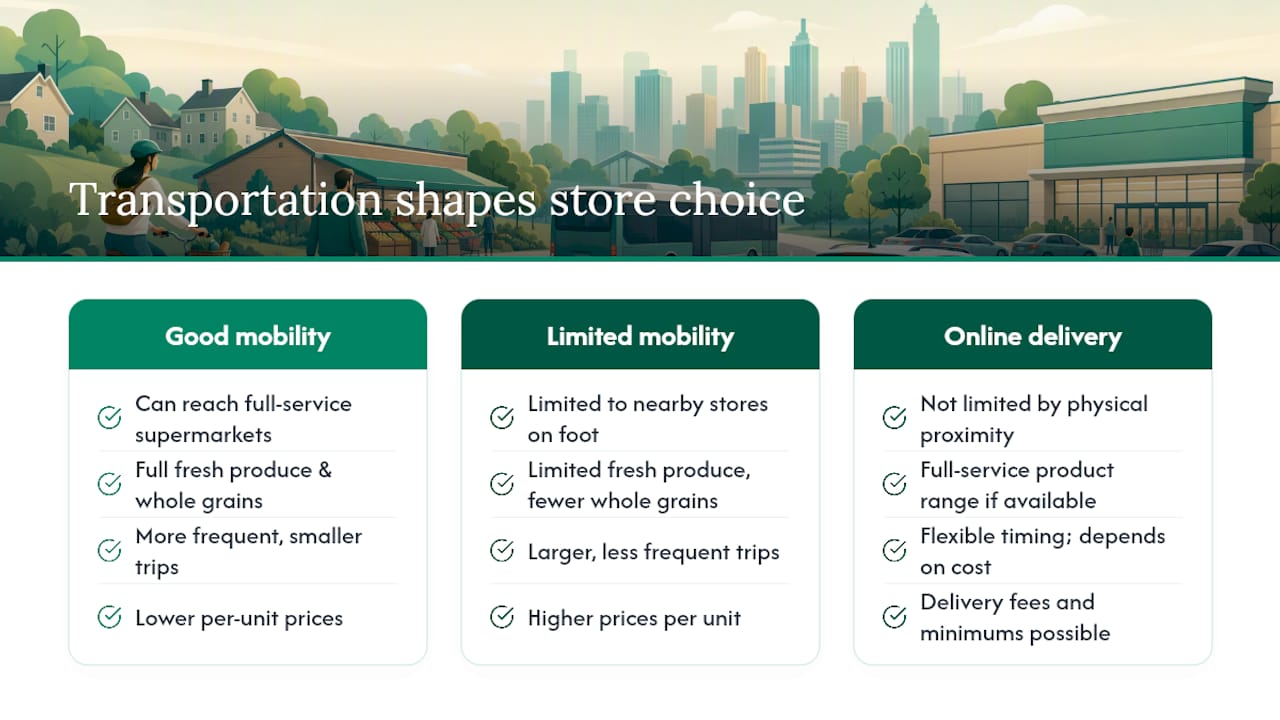
Households without personal vehicles in areas with limited public transit often rely on stores within walking distance, which in many urban and rural areas means convenience stores or small-format retailers with limited fresh produce, fewer whole-grain options, and higher prices per unit than full-service supermarkets. The nutritional quality of what these households can purchase is structurally limited before any individual choice is made.
Transportation barriers also affect shopping frequency. Households that can only shop when they can arrange a ride or access transit tend to make larger, less frequent trips. This favors shelf-stable, processed items over fresh produce, which has a shorter usable life. The result is a diet that skews toward higher sodium, added sugar, and refined carbohydrates, not by preference, but by logistics.
Online grocery delivery has the potential to reduce transportation barriers for low-access households. When delivery is affordable and available, it can provide access to a full-service product range regardless of physical proximity to a supermarket. The MDPI Nutrients research supports this conditional benefit: online shopping improves nutrition outcomes for low-access shoppers when delivery is accessible and when the interface supports active nutrition filtering. The barrier is that delivery fees and minimum order requirements can make online grocery shopping financially inaccessible for the households that would benefit most.
Mobility limitations among older adults and individuals with disabilities create a parallel dynamic. These shoppers may rely on whoever accompanies them or shops on their behalf, effectively delegating nutritional decisions to a caregiver or family member. Nutrition coaching and meal planning support that accounts for this dynamic, rather than assuming full individual agency over store choice, is more realistic and more effective.
Daily habits and mobility routines intersect with grocery access in ways that compound over time. A household that consistently shops at a limited-selection store will develop meal habits and recipes that fit what that store carries, making it harder to shift dietary patterns even when access improves.
Key Takeaways
Grocery shopping behaviors, store access, and shopping mode are among the most consistent upstream determinants of household diet quality, with evidence from USDA ERS, PMC-indexed trials, and industry surveys all pointing to the same conclusion: planning, defaults, and price environments shape what households eat.
Point | Details |
Planning raises diet quality | Shoppers who use a written or digital list consistently bring home more nutrient-dense items and fewer impulse purchases. |
82% changed behaviors in 2025 | Economic pressure caused the majority of U.S. shoppers to seek discounts and switch brands, per the Purdue Consumer Food Insights survey. |
Online shopping is conditionally better | Online formats reduce impulse cues but improve nutrition only when shoppers actively use nutrition filters and healthy defaults. |
Access and income are structural moderators | USDA ERS data show SNAP participants and low-access households have measurably lower nutritional quality in their food acquisitions. |
Coachjillbyrne turns evidence into habits | Personalized coaching from Coachjillbyrne translates these research findings into practical grocery routines, meal planning, and portion strategies clients can maintain long-term. |
The grocery store is where nutrition really begins
Most nutrition conversations focus on what to eat. The more useful question, and the one the research keeps returning to, is where the decision actually gets made. By the time food is on the table, the nutritional outcome is largely determined. It was set at the store.
What strikes me about the evidence is how consistently it shows that environment outperforms willpower. The optimal defaults research is a good example: when online carts are pre-filled with healthier items, people buy healthier items. Not because they suddenly became more motivated, but because the path of least resistance changed. That is the insight most individual-focused nutrition advice misses.
The practical implication is that the most durable nutrition improvements often come from changing the shopping environment rather than relying on in-the-moment decision-making. Automating a recurring order for staples, setting up a meal plan before building the list, and using %DV as a quick filter at the shelf are all structural changes. They work because they reduce the number of decisions that have to be made under pressure, in a retail environment specifically designed to redirect attention toward less nutritious options.
The socioeconomic and access findings deserve more weight in individual coaching conversations, too. When a client is not making the nutritional progress you would expect, the question worth asking is not “why aren’t they trying harder?” It is “what does their shopping environment actually look like?” Transportation constraints, store availability, and budget pressure are not excuses. They are real structural variables that shape what is possible, and any coaching approach that ignores them will produce limited results.
The research on cultural food practices is similarly underused. Clients who have strong culinary traditions centered on whole foods are often sitting on a nutritional asset they do not recognize as one. The coaching work there is not to replace their food culture but to build on it.
Personalized nutrition coaching that puts the research to work
The evidence on how grocery shopping impacts nutrition is clear. Turning that evidence into consistent daily habits is where most people get stuck, and that is exactly where structured coaching support makes a measurable difference.

Coachjillbyrne offers personalized nutrition coaching built around the behaviors the research most consistently links to better outcomes: meal planning, grocery list building, portion control, and habit formation that fits your actual life. Whether you are navigating economic pressure on your food budget, working with GLP-1 medication and need nutrition support, or simply trying to build a grocery routine that holds up past the first two weeks, coaching provides the accountability and structure that self-directed change often lacks.
The approach is practical, not restrictive. Clients work on one or two grocery habits at a time, building on what already works in their routine rather than overhauling everything at once. For clients who want to build sustainable eating routines that last beyond a single shopping trip, personalized guidance makes the process more efficient and more durable.
To learn more about how coaching can help you build grocery habits that support your nutrition goals, visit Coachjillbyrne and book a consultation.
Useful sources
The following sources were cited in this article. Each entry includes a brief note on what the source contributes and its evidence type.
Source | Evidence Type | Key Contribution |
USDA ERS Economic Information Bulletin 188 | Nationally representative purchase survey | Links SNAP participation and store access to lower nutritional quality in food acquisitions |
PMC / NCBI: Online grocery shopping review | Systematic empirical review | Summarizes benefits (reduced impulse cues) and pitfalls (perishables control) of online shopping |
Optimal Defaults RCT (Journal of Nutrition Education) | Randomized controlled trial | Pre-filled healthy online carts improved purchase quality; intake effects were trend-level |
BMC Medicine DS123 natural experiment | Natural experiment | Price incentives + food-literacy supports increased vegetable purchases in lower-SES families |
FMI U.S. Grocery Shopper Trends | Industry survey report | Documents in-person shopping preferences and reasons (perishables control, social role) |
Purdue Consumer Food Insights (2025 survey) | Consumer survey | 82% of shoppers changed behaviors due to economic pressure; average weekly spending data |
Texas A&M AgriLife Extension | Extension guidance | Practical label-reading tips and the one-special-snack moderation strategy |
MDPI Nutrients (online grocery and nutrition) | Peer-reviewed analysis | Conditional benefits of online shopping for low-access shoppers; interface design matters |
MedlinePlus patient instructions | Clinical patient guidance | %DV benchmarks and practical label-reading recommendations |
Online grocery shopping: promise and pitfalls for healthier food and beverage purchases
Nutritional quality of food purchases and acquisitions (USDA ERS report)
Consumer Food Insights survey assesses 2025 grocery spending
Shop smarter with healthy grocery shopping tips — AgriLife Today
Healthy grocery shopping tips (MedlinePlus patient instructions)
FAQ
How does grocery shopping affect your diet quality?
Grocery shopping determines what food is available at home, which is the primary driver of what households eat. Planning, list use, store access, and pricing all shape the nutritional quality of purchases, according to USDA ERS research and peer-reviewed studies.
Is online grocery shopping better for nutrition than shopping in-store?
Online shopping can reduce impulse purchases and supports healthy defaults, but it improves nutrition outcomes only when shoppers actively use nutrition filters and pre-built lists. Passive online browsing can replicate in-store impulse patterns, per PMC and MDPI Nutrients research.
What are the most evidence-backed healthy grocery shopping tips?
The most consistently supported behaviors are: writing a list before shopping, not shopping hungry, using %DV on the Nutrition Facts panel, shopping the perimeter first, and including frozen produce. Texas A&M AgriLife Extension also recommends allowing one intentional snack per trip to avoid all-or-nothing cycles.
How do income and store access affect what people buy?
USDA ERS data show that SNAP participants and households with limited access to healthy food retailers have measurably lower nutritional quality in their food acquisitions. Transportation barriers and limited store options constrain purchase choices before individual decisions are made.
Can coaching help improve grocery shopping habits?
Structured coaching, like the programs offered by Coachjillbyrne, translates research-backed strategies into personalized grocery routines, meal planning, and portion habits. This kind of accountability support helps clients build consistent behaviors that hold up beyond the initial motivation phase.
Recommended
Comments