
How to Transition Back to Healthy Eating Gradually

Transitioning back to healthy eating gradually is the most effective method for rebuilding lasting wellness without triggering the deprivation cycle that causes most diets to fail. The process, known in behavioral nutrition as incremental dietary change, works because small adjustments compound over time rather than demanding an immediate overhaul of every meal. Physical improvements like increased energy and better digestion typically appear within 1–2 weeks of returning to balanced eating. That timeline matters because it gives you a concrete, near-term reason to stay consistent. Coachjillbyrne has guided hundreds of clients through this exact process, and the results consistently show that patience and structure outperform restriction every time.
How to transition back to healthy eating gradually: start with a baseline
The first step in any gradual diet change is knowing exactly where you stand. Without a clear baseline, you cannot measure progress or identify which habits need the most attention.
Spend one week tracking what you actually eat, not what you plan to eat. Pay close attention to:
Fruit and vegetable intake. Experts recommend tracking servings for one week, with the goal of adding one serving per day from there. One serving equals 1/2 cup of most chopped fruits or vegetables, or 1 cup of raw leafy greens.
Processed and high-sodium foods. More than 70% of sodium in the American diet comes from packaged and prepared foods. Spotting these in your pantry gives you a clear target.
Habitual triggers. Note when you reach for convenience food. Stress, boredom, and time pressure are the three most common drivers.
Kitchen environment. If your counter holds chips and your refrigerator holds mostly condiments, your environment is working against you before you even make a decision.
Set one measurable goal from this audit. “Eat one more vegetable serving daily” beats “eat healthier” because you can track it.
Pro Tip: Take a photo of your pantry and refrigerator before you start. Reviewing it two weeks later shows concrete environmental progress and reinforces momentum.
What are the best steps to add healthy foods without feeling deprived?
The most effective strategy for moving to healthy food is addition, not subtraction. Adding nutrient-dense, fiber-rich whole foods displaces processed options naturally without triggering the psychological reactance that comes from restriction. When you feel deprived, willpower collapses. When you feel full and satisfied, change becomes sustainable.
Follow these steps in sequence:
Fill half your plate with vegetables and lean protein first. Physically limiting the space available for less nutritious foods is one of the simplest portion control tools available. Colorful vegetables, grilled chicken, canned salmon, or legumes all qualify.
Add one fruit or vegetable serving per day for two weeks. Do not attempt to overhaul every meal at once. One serving added consistently creates a new default without demanding a complete identity shift.
Replace one processed snack daily. Swap chips or crackers for a small handful of unsalted nuts, sliced cucumber with hummus, or a piece of fresh fruit. The goal is substitution, not elimination.
Apply meal sequencing. Eat vegetables and protein before grains or starches at each meal. This approach slows glucose absorption, extends satiety, and reduces the urge to overeat later in the meal.
Batch cook once per week. Prepare a base of roasted vegetables, cooked grains like brown rice or farro, and a lean protein source every Sunday. Weekly batch meal prep reduces decision friction and makes healthy eating the default rather than the effortful choice.
Pro Tip: Keep a bowl of washed, ready-to-eat fruit on your counter and pre-cut vegetables at eye level in your refrigerator. Visibility drives consumption more reliably than intention.
Eating clean gradually works because each small win builds the next one. You are not relying on motivation. You are redesigning the path of least resistance.

Why does healthy food taste bland at first, and how long does it last?
Healthy food often tastes less satisfying in the early weeks of a dietary transition. This is not a personal failure. It is a neurological process.
The recalibration period typically lasts 2–3 weeks, during which brain dopamine sensitivity to hyperpalatable foods resets. Processed foods engineered with high salt, fat, and sugar combinations create a reward signal that whole foods cannot immediately match. As your brain recalibrates, whole foods gradually regain their natural appeal.
“Taste preferences adjust through consistent exposure and patience, allowing healthy foods to regain appeal over time. The discomfort of the transition period is a signal that adaptation is working, not a sign that the approach is wrong.”
Practical steps to support this recalibration include:
Skip added salt for two days. Taste buds can reset in short-term experiments like skipping salt for 48 hours. After this reset, natural food flavors become noticeably more distinct.
Taste before seasoning. Make it a habit to take one bite of every meal before reaching for salt, sauce, or condiments. This re-engages your natural sensory response to food.
Expect a dip in food enjoyment. Weeks one and two often feel flat. This is temporary. Most people report that by week three, whole foods taste noticeably better than they did before the transition.
Use herbs and spices freely. Fresh basil, garlic, cumin, smoked paprika, and lemon juice add complexity without sodium. They also accelerate the re-engagement of taste receptors.
The recalibration of brain reward pathways takes several weeks, and patience during this period is the single most important factor in whether the change sticks. Understanding this removes the temptation to quit when food feels unrewarding.
How do you handle cravings and setbacks during a gradual diet change?
Cravings, social pressure, and stress-related eating are the three obstacles that derail most gradual transitions. Each one has a practical solution that does not require willpower.
Manage cravings by adding, not restricting. When a craving hits, eat a protein-rich snack or a piece of fruit first. Cravings often signal hunger or blood sugar dips, not a specific need for the craved food. Addressing the underlying signal reduces the craving’s intensity.
Organize your kitchen to reduce friction. Store less nutritious foods out of sight and keep healthy options at the front of shelves and counters. Environmental management is more reliable than self-control. Coachjillbyrne’s approach to building a healthy food culture at home addresses this directly.
Handle social situations without guilt. At restaurants, order a salad or vegetable side first. At gatherings, eat a small protein-rich snack before arriving. You do not need to explain your choices to anyone. One off-plan meal does not erase consistent progress.
Track three healthy choices each day. Tracking small daily wins builds positive reinforcement and counters the guilt that causes people to abandon their efforts entirely. Write them down or note them in a phone app. The act of recording shifts your focus from what went wrong to what went right.
Pro Tip: Treat a setback as data, not a verdict. Ask what triggered it, adjust one environmental factor, and move forward the same day.
How do you maintain healthy eating habits long term?
Sustaining a slow transition to healthy eating requires pairing nutrition changes with supportive routines across the rest of your day. Nutrition does not exist in isolation.
Add movement gradually alongside food changes. A 20-minute walk after dinner improves insulin sensitivity and reinforces the behavioral identity of someone who takes care of their health. You do not need a gym membership in week one.
Increase water intake before meals. Drinking 16 ounces of water 30 minutes before eating reduces meal size naturally and supports digestion. This is one of the lowest-effort healthy eating tips with measurable impact.
Build meal planning skills incrementally. Start with planning three dinners per week. Add a fourth in week three. By week six, planning the full week feels normal rather than burdensome. Coachjillbyrne’s guidance on sustainable weight loss habits covers this progression in detail.
Celebrate measurable progress regularly. Visible body composition changes generally appear after 3–4 weeks of consistent incremental habit changes. Acknowledge these milestones. Celebration reinforces the behavior that produced the result.
The table below shows how to adapt your approach across common lifestyle shifts without losing momentum.
Life situation | Recommended adjustment |
Increased work stress | Rely on batch-cooked meals; reduce new recipe attempts temporarily |
Travel or frequent dining out | Apply the half-plate rule and meal sequencing at restaurants |
Family or social obligations | Prepare one healthy dish to share; focus on protein and vegetables |
Illness or low energy | Simplify to three core meals with minimal preparation; prioritize hydration |
Return after a setback | Restart with one added vegetable serving daily; do not attempt full reset at once |
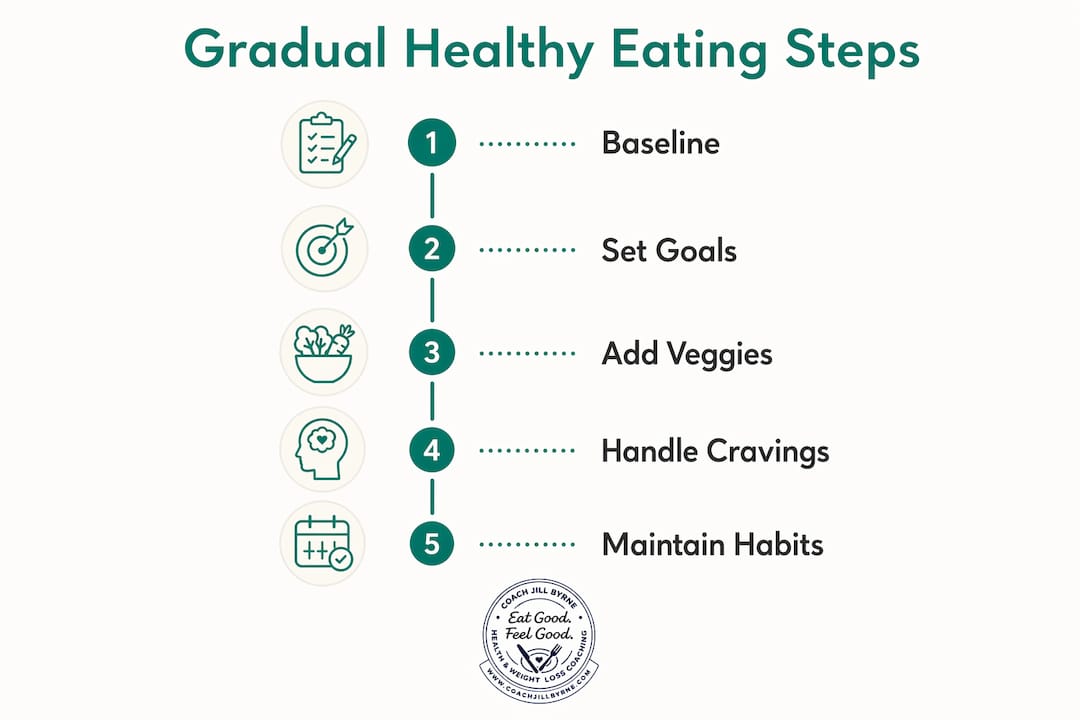
Restarting healthy eating is a repeated skill acquisition process, not a one-time event. Intentional celebration of incremental achievements reinforces behavior change more effectively than any motivational strategy.
Key Takeaways
Gradual dietary change succeeds because it works with your neurology and environment rather than against them, making sustainable healthy eating habits the natural outcome of small, consistent actions.
Point | Details |
Start with a baseline audit | Track fruit, vegetable, and processed food intake for one week before making changes. |
Add before you subtract | Introduce whole foods and lean protein first to displace processed options without deprivation. |
Expect a 2–3 week recalibration | Brain dopamine sensitivity resets during this period; temporary taste flatness is normal and temporary. |
Manage your environment | Batch cooking and kitchen organization reduce decision fatigue and make healthy choices the default. |
Track daily wins | Recording three healthy choices each day builds positive reinforcement and prevents guilt-driven abandonment. |
What I have learned coaching clients through dietary transitions
Most people come to me believing they failed because they lacked willpower. That framing is wrong, and it costs them years of unnecessary struggle.
Willpower is a finite resource. It depletes by midday for most people, which is exactly when cravings peak. The clients I have seen succeed long term are not the ones with the strongest discipline. They are the ones who stopped relying on discipline entirely and started redesigning their kitchens, their schedules, and their defaults.
The part that surprises people most is the taste recalibration period. Nobody warns them that healthy food will feel boring for two to three weeks. When it happens, they assume something is wrong with the plan. Nothing is wrong. The brain is adjusting. I tell every client to expect that dip and to treat it as confirmation that the process is working.
The other thing I have learned is that setbacks are not failures. They are the most useful data points in the entire process. A client who eats well for ten days, has a difficult weekend, and restarts on Monday has not failed. She has practiced the skill of returning. That skill, repeated enough times, becomes the habit itself.
Patience is not passive. It is the active choice to keep showing up when the results are not yet visible. The science of rebuilding healthy eating routines confirms what I see in practice: small, reproducible habits outperform dramatic overhauls every single time.
— Coach Jill
Personalized support for your gradual nutrition transition
Knowing the steps is one thing. Having structured support while you take them is another.

Coachjillbyrne offers personalized nutrition coaching built around the exact principles covered here: incremental habit formation, meal planning, environmental management, and accountability that keeps you moving forward without restriction or guilt. Programs are designed for real life, not ideal conditions. Whether you are rebuilding after a setback, managing weight alongside a busy schedule, or looking for real food nutrition guidance that actually fits your day, Coachjillbyrne provides the structure and support to make gradual change stick. Visit coachjillbyrne.com to learn more about available programs and find the right fit for your goals.
FAQ
How quickly will I notice results from gradual healthy eating changes?
Physical improvements like increased energy and better digestion typically appear within 1–2 weeks. Visible weight or body composition changes generally follow after 3–4 weeks of consistent incremental habits.
Is it better to change everything at once or make small changes over time?
Small, incremental changes produce more sustainable results. Gradual transitions avoid the deprivation response and allow your brain and taste preferences to adapt without triggering cravings or burnout.
Why does healthy food taste bland when I first start eating clean?
The brain’s dopamine sensitivity to hyperpalatable processed foods resets over 2–3 weeks. During this period, whole foods may taste less exciting, but flavor perception improves significantly once recalibration completes.
How do I handle cravings without abandoning my gradual diet change?
Eat a protein-rich snack or piece of fruit when a craving hits to address the underlying hunger signal. Adding food rather than restricting it prevents the psychological reactance that causes most people to quit.
What is the single most effective environmental change I can make?
Weekly batch cooking is the highest-impact adjustment. Preparing vegetables, grains, and proteins in advance removes the daily decision burden and makes nutritious meals the easiest available option.
Recommended
Comments