
Stop Late Night Snacking in 7 Days With Protein First Habits

The most effective fix for late night snacking is not willpower after 9 p.m. It’s fixing what happens earlier in the day: eating enough protein and fiber at meals, protecting your sleep window, and breaking the automatic TV-and-fridge routine. If genuine hunger hits anyway, a small, planned snack with moderate calories is a smarter move than white-knuckling through it.
TL;DR:
Consuming sufficient protein and fiber during the day reduces nighttime hunger by stabilizing blood sugar and increasing satiety, especially at breakfast and lunch.
Night cravings are driven by circadian biology and hormonal shifts, making biological hunger and conditioned habits key factors to address separately.
Improving sleep quality and managing stress significantly lower hormone-related hunger signals, which are often more influential than dietary rules alone.
Interrupting automatic routines by changing environmental cues and using deliberate delays can help break the habit of emotional or routine snacking at night.
Planning small, balanced snacks under 300 calories with protein and fiber prevents hunger without disrupting sleep or metabolism.
Table of Contents
Why Late-Night Cravings Happen: Biology vs. Habit
Your appetite has a clock, and it points toward the evening. Research on circadian biology shows cravings tend to peak somewhere between 8 p.m. and midnight, driven by shifting hormones rather than a lack of discipline. That timing isn’t random. It’s built into how your body regulates hunger across a 24-hour cycle, and it explains why the “I’m fine all day, then I raid the pantry at 10 p.m.” pattern feels so consistent night after night.
There’s a metabolic wrinkle here that most people never hear about. The same exact meal, eaten during a high-melatonin window at night, produces a bigger spike in blood sugar than it would earlier in the day. Circadian research on appetite and glucose tolerance found that melatonin suppresses insulin secretion, so your body handles carbohydrates less efficiently after dark. Eat a bowl of cereal at 7 a.m. and your glucose response is moderate. Eat the identical bowl at 11 p.m. and the spike runs higher. Repeated over months and years, that pattern adds up to what researchers describe as a subtle metabolic penalty, distinct from the calories themselves.
None of this means night eating is a moral failing. It means your biology is nudging you toward the kitchen at a predictable hour, and treating that pull as a personal weakness is the wrong frame. The better question isn’t “why do I have no self-control?” It’s “is this hunger, or is this a habit wearing hunger’s mask?”
Physiological hunger builds gradually, comes with stomach signals, and is satisfied by most foods. Conditioned or emotional snacking shows up suddenly, targets specific comfort foods, and often has nothing to do with your last meal. Before you open the pantry at night, run through a short mental checklist: Am I actually hungry, or am I thirsty, tired, bored, or stressed? That kind of quick self-check, recommended by nutrition educators researching emotional eating, separates a body that needs fuel from a brain that’s reaching for a distraction.
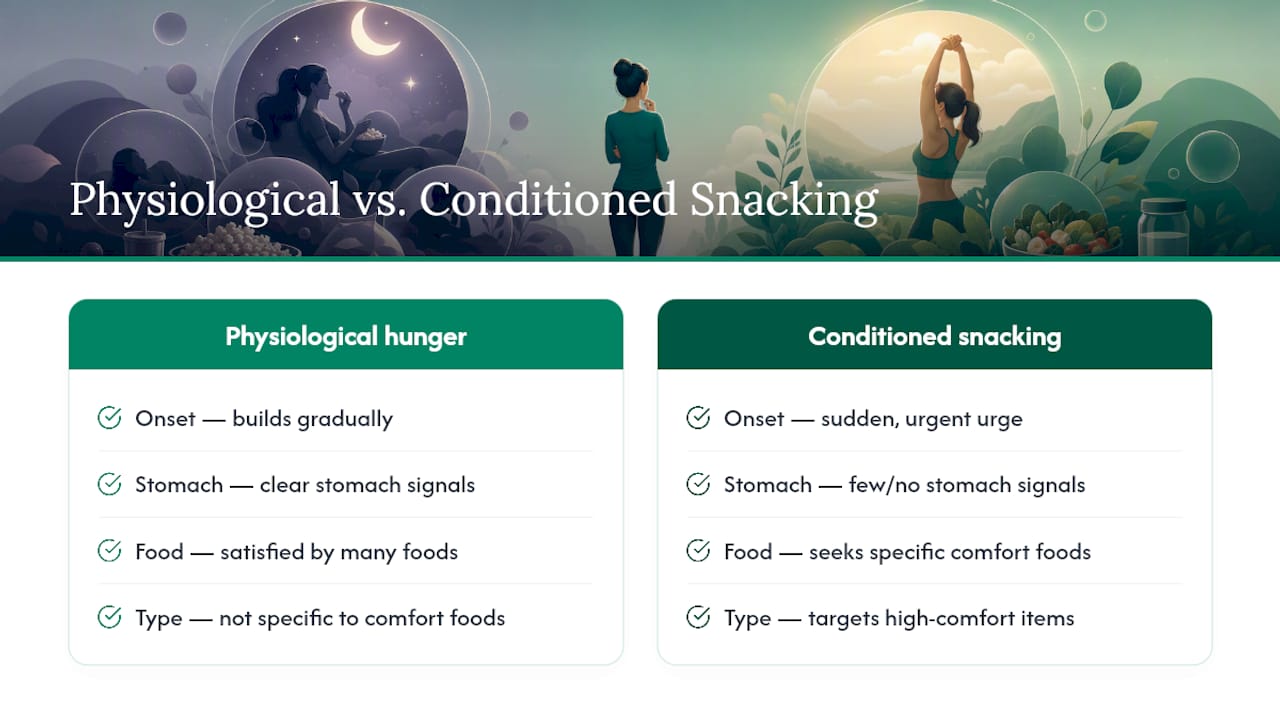
Here’s the part worth remembering: this is not a willpower problem to solve at 10 p.m. It’s a pattern to intercept earlier in the day, which is exactly where the next fix starts.
Daytime Nutrition Fixes That Lower Evening Hunger
If you’re fighting cravings every night, look at your breakfast first. Skipping meals or eating too little earlier in the day frequently triggers an evening “catch-up” response, where your body compensates for an under-fueled afternoon by demanding calorie-dense food once the sun goes down, according to clinical guidance from Ohio State Health & Discovery. That granola bar you skipped lunch to “save calories” almost always comes back around 9 p.m., except now it’s a bag of chips.
Protein is your strongest lever here. Aiming to include a significant amount of protein at both breakfast and lunch keeps you fuller for longer and blunts the appetite swing that shows up later. Front-loading protein this way can meaningfully reduce evening hunger even when your total daily calories stay about the same, which is a detail most calorie-counting apps never surface. It’s not about eating more. It’s about shifting when the bulk of your protein lands.
Practical breakfast options that hit that range: three eggs with a slice of whole grain toast, a Greek yogurt bowl with a scoop of protein powder, or overnight oats mixed with cottage cheese. Lunch can be similarly straightforward: a grilled chicken salad with beans, a turkey and hummus wrap, or a bowl built around salmon or tofu with a full cup of vegetables. Coachjillbyrne clients working through meal planning for sustained energy often find that once protein and fiber anchor the first two meals of the day, the 8 p.m. cravings noticeably soften on their own.
Fiber does quieter but real work alongside protein. It slows digestion, stabilizes blood sugar, and stretches out satiety for hours rather than minutes. A few swaps that make a real difference:
Swap white rice for lentils or farro at lunch to add both fiber and protein in one move.
Add a tablespoon of chia or ground flax to your morning yogurt or oatmeal.
Choose an apple or pear over juice, since the fiber slows the sugar hit.
Build lunch around a full cup of non-starchy vegetables before adding starches.
Keep a protein source on the plate at every meal, not just dinner.
If your afternoons run long between lunch and dinner, a small planned snack around 3 p.m., something like cottage cheese with fruit or a handful of almonds, can prevent the kind of extreme hunger that makes 9 p.m. feel like an emergency. The goal across the whole day is steady fuel, not a feast-or-famine rhythm that leaves your evening self negotiating with a half-empty tank. Readers rebuilding their overall eating pattern from scratch may find structured swap strategies for weight loss useful for turning these principles into a repeatable weekly rhythm.
Sleep, Stress, and Alcohol: The Non-Diet Levers That Matter Most
Poor sleep might be doing more damage to your evening appetite than any single food choice. Sleep restriction raises ghrelin, the hormone that signals hunger, while suppressing leptin, the one that signals fullness. That hormonal shift, described in clinical guidance from the Cleveland Clinic, makes cravings feel sharper and harder to resist precisely on the nights you’re most tired and least equipped to fight them. Improving sleep is one of the highest-leverage moves available, often outperforming any snack rule you could set for yourself.
A workable sleep hygiene routine doesn’t need to be elaborate. Set a consistent bedtime and wake time, even on weekends. Cut caffeine by early afternoon since its half-life runs longer than most people assume. Dim household lights an hour before bed to support your body’s natural melatonin rise, and keep screens out of the bedroom if you can manage it. Small, boring, repeatable habits beat any single dramatic change.

Stress deserves its own attention, because emotional eating rarely announces itself as emotional. It shows up as “I just want something” at 9:45 p.m. A five-minute wind-down, slow breathing, a short walk, or even writing down tomorrow’s top three tasks, can defuse the low-grade anxiety that drives a lot of nighttime grazing. If caregiving responsibilities or family stress are eating into your rest, that’s worth naming directly. Sleep disruption tied to caregiving stress is a documented pattern, and the fatigue it creates feeds straight into the ghrelin problem above.
Alcohol complicates both sides of this equation at once. A glass of wine with dinner rarely causes trouble. A second or third glass, especially close to bedtime, tends to open the door to exactly the kind of mindless snacking you’re trying to eliminate. If you drink, keeping it earlier in the evening and pairing it with food blunts both the appetite spike and the sleep disruption that follows.
Behavioral Tactics: Interrupt Routines and Change Cues
Most late-night eating isn’t hunger. It’s a routine that got wired to a cue years ago, and the cue is usually the couch, the TV remote, or the specific feeling of finally sitting down after a long day. You don’t break that pattern by trying harder. You break it by changing the environment that triggers it.
Start by naming your actual trigger, honestly. Is it the opening credits of your evening show? The first scroll through your phone after the kids are in bed? A specific chair? Once you know the trigger, you can build around it:
Remove the easy option. Keep trigger foods out of the house, or store them somewhere inconvenient, like a high cabinet instead of the counter.
Change your physical location. If snacking is tied to the couch, moving to a different room for the first 20 minutes after dinner can break the automatic link.
Use the 10 to 15 minute delay. When a craving hits, set a timer instead of deciding immediately. Interrupting the routine for a short window frequently lets the urge pass on its own.
Occupy your hands. Knitting, a puzzle, folding laundry, anything that keeps your hands busy competes directly with the habit of reaching for food.
Have a replacement ready. Herbal tea, sparkling water, or a piece of gum can satisfy the “I need to do something with my mouth” urge without calories.
A simple script helps in the moment: Cue, Pause, Choose. Notice the cue (the show started, the stress hit), pause for the timer to run out, then choose deliberately, whether that’s a planned snack, a glass of water, or nothing at all. That three-step pause turns an automatic reflex into an actual decision, which is the entire point.
Pro Tip: Put a sticky note on the pantry or fridge that just says “Hungry or habit?” It sounds almost too simple, but that two-second pause before the door opens is often enough to break the automatic reach.
If you’re rebuilding your evening routine from the ground up, proven approaches for resetting eating habits walk through how to sequence these changes without burning out on day three. And if the line between genuine hunger and habit still feels blurry most nights, it helps to read up on how hunger and cravings actually differ so you’re not guessing in the moment.
Planned Late-Night Snacks: What to Eat and What to Skip
If you’ve run the hunger check and you’re genuinely hungry, eating a small snack is the right call, not a failure. Clinical guidance generally supports snacks under roughly 200 to 300 calories that pair protein with fiber, since that combination satisfies hunger without derailing sleep or next-day appetite regulation, according to Healthline’s clinical review of late-night eating. Planning one option in advance also short-circuits the “grab whatever’s closest” spiral that usually ends with unhealthy processed snacks.
Reasonable options to keep on hand:
Greek yogurt with berries — protein and fiber in one bowl, around 150 calories.
A hard-boiled egg — roughly 70 calories, pure protein, almost no prep.
Edamame, half a cup — fiber and plant protein, satisfying to eat slowly.
Cottage cheese with a few pineapple chunks — protein-heavy and naturally sweet.
A small apple with a tablespoon of almond butter — fiber plus healthy fat for staying power.
Air-popped popcorn, three cups — volume and crunch for under 100 calories.
A handful of roasted chickpeas — crunchy, high in fiber, easy to portion in advance.
Half a banana with a spoonful of peanut butter — quick and genuinely filling.
A small bowl of berries with a few walnuts — antioxidants and healthy fat together.
Herbal tea with a square of dark chocolate — a real portion boundary that still feels like a treat.
Many of these overlap with recommendations from Verywell Health’s roundup of registered-dietitian-approved snacks, and the common thread across all of them is portion control paired with real food, not processed convenience items.
What to skip in that same window: caffeine (obvious, but often hiding in chocolate too), heavy alcohol, and spicy or greasy food, all of which can disrupt sleep or trigger heartburn when you lie down soon after eating. Cleveland Clinic guidance recommends stopping eating a few hours before bed specifically to reduce heartburn risk and give digestion a head start before you’re horizontal. If you’re trying to move away from processed snack foods entirely, swapping in real-food alternatives tends to stick better long-term than an outright ban ever does.
A 7-Day Plan and Nightly Checklist to Stop Night Snacking
Trying to change everything at once is how most people quit by Wednesday. Instead, tackle one lever per day:
Day 1: Add 30 to 40 grams of protein to breakfast. Nothing else changes yet.
Day 2: Do the same at lunch. Notice if your 4 p.m. energy feels different.
Day 3: Set a fixed bedtime and stick to it, even if it feels early.
Day 4: Identify your top snacking trigger and remove one easy-access trigger food from the house.
Day 5: Practice the Cue, Pause, Choose script the next time a craving hits.
Day 6: Cut caffeine after 2 p.m. and note whether you fall asleep faster.
Day 7: Review the week. Which change moved the needle most?
Run through a short nightly checklist alongside the plan: Have I had enough water today? Am I actually hungry right now, or is this the couch talking? If hungry, is my planned snack ready? Is my wind-down routine starting on time?
Track two numbers over the following weeks: snacking episodes per week and average hours of sleep. If episodes drop but sleep hasn’t improved, that’s your next target. If neither moves after two or three weeks of honest effort, that’s a signal worth taking to a professional rather than a sign you should try harder alone.
Coach Jill’s Perspective: Habits Beat Rules
Most snacking advice tells you what to eliminate. Habit-based coaching does something different: it identifies the one or two upstream changes, usually protein at breakfast and a consistent bedtime, that make the evening pull weaker without a single rule about what you’re “allowed” to eat. Coach Jill Byrne builds this into real-food coaching plans that include GLP-1 nutrition support for clients navigating appetite changes on medication, with weekly accountability check-ins that catch a slipping pattern before it becomes three weeks of it.
[author_bio]
— Coach Jill
When It’s Time for Personalized Support
Self-directed changes work for a lot of people, but not everyone. If you’ve tried the daytime fixes, the sleep adjustments, and the cue-interruption tactics above for a few weeks and you’re still raiding the kitchen most nights, or if it’s affecting your weight, mood, or how rested you feel, that’s usually a sign the pattern needs a second set of eyes.
That’s exactly the gap Coachjillbyrne fills. Unlike a generic meal plan or a one-size app, Coach Jill Byrne builds a habit-based coaching plan around your actual triggers, your schedule, and your relationship with food, including real-food strategies and GLP-1 nutrition support for clients managing appetite shifts from medication. Weekly accountability check-ins mean you’re not troubleshooting a 10 p.m. craving alone with a list of tips. You have someone reviewing your patterns with you and adjusting the plan before a rough week turns into a rough month. If the strategies above helped but you want a plan built specifically around your evenings, book a consultation with Coach Jill Byrne to get started.
Sources
For deeper reading, the circadian appetite research cited throughout this article and Cleveland Clinic’s guidance on curbing nighttime cravings cover the clinical detail behind these recommendations.
This article is general information, not a substitute for advice from a qualified doctor. Consult a qualified healthcare professional about your own circumstances before acting on anything here.
FAQ
Is It Healthy to Snack Late at Night?
It depends on what and how much. A small, protein-and-fiber snack under about 200 to 300 calories eaten when you’re genuinely hungry generally isn’t harmful, but eating heavy or high-sugar food close to bedtime can disrupt sleep and digestion.
Will I Lose Weight If I Stop Late-Night Snacking?
You may, particularly if your current snacking adds calories beyond what your body needs, but the bigger win usually comes from what stopping it signals: better daytime meals, more consistent sleep, and less stress-driven eating overall.
Why Do I Keep Snacking Late at Night?
Evening cravings are partly biological, driven by a circadian rhythm that peaks appetite between roughly 8 p.m. and midnight, and partly learned, tied to routines like watching TV or unwinding after a stressful day.
What Should I Eat as a Late-Night Snack?
Reach for something small that combines protein and fiber, like Greek yogurt with berries, a hard-boiled egg, or a handful of edamame, and keep it under roughly 200 to 300 calories.
How Do I Stop Night Snacking for Good?
Fix daytime protein and fiber intake first, protect your sleep window, and interrupt automatic evening routines with a short delay or a change in location. If the pattern persists despite consistent effort, working with a coach like Coach Jill Byrne to build a personalized plan tends to close the gap self-help alone can’t.
Recommended
Comments