
What Does a Nutrition Coach Cost in 2026?

A nutrition coach in the United States typically charges $50 to $200+ per hour, while monthly coaching packages run $65 to $400 or more, depending on credentials, contact frequency, and whether meetings happen online or in person. Most people land between $99 and $250 a month for a legitimate, structured program. If you want weekly accountability and simple habit change, a $99–$200 monthly package usually covers it. If you need clinical oversight for diabetes, GLP-1 medication, or another diagnosed condition, expect to pay more for a registered dietitian.
Hourly: $50–$200+ (coaches on the low end, RDs and specialists on the high end)
Monthly, low-touch: $65–$100 (app-based or self-guided, minimal contact)
Monthly, mid-tier: $99–$250 (weekly check-ins, meal guidance)
Monthly, high-touch: $250–$400+ (daily messaging, labs, custom meal plans)
Quick math: Online nutrition coaching packages typically run $99–$200 per month, while in-person initial consultations commonly cost $100–$250 with follow-ups at $75–$165. Before you sign anything, ask three questions: What’s included per session? How often can I message you? What happens if I need to cancel?
TL;DR:
Most standard nutrition coaching programs cost between $99 and $250 per month, with prices primarily driven by contact frequency and personalization level.
Hourly rates vary from $50 to over $200, while subscription tiers range from budget self-guided plans at around $65 to premium packages exceeding $400, mostly based on support intensity.
In-person coaching generally costs more than online services, but hybrid models combining initial face-to-face assessments with remote support can optimize value.
Insurance coverage is limited to Registered Dietitian services for diagnosed medical conditions, with general coaching typically paid out of pocket unless covered by an HSA or FSA with medical necessity.
Matching your contact frequency and support needs to your specific goal is more important than focusing solely on the sticker price when choosing a coaching program.
Table of Contents
How Much Does A Nutrition Coach Cost By Billing Model?
Nutrition coaching prices vary less by geography than by what’s actually included in the fee. A $65 monthly app subscription and a $400 monthly coaching package can both claim to help you “eat better,” but they buy wildly different levels of attention.
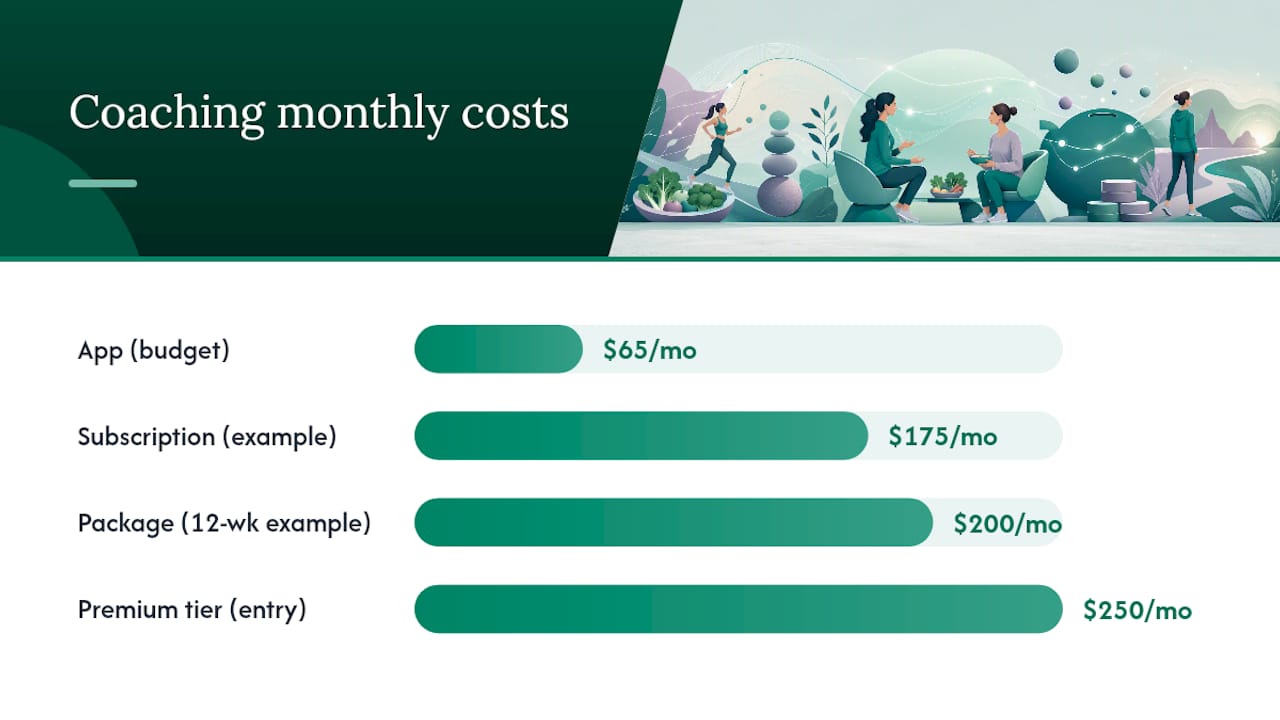
Hourly rates span the widest range because they capture everyone from newly certified coaches to registered dietitians with specialty training. Industry survey data puts median hourly rates around $65–$75, with entry-level coaches charging closer to $50 and experienced specialists commanding $125–$200 or more per hour. A single 45-minute session with a sports dietitian or diabetes specialist can easily hit the top of that range.
Monthly subscriptions are the most common format for ongoing support, and they cluster into three tiers:
Budget tier ($65–$100/month): App-driven or self-guided programs with minimal live coaching. Self-guided plans in this range work best for people who are self-motivated and just need structure, not hand-holding.
Standard tier ($99–$250/month): The most common range for real coaching relationships. This usually includes a weekly or biweekly check-in, ongoing messaging access, and periodic plan adjustments.
Premium tier ($250–$400+/month): Daily or near-daily contact, custom meal plans updated regularly, and often integration with lab work or a physician’s care team.
Group coaching brings costs down substantially because the coach’s time gets spread across multiple clients. Group programs often run $30–$75 per person monthly, though the trade-off is less individualized feedback and shared session time.
Package pricing deserves a second look because the sticker price can be misleading. A 3-week package priced at $300 sounds cheaper than a $250 monthly subscription, until you realize the subscription covers a full month while the package covers 21 days. Converting everything to a monthly equivalent is the only fair way to compare offers.
Here’s a worked example: if a coach charges $600 for a 12-week package, that breaks down to $200 per month. Compare that against a $175/month subscription with similar check-in frequency, and the subscription wins on price even though the package number looked bigger upfront.
Pro Tip: Always ask a coach to state their pricing as a monthly figure, even if they sell packages. If they hesitate or the math doesn’t add up cleanly, that’s a sign the package is structured to obscure the real cost per session.
One more wrinkle: single drop-in sessions, sometimes called à la carte consults, often cost $75–$150 each with no ongoing support. These make sense for a one-time meal plan review or a second opinion, but they rarely deliver the accountability that drives lasting change.
Which Pricing Model Fits Your Goal?
Coaches structure their fees around one of four models, and each one signals something different about the relationship you’re buying.
Hourly billing. You pay per session, with no ongoing commitment. This model fits people who want occasional guidance, like a one-time meal plan overhaul or a pre-race nutrition strategy for an athlete. It’s the most flexible option and the easiest to walk away from, but it rarely builds the habit change most people are actually after.
Package pricing. A fixed number of sessions over a set window, often 4, 8, or 12 weeks. Packages work well for people targeting a specific short-term goal, like preparing for a medical procedure or a wedding. A 3-month coaching engagement is often long enough to see measurable progress, which is why so many coaches default to a 12-week structure.
Monthly subscription. Ongoing access for a flat recurring fee, typically including a mix of live check-ins and asynchronous messaging. This is the best fit for sustainable weight loss or habit-based coaching, since real behavior change tends to take months, not weeks.
Value-based or tiered pricing. Some coaches price based on the complexity of your case rather than a flat per-session rate. Someone managing GLP-1 medication alongside nutrition changes, or an athlete needing performance-specific macros, might pay a premium reflecting the coach’s specialized training.
The math behind these models often comes down to unseen labor. Higher-priced coaches typically build in more frequent check-ins and custom meal plan updates, work that happens between sessions and rarely shows up on an invoice. A $300/month coach isn’t necessarily overcharging. They may simply be doing more behind the scenes than a $100/month coach who only shows up for the scheduled call.
Pro Tip: If a coach’s price feels too high, try negotiating the scope instead of the rate. Ask whether a biweekly check-in instead of weekly, or text-only support instead of video calls, brings the package into your budget without cutting corners on the coach’s expertise.
What Factors Push Nutrition Coaching Prices Up Or Down?
Credentials are the single biggest price driver. A certified nutrition coach and a Registered Dietitian Nutritionist (RDN) are not interchangeable, even though both may use the word “coach” in their marketing. RDNs complete a supervised clinical internship and hold a scope of practice that includes medical nutrition therapy, work governed by state licensure. Occupational data from the U.S. Bureau of Labor Statistics reflects this training gap in clinician pay, and it’s part of why RD-led sessions often carry higher rates than general coaching.
Beyond credentials, several concrete features move the price up or down:
Contact frequency. Weekly video check-ins cost more than monthly ones. Unlimited messaging access adds a premium most coaches build into subscription tiers.
Testing and device integration. Programs that include lab work, continuous glucose monitor data, or body composition scans carry higher first-month costs because of testing fees and the time it takes a coach to interpret results.
Meal planning. Custom meal plans that get updated regularly are often the most time-consuming deliverable a coach provides, and many coaches bill this as a separate add-on rather than folding it into a base rate.
Specialization. Sports nutrition, diabetes management, and GLP-1 medication support all require additional training, and coaches with that expertise typically charge accordingly.
Session length and format. A 15-minute check-in costs less than a 60-minute deep-dive consultation, even at the same hourly rate.
None of these factors operate alone. A coach charging $350 a month for daily messaging, quarterly lab review, and weekly meal plan updates isn’t overpriced relative to a $100/month coach offering a single monthly call. They’re selling a fundamentally different service.
Does Online Or In-Person Coaching Cost More?
Online coaching is usually the more affordable route, running roughly 10% to 30% cheaper than comparable in-person service because coaches skip the overhead of office space and travel time. That savings typically shows up in subscription pricing rather than one-off session fees.

In-person initial consultations commonly run $100–$250, with follow-up visits at $75–$165, reflecting the added value of face-to-face assessment, sometimes including body measurements or a physical review that’s harder to replicate over video. Online packages, by comparison, tend to fall in the $99–$200 monthly range for comparable service levels.
That price gap doesn’t mean online coaching is a lesser product. For habit-based work like meal planning and accountability check-ins, a video call or phone consult often works just as well as sitting across a desk. Where in-person sessions earn their premium is in cases needing physical assessment, like body composition testing or working alongside a physician’s office.
Hybrid models are becoming more common: an initial in-person consultation for baseline measurements, followed by ongoing remote check-ins for the bulk of the coaching relationship. This structure captures the assessment value of a face-to-face visit while keeping monthly costs closer to the online range.
Before comparing an online offer to an in-person one, confirm the two are actually apples to apples:
Does the online plan include the same check-in frequency as the in-person option?
Are meal plans customized the same way, or is one plan template-based?
Is messaging support included in both, or only the pricier tier?
Does either option include lab review or biometric tracking?
Skipping this comparison is how people end up paying more for less, simply because one format felt more “premium” on the surface.
How Do You Budget For And Choose A Nutrition Coach?
Start with your goal, not your budget. The goal determines how much contact you actually need, and contact frequency is the single biggest driver of monthly cost.
Step 1: Translate your goal into a contact frequency.
Simple habit change (more vegetables, less soda) → biweekly check-ins, budget tier ($65–$150/month)
Sustainable weight loss with accountability → weekly check-ins, standard tier ($99–$250/month)
Medical condition or GLP-1 medication support → weekly or biweekly contact with clinical oversight, premium tier ($250–$400+/month)
Athletic performance or competition prep → frequent contact plus specialized programming, often $200–$400/month
Step 2: Run the math. A simple worksheet: multiply your desired number of monthly check-ins by the coach’s per-session rate, then add any flat fees for messaging or meal plan updates. Four 30-minute check-ins at $50 each plus a $40 messaging add-on equals roughly $240 a month. That figure should roughly match the subscription price a coach quotes you. If it doesn’t, ask why.
Step 3: Ask the right questions on a discovery call.
What certification or license do you hold, and what’s included in your scope of practice?
How many check-ins are included monthly, and in what format (call, video, message)?
Is meal planning included, or billed separately?
What’s your cancellation policy?
How do you handle communication between scheduled sessions?
Step 4: Watch for red flags. Any coach promising rapid, dramatic weight loss timelines is overselling. Anyone recommending restrictive diets or supplements without qualifying their credentials, or making medical claims (like adjusting medication dosages) without a licensed clinician involved, should be a hard pass. Legitimate coaching, including the accountability-based approach many clients look for, focuses on sustainable habits, not shortcuts.
Pro Tip: Before your first paid session, ask a prospective coach to walk you through what a typical week looks like for a client at your goal level. Vague answers usually mean vague service. Specific answers, like “you’ll get a Sunday planning call and two text check-ins,” mean you’re getting a real structure.
If your budget is tight, pairing a lower-cost coaching tier with free self-guided resources, like a structured checklist for improving your relationship with food, can stretch your investment further without sacrificing accountability entirely.
Will Insurance Cover Nutrition Coaching Costs?
Insurance coverage in the U.S. depends almost entirely on your diagnosis and who’s providing the service. Insurance sometimes covers Registered Dietitian services for specific medical conditions, like diabetes, kidney disease, or obesity when referred by a physician, but general wellness coaching is almost always paid out-of-pocket.
RD/RDN sessions tied to a diagnosed condition and ordered by a physician have the best odds of partial coverage.
General nutrition coaching, habit-based programs, and weight loss accountability support are typically not reimbursable, since coaches don’t bill under medical codes.
A Health Savings Account (HSA) or Flexible Spending Account (FSA) can sometimes cover nutrition coaching costs if a doctor provides a letter of medical necessity. Check with your plan administrator before assuming eligibility.
The credential gap matters here too. RDs are trained in medical nutrition therapy and can bill insurance for clinical conditions; certified coaches focus on behavior change and typically can’t. If you have a diagnosed condition, start with an RD. If your goal is habit change and accountability, a certified coach is often the more affordable and equally effective route.
What Should You Expect From Coach Jill Byrne’s Pricing Tiers?
Coach Jill Byrne structures her coaching around real food, habit-based change, and consistent accountability rather than restrictive meal plans or short-term fixes. Her approach maps cleanly onto the pricing tiers outlined throughout this guide: an initial consultation to understand goals and current habits, followed by a recurring cadence of check-ins that scales with how much support a client needs.
Clients working through structured accountability programs typically get weekly check-ins, practical meal planning guidance built around real food rather than rigid macros, and ongoing support for building routines that stick after the coaching relationship ends. For clients navigating GLP-1 medication, coaching focuses on pairing the medication’s appetite changes with sustainable eating patterns, so nutrition habits hold up even as the medication’s effects shift over time.
The value in coaching isn’t the meal plan itself. It’s having someone checking in on Tuesday when Monday’s plan didn’t survive contact with a busy week, and helping you adjust instead of abandoning the whole effort.
That kind of consistent course-correction is what separates coaching that produces lasting results from a one-time consultation that gets filed away and forgotten.
Why Most Pricing Guides Miss the Point
Most cost guides treat nutrition coaching like a commodity: list some numbers, rank them cheap to expensive, done. That framing misses what actually determines whether a price is fair. A $300/month coach who personally reviews your food log every night and adjusts your plan weekly is not more expensive than a $100/month app that sends automated reminders. They’re solving different problems.
The conventional advice to “shop around for the lowest rate” also falls short because it treats coaching like a commodity purchase instead of a labor-intensive relationship. The real question isn’t “what’s the cheapest option,” it’s “what does this price actually buy me in contact time and personalization.” A coach’s rate should scale with how much unseen work goes into your specific plan, not just how many minutes you spend on a call together.
If you take one thing from this guide, prioritize matching contact frequency to your actual goal before comparing dollar figures. Someone managing a chronic condition alongside GLP-1 medication needs weekly oversight that a $65 app subscription simply cannot deliver. Someone who just wants to eat more vegetables probably doesn’t need daily messaging. Buy the support level your situation requires, not the one that looks impressive on a landing page.
— Coach Jill
Ready to Find Your Right Fit With Coach Jill Byrne?
If you’ve read this far, you already know that the right price depends on the right service level, and that’s exactly how Coach Jill Byrne structures her coaching. Rather than a one-size template, packages are built around your actual goal, whether that’s sustainable weight loss, building consistent habits around real food, or navigating nutrition alongside GLP-1 medication.

Coach Jill works with clients who want accountability that fits into an actual life, not a rigid meal plan that collapses the first time a schedule gets busy. Package shapes typically include an initial consultation to map your goals and current habits, followed by a recurring cadence of check-ins and real-food guidance scaled to how much support you need month to month. If you’re weighing a $99 app against a $250 accountability program, the deciding factor should be whether you need a human checking in on your progress, not just a tracker counting your steps.
Book a discovery call through Coach Jill Byrne’s coaching page to talk through your goals and find the package that actually matches them.
Key Takeaways
Nutrition coaching in the U.S. typically costs $99 to $250 per month for a standard program, with price scaling directly to contact frequency, credentials, and personalization.
Point | Details |
Know your baseline numbers | Hourly rates run $50–$200+; standard monthly packages run $99–$250. |
Convert everything to monthly cost | Compare packages and subscriptions using a monthly dollar figure to avoid hidden per-session markups. |
Match contact frequency to your goal | Simple habit change needs less contact than weight loss or GLP-1 medication support. |
Check insurance and HSA eligibility first | RD services tied to a diagnosis have the best coverage odds; general coaching is usually out-of-pocket. |
Coach Jill Byrne scales to your tier | Packages combine real-food guidance and accountability check-ins matched to your goal and budget. |
This article is general information, not a substitute for advice from a qualified doctor. Consult a qualified healthcare professional about your own circumstances before acting on anything here.
Sources
FAQ
How much should you pay for a nutrition coach?
Most people pay $99 to $250 per month for standard coaching with weekly check-ins, though budget-friendly self-guided options start around $65 and premium clinical programs can run $400 or more.
Is a nutrition coach worth it?
For most people pursuing sustainable weight loss or habit change, yes: a 3-month coaching engagement is often enough to produce measurable progress, and the accountability structure tends to outperform going it alone. Programs built around mindful, habit-based coaching show particularly strong results for lasting change.
Will insurance cover a nutrition coach?
Rarely for general coaching. Insurance more commonly covers Registered Dietitian services tied to a diagnosed medical condition and referred by a physician; check your HSA or FSA for possible partial coverage with a letter of medical necessity.
Can I call myself a nutrition coach?
Certification requirements vary by state and organization, and “nutrition coach” is not a licensed clinical title the way “Registered Dietitian Nutritionist” is. Coaches without an RDN credential should stay within behavior-change and habit coaching rather than offering medical nutrition therapy.
Recommended
Comments