
Healthy Fats and Brain Function: What the Science Shows

Healthy dietary fats, particularly DHA (docosahexaenoic acid) and EPA (eicosapentaenoic acid), are structural and functional building blocks that support neuronal membranes, synaptic signaling, and cognitive resilience. The NIH Office of Dietary Supplements confirms that DHA is a primary component of neuronal membrane phospholipids, with concentrations notably higher in brain and retinal tissue than anywhere else in the body. Understanding the role of healthy fats in brain function is not just academic. It translates directly into the food choices you make every day.
Here is what the evidence establishes:
DHA and EPA (from fatty fish, fish oil) form neuronal membranes, support synaptic plasticity, and produce anti-inflammatory mediators that protect brain tissue.
ALA (alpha-linolenic acid, from flaxseed, chia, walnuts) is the plant-based omega-3 precursor; the body converts it to EPA and DHA at low rates, so marine sources remain the most direct route.
Monounsaturated fats (oleic acid from olive oil and avocado) reduce systemic inflammation and support the structural integrity of brain cell membranes.
The Mediterranean and MIND diets, both centered on fatty fish, olive oil, and nuts, are consistently linked to slower cognitive decline in observational studies.
Trans fats and high saturated-fat diets disrupt membrane composition and promote neuroinflammation, with measurable effects on memory and mood.
The practical takeaway: prioritize fatty fish twice a week, use olive oil as your primary cooking fat, add walnuts or chia seeds daily, and minimize processed foods containing industrial trans fats. When dietary intake is consistently low, a clinician-guided fish-oil supplement may be worth discussing.
Table of Contents
How do healthy fats actually work inside the brain?
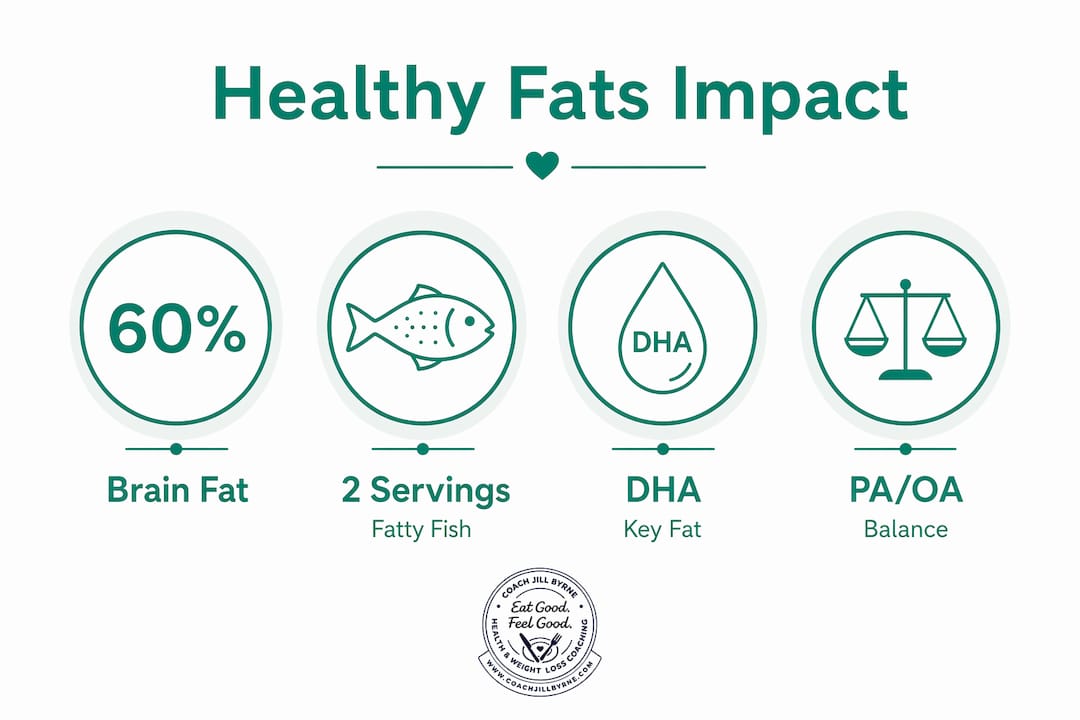
The brain is roughly 60% fat by dry weight, and the specific fatty acids you eat determine the quality of that fat. DHA dominates the phospholipid bilayers of neuronal membranes, particularly in phosphatidylcholine and phosphatidylserine fractions. Membrane fluidity, which governs how efficiently proteins and receptors move and signal, depends directly on DHA content. A membrane rich in DHA is more flexible and responsive; one depleted of it becomes rigid and less efficient at transmitting signals.

Beyond structure, dietary PUFAs and their derivatives modulate synaptic transmission and produce specialized pro-resolving mediators, including resolvins and protectins, that actively resolve neuroinflammation rather than simply suppressing it. This distinction matters: chronic low-grade neuroinflammation is implicated in cognitive decline, depression, and neurodegenerative conditions, and EPA/DHA-derived mediators are among the few dietary compounds that address it at the molecular level.
DHA also plays a direct role in neurogenesis and glucose uptake in neurons, with implications for how well the brain sustains energy-dependent tasks like working memory and attention. The blood-brain barrier, which controls what enters the brain, maintains its integrity partly through the fatty-acid composition of its endothelial cell membranes. Diets low in omega-3s can compromise that barrier, allowing inflammatory molecules greater access to brain tissue.
The endocannabinoid system adds another layer. PUFA derivatives serve as precursors to endocannabinoids, the brain’s own signaling molecules that regulate synaptic plasticity, stress responses, and neuroendocrine function. That biochemical link means your daily fat choices influence not just membrane structure but the moment-to-moment chemistry of how neurons communicate.
Which fats support the brain and which ones work against it?
Not all fats affect the brain the same way. The categories below reflect both their chemical structure and their functional impact on cognition.
DHA (n-3 PUFA): Primary structural fat in neuronal membranes; supports synaptic plasticity, neurogenesis, and anti-inflammatory signaling.
EPA (n-3 PUFA): Precursor to resolvins and protectins; primarily anti-inflammatory with emerging evidence for mood regulation.
ALA (n-3 PUFA): Plant-based precursor; limited conversion to EPA/DHA in humans, but still contributes to overall omega-3 status.
Arachidonic acid (ARA, n-6 PUFA): Present in neuronal membranes alongside DHA; has both pro-inflammatory and pro-resolving roles depending on context. The omega-3 to omega-6 ratio matters more than absolute omega-6 intake.
Oleic acid (MUFA): The primary fat in olive oil; supports membrane integrity and reduces inflammatory signaling.
Saturated fats (SFAs): Not a uniform category. Palmitic acid (PA), the most common SFA in Western diets, is the one most consistently linked to neuroinflammation and impaired insulin signaling in the brain. However, long-term cohort data show that very long-chain saturated fatty acids have different epidemiologic associations than shorter-chain SFAs, which calls for nuanced guidance rather than a blanket prohibition.
Trans fats (industrial): Disrupt membrane composition, promote systemic inflammation, and are associated with cognitive impairment. The FDA has effectively eliminated partially hydrogenated oils from the U.S. food supply, but small amounts persist in some processed foods.
The PA/OA ratio: why the balance between palmitic and oleic acid matters
The ratio of palmitic acid (PA) to oleic acid (OA) in the diet has emerged as a meaningful marker for brain health. Randomized crossover trials showed that lowering the dietary PA/OA ratio reduced systemic inflammatory markers and produced greater activation of working-memory brain networks. In practical terms, this means replacing butter and processed-food fats (high PA) with olive oil and avocado (high OA) has measurable functional consequences, not just theoretical ones.

The directive is straightforward: prioritize long-chain omega-3 PUFAs and monounsaturated fats, keep omega-6 intake in reasonable proportion to omega-3s, avoid industrial trans fats entirely, and moderate high-PA foods rather than eliminating all saturated fat.
What does the human research actually show?
The evidence base for dietary fats and cognition spans observational cohorts, randomized controlled trials (RCTs), and mechanistic studies. The picture is promising but nuanced.
Observational data consistently link higher fish and omega-3 intake to lower risk of cognitive decline. The NIH ODS consumer summary notes that some, though not all, research shows people who consume more omega-3s from food may have a lower risk of developing Alzheimer’s disease and dementia. The Mediterranean and MIND diets, which emphasize fatty fish, olive oil, and nuts while minimizing saturated and trans fats, are associated with slower cognitive decline across multiple large cohort studies.
RCT evidence is more mixed. Trials in cognitively healthy adults often show modest or non-significant effects on standard cognitive tests. Benefits tend to appear more consistently in specific subgroups: individuals with low baseline DHA status, those with mild cognitive impairment, or people with elevated inflammatory markers. This pattern suggests that omega-3 supplementation may be most impactful when there is a genuine nutritional deficit to correct.
Short-term dietary crossover trials offer a different angle. When participants shifted to lower PA/OA diets, changes in mood, inflammatory markers, and working-memory network activation appeared within weeks, not years. That speed of response suggests some cognitive effects of dietary fat operate through acute inflammatory and signaling pathways, not just long-term structural changes.
Research also shows that dietary fat intake modifies the relationship between cortical thickness and cognitive performance. Individuals with lower intake of beneficial fats may not show the expected link between healthy brain structure and cognitive function, suggesting that adequate fat intake is necessary for brain structure to translate into actual performance.
Evidence Type | Key Finding | Strength | Limitation |
Observational cohorts | Higher fish/omega-3 intake linked to lower cognitive decline risk | Moderate–Strong | Confounding by overall diet quality |
RCTs (healthy adults) | Modest or non-significant cognitive effects | Mixed | Short duration, heterogeneous doses |
RCTs (at-risk subgroups) | Benefits more consistent in low-DHA or MCI populations | Moderate | Small samples, varied formulations |
Dietary crossover trials | Lower PA/OA ratio improves working-memory activation and mood | Moderate | Short timeframes, limited generalizability |
Dietary pattern studies | Mediterranean/MIND diets associated with slower decline | Moderate–Strong | Observational; diet complexity makes attribution difficult |
Which foods give you the most brain-healthy fats?
Knowing the mechanisms is useful. Knowing which foods to put on your plate is what actually changes outcomes.
Marine omega-3 sources (DHA + EPA):
Salmon (3 oz cooked): roughly 1,200–2,000 mg combined EPA+DHA
Sardines (3 oz canned in water): approximately 800–1,400 mg EPA+DHA
Mackerel (3 oz cooked): one of the highest omega-3 concentrations of any common fish
Canned light tuna: a lower-cost option with moderate omega-3 content and lower mercury than albacore
Plant-based ALA sources:
Ground flaxseed (1 tbsp): approximately 1,600 mg ALA
Chia seeds (1 oz): approximately 5,000 mg ALA
Walnuts (1 oz, about 14 halves): approximately 2,500 mg ALA
MUFA sources:
Extra-virgin olive oil (1 tbsp): primary source of oleic acid; use as a finishing oil or for low-to-medium heat cooking
Avocado (half a medium): provides MUFAs alongside fiber and potassium
Almonds and cashews (1 oz): mixed MUFA and PUFA profile
Sample one-day brain-healthy fat plan:
Breakfast: Greek yogurt with 1 tbsp ground flaxseed and a small handful of walnuts
Lunch: Large salad with canned sardines, mixed greens, cucumber, and 1 tbsp olive oil dressing
Dinner: 4 oz baked salmon with roasted vegetables finished with olive oil
Snack: 1 oz almonds or a quarter of an avocado on whole-grain crackers
A note on mercury and contaminants: The FDA and EPA advise most adults to eat 2–3 servings of low-mercury fish per week. Salmon, sardines, and mackerel are all low-mercury choices. Pregnant individuals and young children should follow current FDA guidance on fish selection, as some species carry higher methylmercury levels. Balancing plant-based ALA sources alongside marine options is a practical way to maintain omega-3 intake while managing contaminant exposure.
How much do you need, and when should you consider supplements?
Translating the research into numeric targets requires drawing on authoritative guidance rather than individual study recommendations.
EPA + DHA from food: The American Heart Association recommends eating two servings of fatty fish per week, which provides roughly 500 mg of combined EPA+DHA per day on average. For individuals with documented cardiovascular risk, the AHA has supported higher prescription-level doses under physician supervision.
ALA: The NIH ODS lists the Adequate Intake for ALA at 1.6 g/day for adult men and 1.1 g/day for adult women. A tablespoon of ground flaxseed or a small handful of walnuts covers this target.
Fish-oil supplements: Consider supplementation when dietary fish intake is consistently below two servings per week, when baseline DHA status is known to be low, or when a clinician recommends it for a specific condition. Look for products that list EPA and DHA amounts separately, carry third-party testing certification (NSF International, USP, or IFOS), and are stored away from heat and light to prevent oxidation.
Safety considerations: Doses above 3 g/day of combined EPA+DHA may increase bleeding risk, particularly for individuals taking anticoagulants such as warfarin or antiplatelet medications. High-dose fish oil can also interact with blood-pressure medications. Contaminants (mercury, PCBs) are a greater concern with whole fish than with molecularly distilled supplements, but quality varies widely across brands.
When to consult a clinician: Anyone managing a neurological condition, taking prescription medications, or considering doses above the standard 1–2 g/day range should discuss omega-3 supplementation with their physician or a registered dietitian before starting.
The NIH ODS and American Heart Association both publish regularly updated guidance on omega-3 intake. These are the most reliable references for current numeric recommendations and clinical context.
Simple swaps that raise your healthy fat intake starting today
You do not need to overhaul your entire diet. A few targeted substitutions deliver most of the benefit.
High-impact swaps:
Replace butter on vegetables with a drizzle of extra-virgin olive oil; this directly lowers the PA/OA ratio in your meal.
Swap a bag of chips or crackers for 1 oz of walnuts or almonds as an afternoon snack.
Use canned sardines or salmon in place of deli meat for lunch; both are lower in sodium and far higher in omega-3s.
Replace croutons in salads with a tablespoon of chia or hemp seeds for ALA and texture.
Budget-friendly pantry staples:
Canned sardines and canned salmon are among the most affordable sources of EPA+DHA available in U.S. grocery stores.
Frozen salmon fillets cost significantly less than fresh and retain full omega-3 content when properly stored.
Bulk walnuts, flaxseed, and chia seeds from warehouse stores or bulk bins lower the per-serving cost considerably.
Three cooking habits that preserve PUFA and MUFA benefits:
Use olive oil as a finishing drizzle on cooked dishes rather than heating it to high temperatures, which can degrade delicate PUFAs.
Make a simple weekly salad dressing with olive oil, lemon juice, and herbs; it takes two minutes and replaces bottled dressings that often contain soybean or canola oil with poor omega-6 to omega-3 ratios.
Bake or poach fish rather than frying; this preserves the EPA+DHA content that high-heat frying can partially destroy.
Pro Tip: Prep one “fat-forward” component each Sunday, such as a batch of walnut-topped grain salad, a jar of homemade olive oil dressing, or portioned bags of mixed nuts. Having these ready removes the decision barrier on busy weekdays, which is where most healthy eating intentions stall.
How to make brain-healthy eating a lasting habit
Knowing what to eat and consistently doing it are two different skills. Behavior-change research is clear that small, specific habits outperform ambitious overhauls, particularly when the goal is long-term dietary adherence.
Start with one anchor habit. Choose a single change, such as adding a tablespoon of ground flaxseed to your morning yogurt or switching to olive oil for all stovetop cooking. Anchor it to something you already do every day. Once it feels automatic, add the next change.
Set a four-week measurable goal. A realistic starting target: two fatty-fish meals per week, daily olive-oil use, and one nut-based snack. Track it with a simple tally in a notes app or a paper habit tracker. Progress visibility improves follow-through.
Use a meal template, not a rigid meal plan. A template (protein + vegetable + healthy fat source at each meal) is flexible enough to survive travel, social events, and busy weeks. Rigid plans tend to collapse under real-life conditions.
Address the food environment. Keep walnuts, olive oil, and canned fish visible and accessible. Remove or relocate high-PA processed snacks. Environment shapes behavior more reliably than willpower.
Know when to seek professional support. If you are managing a neurological condition, taking medications that interact with omega-3s, or navigating complex dietary restrictions, a registered dietitian or your physician is the right resource for personalized dosing and meal planning. Coaching and clinical care serve different but complementary roles, and the connection between eating habits and medication outcomes is well-supported by current research.
Pro Tip: The most effective accountability technique in habit-based nutrition coaching is the “implementation intention”: writing down not just what you will eat, but exactly when and where. “I will eat sardines on whole-grain crackers at my desk on Tuesday and Thursday lunch” is far more likely to happen than “I will eat more fish this week.”
Coachjillbyrne’s approach to mindful nutrition coaching is built around exactly this kind of structured, incremental habit-building, helping clients move from intention to consistent practice without the pressure of perfection.
Key Takeaways
DHA and EPA from fatty fish are the most direct dietary contributors to neuronal membrane health, synaptic function, and reduced neuroinflammation, with the Mediterranean and MIND diets providing the strongest pattern-level evidence for cognitive protection.
Point | Details |
DHA is structurally critical | DHA is a primary component of neuronal membrane phospholipids, with concentrations highest in brain and retinal tissue. |
PA/OA ratio affects cognition quickly | Lowering dietary palmitic acid relative to oleic acid improved working-memory network activation in randomized crossover trials. |
Mediterranean and MIND diets lead the evidence | Both diets emphasize fatty fish, olive oil, and nuts and are associated with slower cognitive decline across multiple studies. |
Two fish servings per week is the AHA target | The American Heart Association recommends two servings of fatty fish weekly to meet EPA+DHA needs from food. |
Coachjillbyrne supports sustainable implementation | Habit-based nutrition coaching from Coachjillbyrne helps translate these dietary targets into consistent, real-life eating patterns. |
The gap between knowing the science and actually changing what you eat
Most people who read about omega-3s and brain health already understand the basics. They know salmon is good for them. What they underestimate is how much the food environment and daily habits determine whether that knowledge ever becomes behavior.
The research on dietary fat and cognition is genuinely compelling, but it also carries a quiet caveat: the benefits observed in Mediterranean-diet cohort studies are not from a single nutrient. They reflect a whole pattern of eating, sustained over years, in a social and cultural context that makes those choices relatively easy. Transplanting that pattern into a busy American life requires more than a shopping list. It requires building the specific habits, meal templates, and environmental cues that make brain-healthy choices the path of least resistance.
The PA/OA ratio findings are a good example of why this matters practically. Swapping butter for olive oil is not a dramatic change, but it is the kind of precise, mechanism-grounded swap that compounds over time. Small, targeted substitutions grounded in the actual science tend to outperform broad dietary overhauls that are hard to sustain. That is the principle Coachjillbyrne applies in practice: start with the highest-leverage changes, build consistency before adding complexity, and measure progress in habits rather than perfection.
Ready to put brain-healthy eating into consistent practice?
Understanding the science behind healthy fats and cognition is a strong first step. Translating it into a sustainable daily routine is where most people benefit from structured support.

Coachjillbyrne offers personalized, habit-based nutrition coaching designed for people who want real, lasting changes without restrictive dieting. Whether your goal is sharper focus, better energy, or long-term cognitive health, the coaching process starts with your current eating patterns and builds from there, one practical swap at a time. Sessions cover meal planning, healthy fat integration, portion guidance, and the accountability structure that turns good intentions into consistent habits.
To get started, visit coachjillbyrne.com to learn about available programs or book a discovery call. Please note: nutrition coaching is general wellness support and is not a substitute for medical advice. Always consult your physician or a registered dietitian for clinical concerns, supplement dosing, or medication interactions.
Useful sources for further reading
These resources represent the strongest available evidence on dietary fats and brain health. Check methods sections and subgroup findings before drawing personal conclusions, and consult a clinician before making significant supplement changes.
Source | What You Will Find |
NIH ODS: Omega-3 Fatty Acids (Health Professional) | Comprehensive intake guidance, mechanisms, and clinical evidence summary from the National Institutes of Health. |
NIH ODS: Omega-3 Fatty Acids (Consumer) | Plain-language overview of omega-3 functions, food sources, and Alzheimer’s/dementia research summary. |
Impact of Dietary Fats on Brain Functions (PMC) | Peer-reviewed mechanistic review covering PUFAs, endocannabinoids, neuroinflammation, and synaptic plasticity. |
Cleveland Clinic: Omega-3 Fatty Acids | Accessible clinical summary of omega-3 roles, food sources, and supplement considerations. |
Scripps Health: Best Foods for Brain Health | Practical dietary pattern overview covering Mediterranean, MIND, and DASH diets and their cognitive associations. |
Nutrients: PA/OA Ratio and Brain Function | Randomized crossover trial data on how lowering the palmitic-to-oleic acid ratio affects inflammation and working-memory networks. |
Alzheimer’s Research Journal: Fat Intake and Cortical Thickness | Research on how dietary fat intake modifies the relationship between brain structure and cognitive performance. |
Springer Nature: n-3 and n-6 PUFAs in the CNS | Detailed mechanistic review of DHA and ARA roles in neurogenesis, glucose uptake, and synaptic function. |
FAQ
What is the most important fat for brain function?
DHA (docosahexaenoic acid) is the most structurally critical fat for the brain, as it is a primary component of neuronal membrane phospholipids and is concentrated at higher levels in brain and retinal tissue than anywhere else in the body.
How often should you eat fatty fish for brain health?
The American Heart Association recommends two servings of fatty fish per week, which provides a meaningful supply of EPA and DHA to support neuronal membrane health and reduce neuroinflammation.
Can plant-based omega-3s replace fish for cognitive benefits?
ALA from flaxseed, chia, and walnuts contributes to overall omega-3 status, but the body converts it to EPA and DHA at low rates. For direct cognitive benefits, marine sources or algae-based DHA supplements remain the most reliable options.
Does olive oil actually benefit the brain?
Yes. Olive oil’s primary fat, oleic acid, lowers the dietary PA/OA ratio, which randomized crossover trials have linked to reduced inflammatory markers and improved working-memory network activation.
When should you consider a fish-oil supplement?
Consider discussing a supplement with your clinician if you eat fatty fish fewer than twice a week, have known low DHA status, or have a condition where higher omega-3 intake is clinically indicated. Always check for third-party testing certification and disclose use to your physician if you take blood-thinning medications.
Recommended
Comments