
Semaglutide Weight Loss Plateau Tips: Your Action Checklist

If your weight has stopped moving on semaglutide (Wegovy or Ozempic), the first thing to do is confirm your current dose and injection adherence with your prescriber, then run a 7-day food log before changing anything else. Pivotal semaglutide trial data show that most patients experience rapid early loss followed by a pronounced deceleration, often flattening by months 12–18. A plateau is common. It is also usually addressable.
Run this checklist over the next 7 days:
Dose and adherence check. Confirm you are on the correct dose and that no injections have been missed or delayed.
7-day food log. Track every meal and drink using an app like MyFitnessPal or Cronometer to detect caloric drift.
Protein audit. Calculate whether you are hitting 1.2–1.5 g per kilogram of body weight daily.
Resistance training restart. Schedule at least two strength sessions this week, even short ones.
Sleep audit. Log your sleep hours for 7 nights. Fewer than 7 hours consistently disrupts hunger hormones.
Contact your prescriber now if you have missed multiple doses, are experiencing rapid weight regain, or have severe GI symptoms such as prolonged vomiting or signs of dehydration.
Key Takeaways
Breaking a semaglutide weight loss plateau requires auditing adherence and dose status first, then correcting protein intake and adding resistance training before pursuing clinical medication changes.
Point | Details |
Dose and adherence first | Confirm your current dose and injection consistency with your prescriber before changing anything else. |
Protein and strength training | Target 1.2–1.5 g of protein per kg of body weight daily and add resistance training 2–3 times per week. |
Track for 7–14 days | A short food log reliably reveals caloric drift that explains most lifestyle-driven plateaus. |
Realistic timelines | Lifestyle changes show signals in 2–4 weeks; dose escalation effects take 4–12 weeks to assess. |
Coachjillbyrne supports GLP-1 users | Personalized nutrition coaching from Coachjillbyrne addresses the protein, meal planning, and accountability gaps medication alone does not fill. |
Table of Contents
Why does weight loss stall on semaglutide?
Semaglutide works as a GLP-1 receptor agonist, reducing appetite and slowing gastric emptying. Over time, the body adapts. Resting metabolic rate decreases as body weight drops, meaning fewer calories are needed to maintain the new, lower weight. Hormonal shifts, including changes in leptin and ghrelin, can partially offset the drug’s appetite-suppressing effects. None of this means the medication has stopped working. It often means the body has reached a new equilibrium at the current dose and caloric intake.
Several routine causes explain most plateaus clinicians see:
Dose not yet at maintenance. Many patients plateau at sub-maximal doses because titration pauses, supply disruptions, or insurance delays prevent them from reaching the full therapeutic dose. A dose check is always step one.
Caloric drift. Appetite suppression can partially adapt, and portion sizes quietly increase without the person noticing.
Low protein and muscle loss. Reduced caloric intake without adequate protein accelerates lean-mass loss, which lowers resting metabolic rate further.
Constipation and fluid shifts. GLP-1 medications slow gut motility. Retained stool and fluid can mask 2–5 pounds of actual fat loss on the scale.
Missed or inconsistent doses. Even one missed weekly injection disrupts the steady-state blood level that drives appetite control.
Sleep deprivation and chronic stress. Both elevate cortisol, which promotes fat storage and increases cravings.
Interacting medications or medical conditions. Certain antidepressants, antipsychotics, corticosteroids, and unmanaged thyroid disease can blunt weight loss independent of semaglutide.
A plateau on the scale does not always mean fat loss has stopped. Body-composition improvements — less visceral fat, preserved or increased lean tissue — can continue while the number on the scale stays flat. Tape measurements and strength markers often tell a more accurate story than the scale alone.
Pro Tip: Before concluding you have plateaued, weigh yourself at the same time each morning, after using the bathroom and before eating, for 14 consecutive days. A true plateau is a flat trend over that full window, not a 3-day stall.
What practical strategies actually break a semaglutide plateau?
Start with the highest-impact changes first, then layer in additional strategies over 2–8 weeks. Trying everything at once makes it impossible to identify what worked.
Step 1: Audit and correct protein intake
Protein is the single most protective nutrient during GLP-1-assisted weight loss. Research supports protein targets of roughly 1.2–1.6 g per kilogram of body weight per day to preserve lean mass and maintain satiety during a caloric deficit. At reduced appetite levels, hitting that target requires deliberate planning. Prioritize protein at every meal before filling the plate with anything else.
Step 2: Add or restart resistance training
Resistance training 2–3 times per week targeting major muscle groups preserves lean mass and supports resting metabolic rate during weight loss. Cardio alone does not accomplish this. Even two 30-minute sessions per week produce measurable body-composition benefits when combined with adequate protein. The Physical Activity Guidelines for Americans recommend muscle-strengthening activities on at least 2 days per week alongside 150 minutes of moderate aerobic activity.

Step 3: Run a 7–14 day food log
A structured food log commonly reveals caloric drift that explains plateaus when appetite suppression has partially adapted. Short-term food logging is one of the most reliable ways to detect incremental intake increases that feel invisible day to day. Log for accuracy, not perfection. The goal is data, not judgment.

Step 4: Reduce liquid calories and alcohol
Liquid calories bypass the satiety signals that semaglutide amplifies. Alcohol adds calories without nutritional value and disrupts sleep quality, compounding the cortisol problem. Cutting or significantly reducing alcohol is one of the fastest dietary levers available.
Step 5: Address sleep and stress
Fewer than 7 hours of sleep per night consistently raises ghrelin (the hunger hormone) and lowers leptin (the satiety hormone). Stress management practices, whether structured breathing, walking, or consistent sleep timing, support the hormonal environment that semaglutide depends on.
Pro Tip: Semaglutide suppresses appetite most strongly in the first few hours after injection. Schedule your highest-protein meal during that window to maximize satiety and protect muscle at the same time.
Long-term weight-loss maintainers consistently use regular monitoring, physical activity, and controlled eating patterns. These behaviors matter as much during a plateau as they do during active loss.
What will your clinician review when lifestyle changes aren’t enough?
When 6–8 weeks of optimized lifestyle habits produce no measurable change, a clinical review is warranted. A prescriber will typically work through the following:
Current dose and titration status. For Wegovy (semaglutide 2.4 mg weekly), patients not yet at the maximum approved dose have a clear clinical pathway. Dose escalation under supervision is often the most direct next step.
Adherence history. Missed doses, storage errors (semaglutide requires refrigeration), and injection technique all affect efficacy.
Relevant labs. Thyroid function (TSH), fasting glucose, and HbA1c can reveal conditions that independently limit weight loss. A full metabolic panel helps rule out secondary causes.
Concomitant medications. Several common drug classes promote weight gain. A prescriber can review the full medication list and consider alternatives where appropriate.
Sleep apnea screening. Untreated obstructive sleep apnea raises cortisol and impairs weight loss. Many patients are undiagnosed.
Dose escalation should only happen under clinical supervision. Self-adjusting injection timing or dose to accelerate loss increases the risk of nausea, vomiting, and pancreatitis. The therapeutic ceiling for Wegovy is 2.4 mg weekly; going beyond it is not approved and carries real safety risk.
When a patient has been at the maximum semaglutide dose for 12+ weeks with minimal additional response, a prescriber may discuss switching to a dual GIP/GLP-1 receptor agonist such as tirzepatide (Mounjaro for type 2 diabetes, Zepbound for obesity). Tirzepatide trials have shown higher mean weight loss than semaglutide trials, though direct head-to-head comparisons are limited and individual responses vary. Insurance coverage and access remain practical barriers for many patients. That conversation belongs with your prescriber, not a checklist.
Timeline expectations after a clinical change: Allow 4–12 weeks after a dose adjustment before judging its full effect. Lifestyle changes (protein, resistance training) typically produce measurable signals within 2–4 weeks.
For GLP-1 medication safety information, including what to discuss with your provider before any dose change, a clinical resource from a telehealth partner can help you prepare for that appointment.
A simple weekly meal and strength template to adapt
Protein targets
The formula is straightforward: multiply your current body weight in kilograms by 1.2–1.5 to get your daily protein target in grams. A 200-pound person (approximately 91 kg) needs roughly 109–136 g of protein per day. Practical food sources to build around:
Chicken breast (31 g per 3.5 oz cooked)
Greek yogurt, plain nonfat (17 g per 6 oz)
Eggs (6 g each)
Cottage cheese (14 g per half cup)
Canned salmon or tuna (22–25 g per 3 oz)
Edamame (17 g per cup)
For sustainable weight loss foods that work well with GLP-1 appetite levels, protein-first meal building is the most reliable structure.
Sample weekly meal framework
This is a structural template, not a rigid recipe plan. Adapt portions to your appetite, which will vary on semaglutide.
Breakfast: Protein-first (eggs, Greek yogurt, cottage cheese, or a protein shake) with fiber from vegetables or berries. Skip high-sugar cereals and pastries.
Lunch: Lean protein (chicken, fish, legumes) with non-starchy vegetables and a small portion of complex carbohydrate (quinoa, brown rice, or sweet potato).
Dinner: Protein and fiber focus. A palm-sized portion of protein, half the plate in vegetables, and a small starch if hunger allows.
Snacks: Keep them protein-anchored. String cheese, hard-boiled eggs, Greek yogurt, or a small handful of nuts with cottage cheese.
Distribute protein across all three meals rather than loading it at dinner. Research on muscle protein synthesis supports spreading intake evenly for better lean-mass preservation.
Beginner 2–3x/week strength template
The NIDDK’s physical activity guidance supports combining aerobic and muscle-strengthening activities for weight management. A simple starting structure:
Goblet squat or bodyweight squat — 3 sets of 10–12 reps
Dumbbell Romanian deadlift — 3 sets of 10 reps
Dumbbell or resistance-band row — 3 sets of 12 reps
Push-up or incline push-up — 3 sets of 8–12 reps
Plank hold — 3 rounds of 20–30 seconds
Each session takes 25–35 minutes. Track the weight or resistance used each session. Progress by adding one rep or a small amount of weight every 1–2 weeks. Consistency over intensity is what drives results at this stage. Understanding muscle loss risks for GLP-1 users helps clarify why this template prioritizes compound movements over isolated exercises.
How do you monitor progress and know if changes are working?
The scale is one data point, not the whole picture. Use a multi-metric approach:
Weekly weigh-ins: Same day, same time, same conditions (morning, post-bathroom, pre-food). Average across 4 weeks to smooth out normal fluctuations.
Tape measurements: Waist, hips, and upper arm monthly. These often move when the scale does not.
Strength markers: Track the weight or resistance used in each exercise. Strength gains during a scale plateau confirm muscle preservation.
Energy and hunger patterns: Improved energy and stable hunger between meals are signs the protocol is working even before the scale moves.
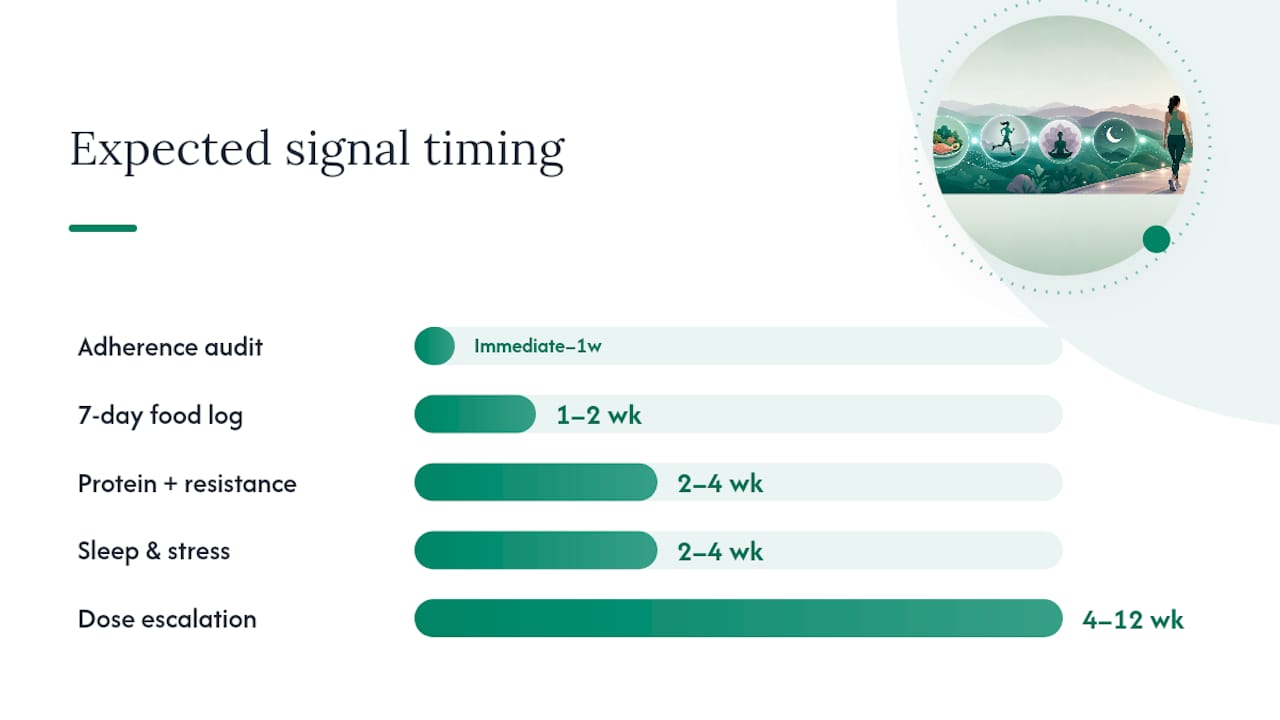
Expected timelines after each intervention
Intervention | Earliest signal of change | Notes |
Adherence and dose audit | Immediate to 1 week | Missed doses resolved quickly restore appetite control |
7-day food log and caloric correction | 1–2 weeks | Caloric drift correction often shows scale movement within 2 weeks |
Protein increase and resistance training | 2–4 weeks | Scale may stay flat while body composition improves |
Sleep and stress correction | 2–4 weeks | Hunger hormone normalization takes consistent nights |
Dose escalation (clinician-guided) | 4–12 weeks | Full effect of a new dose takes weeks to stabilize |
Day-to-day weight fluctuations of 1–3 pounds are normal and reflect water, food volume, and hormonal cycles, not fat change. A true plateau is a flat 4-week trend across consistent measurement conditions. Harvard Health’s maintenance research confirms that frequent weighing and food logging are among the most reliable habits of long-term weight-loss maintainers, precisely because they separate signal from noise.
When should you contact your provider right away?
Some situations call for prompt medical attention rather than a self-directed checklist. Contact your prescriber or seek care immediately if you experience:
Rapid, unexplained weight gain over 1–2 weeks with no clear dietary cause
Prolonged vomiting or inability to keep fluids down for more than 24 hours
Signs of dehydration: dizziness, dark urine, rapid heart rate
Symptomatic hypoglycemia (shakiness, confusion, sweating), particularly if you also take insulin or a sulfonylurea
Severe or persistent abdominal pain that radiates to the back (a potential sign of pancreatitis)
Signs of acute illness that prevent normal eating or medication use
Schedule a routine provider review (not urgent) when:
Eight or more weeks have passed with no scale or measurement change after optimizing protein, resistance training, sleep, and caloric intake
You are at the maximum approved dose and still significantly above your goal weight
A new medication has been added that is known to promote weight gain
You have been newly diagnosed with sleep apnea, hypothyroidism, or another condition that affects metabolism
For questions about GLP-1 program structure and insurance, a telehealth resource can help you prepare practical questions before your appointment.
What plateaus actually tell you about your progress
Plateaus are not failures. They are the body doing exactly what physiology predicts: adapting to a sustained caloric deficit and a lower body weight. The patients who break through them consistently are not the ones who restrict harder. They are the ones who audit honestly, add muscle-preserving exercise, and work with their prescriber rather than around them.
The tendency to cut calories further when weight stalls is one of the most common and counterproductive responses. Severe under-eating on semaglutide accelerates lean-mass loss, lowers metabolic rate, and makes the plateau worse over time. Sustainable habits, not short-term restriction, are what eating habits beyond medication research consistently supports for long-term outcomes.
Medication is a tool. It works best when paired with structured nutrition, consistent movement, and the kind of accountability that keeps small habits from quietly eroding over months.
Personalized nutrition coaching for people on semaglutide
Hitting a plateau on semaglutide often reveals the gaps that medication alone cannot fill: unclear protein targets, no strength routine, inconsistent tracking, and no one to course-correct when habits drift. Coachjillbyrne provides GLP-1 nutrition support designed specifically for people in this situation.

A first coaching session with Coach Jill Byrne typically covers your current protein intake, a practical meal framework built around your appetite levels, and a simple strength plan you can start that week. Ongoing sessions provide the accountability and adjustments that keep progress moving between prescriber appointments. This is not a generic meal plan. It is structured, personalized support for the specific challenges that come with GLP-1 therapy.
If you are ready to move past the plateau with a clear, sustainable plan, book a session with Coachjillbyrne and get a protocol built around your goals.
Sources
This article provides general health information and is not a substitute for professional medical advice. Consult your prescriber or a qualified healthcare provider before making changes to your medication, dose, or exercise program.
FAQ
How do you shock your body out of a weight loss plateau on semaglutide?
The most effective approach is a combination of auditing caloric intake with a 7–14 day food log, increasing protein to 1.2–1.5 g per kilogram of body weight, and adding resistance training 2–3 times per week. If those changes produce no movement after 6–8 weeks, a clinical dose review is the appropriate next step.
Can semaglutide stop working for weight loss?
Semaglutide does not stop working in the pharmacological sense, but the body adapts to a lower weight by reducing resting metabolic rate, which can make further loss harder at the same dose and caloric intake. A plateau often signals that lifestyle habits or dose need adjustment, not that the medication has failed.
Can a cheat day break a weight loss plateau?
A single higher-calorie day is unlikely to restart meaningful fat loss and may disrupt the consistent eating patterns that support long-term progress. Addressing the underlying cause of the plateau, such as low protein, insufficient activity, or a sub-maximal dose, produces more reliable results than a planned deviation.
How long does a semaglutide plateau typically last?
Duration depends on the cause. Correcting missed doses or caloric drift can show results within 1–2 weeks. Adding protein and resistance training typically produces measurable body-composition changes within 2–4 weeks. A clinician-guided dose escalation may take 4–12 weeks to show its full effect.
Recommended
Comments