
Slow Eating Techniques to Eat Less and Enjoy Meals More
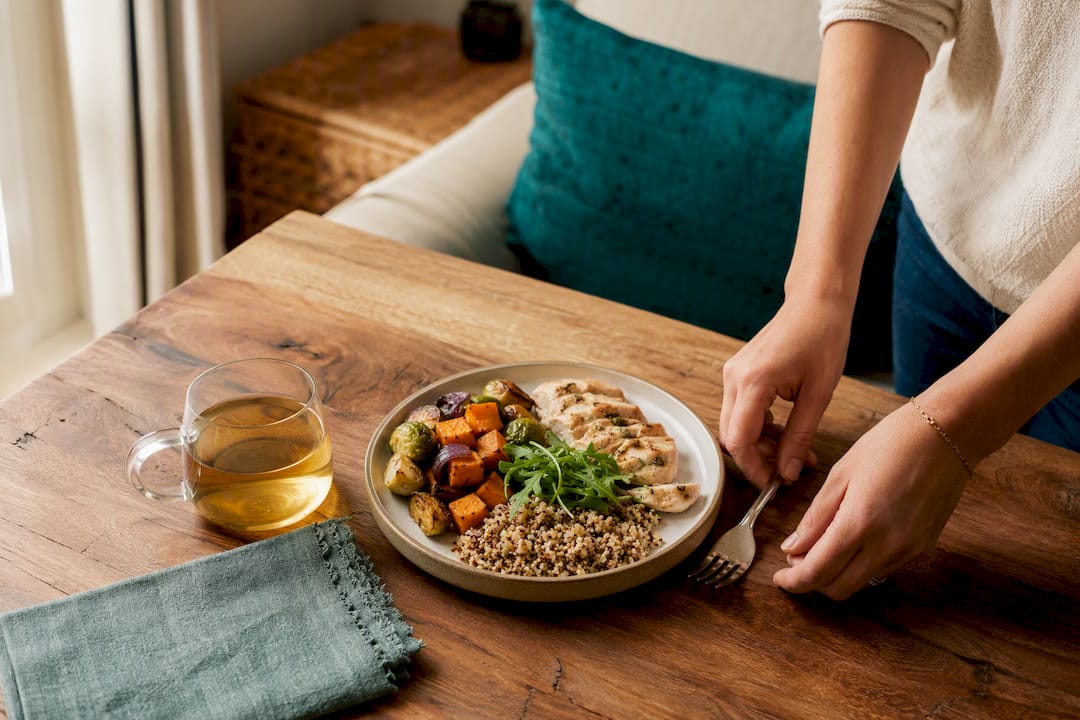
Eating slower reduces overeating and improves how satisfied you feel after a meal, mainly because it gives your gut and brain time to talk to each other. Try these five changes at your very next meal:
Set a target of 20 minutes before you clear your plate.
Put your fork or spoon down between bites instead of holding it.
Sip water between bites to create a natural pause.
Chew each mouthful more deliberately, especially with denser foods.
Turn off the TV or put your phone away during the meal.
Pro Tip: Your stomach and brain need about 20 minutes to register fullness, so a meal that lasts less than 10 minutes often ends before your body has a chance to say “enough.”
Key Takeaways
Eating slower gives your gut and brain roughly 20 minutes to communicate fullness, and that timing gap is the mechanism behind nearly every technique in this guide.
Point | Details |
Target meal duration | Aim for 20 to 30 minutes per meal to let satiety hormones catch up with intake. |
Use simple pause rules | Fork-down and sip-of-water rules slow pacing more sustainably than counting chews. |
Expect individual variation | Normal-weight eaters see bigger intake drops than overweight or obese eaters in trials. |
Build habits in stages | A 3 to 4 week plan (awareness, technique, integration, maintenance) outlasts trying everything at once. |
Get personalized support | Coachjillbyrne pairs pacing techniques with accountability coaching, including GLP-1 nutrition guidance, when techniques alone aren’t enough. |
Table of Contents
How Do Slow Eating Techniques Work?
Slow eating techniques work by closing the gap between when your stomach is actually full and when your brain finds out about it. That gap is not instant. It runs on a hormonal and neural relay system, and understanding it is the difference between “eat slower” as vague advice and eat slower as something you actually do at dinner tonight.
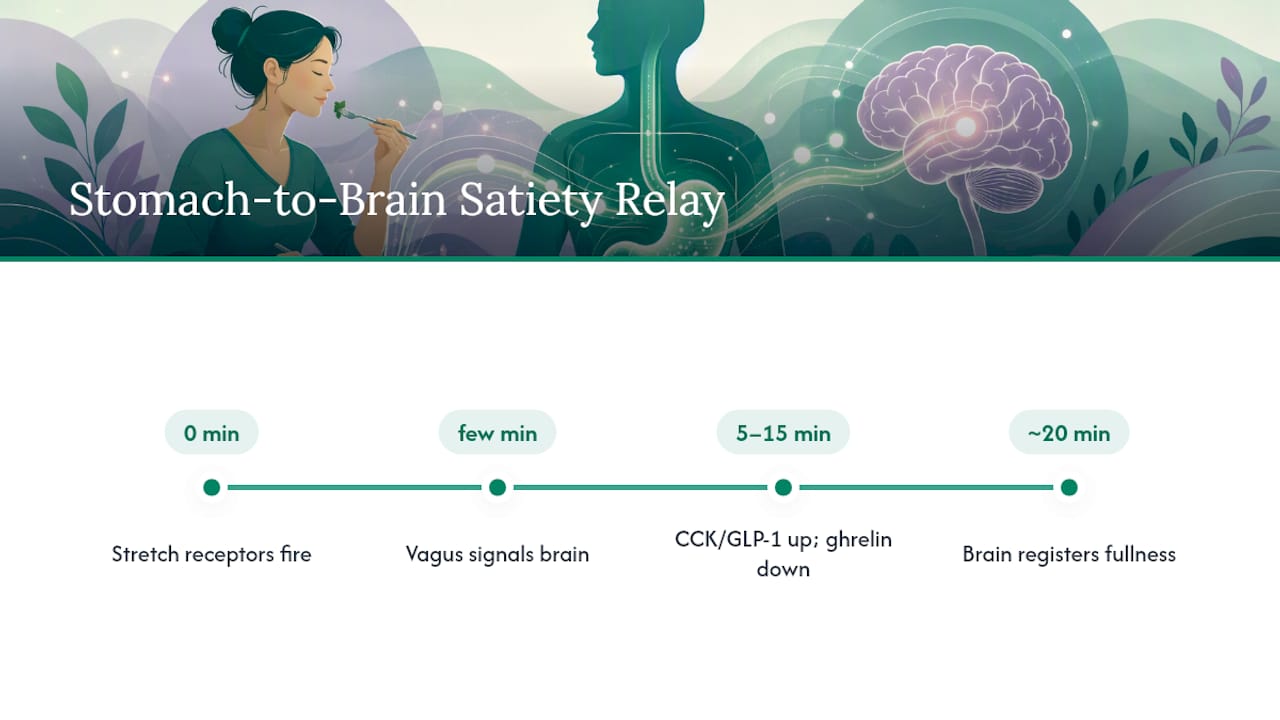
Here’s the mechanism. As food fills your stomach, stretch receptors in the stomach wall send signals up the vagus nerve to your brainstem and hypothalamus. At the same time, your gut releases satiety hormones like cholecystokinin and GLP-1, while ghrelin (the hunger hormone) drops. This entire relay, from first bite to “I’m satisfied” registering in your brain, takes roughly 20 minutes. Eat a large meal in eight minutes and you’ve likely taken in several hundred extra calories before the system had a chance to flag it.
The clearest evidence for this comes from a 2014 randomized crossover study published on PubMed, where researchers had participants eat the same meal at a slow pace on one occasion and a fast pace on another. Slower eating significantly lowered total meal energy intake, but only in normal-weight participants. Overweight and obese participants ate more slowly too, and reported feeling less hungry afterward, but their total calorie intake didn’t drop by a statistically meaningful amount. That’s an important nuance most quick-tip articles skip: slow eating changes hunger perception fairly reliably, but it doesn’t guarantee lower intake for everyone, and weight status appears to be one variable that changes the outcome.
Other research adds texture to that picture. Some more recent trials show modest reductions in cumulative intake across several days when people eat more slowly, but the effect size and how long it lasts vary a lot from study to study. Short-term lab trials are good at proving the mechanism exists. They’re less good at telling you whether eating slowly for six weeks changes your weight in six months. That takes longer-term behavioral data researchers don’t yet have in abundance.
There’s also a hormonal wrinkle worth knowing about. Harvard Health has noted that leptin resistance, common in people who carry more body fat or who’ve dieted repeatedly, can blunt the strength of satiety signals reaching the brain. If your leptin signaling is dulled, slow eating still helps, because it gives whatever signal you do have more time to register, but it may not fully resolve overeating by itself. That’s one reason technique alone sometimes needs to be paired with broader nutrition strategy rather than treated as a standalone fix.
Public health coverage backs the general framing: outlets have noted that people who regularly eat meals in 20 minutes or less tend to report less awareness of fullness and more digestive discomfort. Distracted, rushed eating isn’t just a pacing problem. It’s an attention problem, and your gut hormones can’t compete with a phone screen for your notice.
What this means practically: aim for that 20 to 30 minute window per meal, but hold your expectations honestly. If you’re at a healthy weight, slowing down may directly cut how much you eat. If you’re managing a higher body weight or hormonal factors like leptin resistance, slowing down still improves your relationship with hunger and fullness cues, even if the calorie math takes more support to shift. Either way, you’re training a system that responds to repetition, not a one-meal miracle.
Practical Techniques to Slow Down While You Eat
You don’t need all twelve of these. Pick three or four that fit your week and build from there.
Set a 20-minute timer. Start it the moment you sit down and treat it as a floor, not a race to beat. This is the single most direct way to apply the 20 to 30 minute meal guidance that shows up across health research.
Put your utensils down between bites. This is the most durable slow-eating habit because it forces a pause without requiring you to count or track anything.
Chew each mouthful thoroughly. Healthline’s coverage of slow-eating research recommends 15 to 30 chews per bite depending on texture. A crisp apple slice needs more chewing than a bite of soup.
Sip water between bites. This does double duty: it slows your pace and helps you notice fullness earlier, since a full stomach registers volume from liquid the same way it does from food.
Portion snacks into a bowl instead of eating from the bag or box. A portion control strategy like this removes the visual cue that keeps your hand reaching back in on autopilot.
Remove screens and reading material from the table. Distracted eating disconnects your attention from your body’s signals, which is one reason rushed, screen-heavy meals correlate with lower fullness awareness.
Engage your senses before you swallow. Name the taste, notice the texture, register the temperature. University of Utah Health’s mindful eating guidance treats this sensory check-in as a natural anchor that slows people down without them counting anything.
Take smaller bites. A fork loaded with three bites’ worth of food skips the pacing benefit entirely, no matter how slowly you chew it.
Mimic the slowest eater at the table. If you regularly eat with someone who takes their time, match their pace instead of finishing first and waiting.
Add a breathing pause halfway through the meal. Three slow breaths at the midpoint interrupts the momentum of eating and gives your body a moment to check in.
Serve your plate, then step away from the stove or counter before eating. Physical distance from the serving dish removes the temptation to refill mindlessly between bites.
Set your utensil down and swallow completely before loading the next bite. Simple, but it’s the rule most people skip when they’re hungry and moving fast.
Pro Tip: Counting chews works for a week, then it gets tedious and people quit. A more sustainable approach is the place-fork-down rule paired with a sip-of-water rule: two automatic pauses per bite that don’t require any mental math, even with a mixed-texture plate like a stir-fry or a loaded sandwich.
Different meals need different adjustments. A sandwich, for instance, is easy to inhale in six bites, so the fork-down rule doesn’t apply (there’s no fork), but you can substitute a rule where you set the sandwich fully on the plate between bites rather than holding it in hand. Soup naturally slows you down already, so your focus there should be on the sensory engagement technique, tasting the broth’s temperature and seasoning rather than gulping it. A mixed plate, protein, starch, vegetables, benefits most from smaller bites and thorough chewing, since the different textures mean some parts of the meal require more mechanical breakdown than others.

Building a Slow Eating Habit in 3 to 4 Weeks
Technique lists are useful, but habits stick when they’re practiced in a sequence rather than attempted all at once. Here’s a week-by-week plan that layers awareness, then technique, then real-world integration.
Week 1: Awareness. Don’t change anything yet. Just notice how fast you currently eat, how many minutes a typical meal takes, and whether you eat while distracted. Jot down meal duration for at least five meals.
Week 2: Technique adoption. Choose two techniques from the toolbox above (the timer and the fork-down rule are a strong starting pair) and apply them at every meal, even quick ones. Expect some meals to feel awkward. That’s normal.
Week 3: Integration and social practice. Bring your chosen techniques into harder settings: eating with others, eating at work, eating takeout. Social meals are where most people abandon new habits, so this week is about proving the techniques survive contact with real life.
Week 4: Maintenance and expansion. Add one more technique from the list, and start tracking perceived fullness (a simple 1 to 10 scale) alongside meal duration.
A few daily micro-exercises make the plan easier to stick with. Try a two-minute pre-meal breathing pause before you pick up your fork. Do one “mindful bite” drill per meal, where you eat the first bite in total silence, noticing texture and flavor before moving on normally. Time just one meal a day with a visible timer rather than trying to track every single meal, which burns out motivation fast.
For tracking, keep it simple: meal duration, one technique you used, and a fullness rating from 1 to 10 at the end of the meal. That’s three numbers, nothing more. Reviewing a habit checklist like this one on rebuilding healthy eating routines can help you see patterns across a full week rather than judging any single meal.

If you plateau, meaning your meal duration stalls around 12 to 14 minutes and won’t budge past it, don’t add more rules. Instead, look at what’s interrupting you. Often it’s a specific meal (lunch at your desk, dinner in front of the TV) rather than a general failure of willpower, and fixing that one meal moves the average more than adding a fifth technique to the ones you already use.
When Slowing Down Needs Extra Care
Most people can adopt these techniques without any special consideration, but a few groups should approach them differently.
History of disordered eating: Techniques that involve close attention to bites, chewing, or food texture can sometimes trigger unhelpful focus for someone recovering from an eating disorder. Work with a treatment provider before adding structured slow-eating rules.
GI conditions: Certain digestive conditions change how food should be paced or chewed. Check with your doctor if you have a diagnosed condition affecting swallowing or digestion.
GLP-1 medications: Slower eating actually pairs well with GLP-1 medications, since these drugs amplify satiety signals and eating too fast on them can cause discomfort or nausea. If you’re on a GLP-1 and exploring nutrition support, a GLP-1 prescription weight loss program alongside pacing techniques often works better than either alone.
ADHD and neurodiversity: Sitting still for a 20 minute meal, or focusing on chewing counts, can feel genuinely harder for someone with ADHD. Shorter techniques like the sip-of-water rule or a single mindful bite per meal tend to work better than a full sensory checklist.
Leptin resistance can blunt how strongly your body signals fullness, which means pacing techniques still help but may not fully resolve overeating without additional support. Slowing down works with your physiology; it doesn’t override it.
None of this replaces personalized medical guidance. If you have a diagnosed condition, take medication that affects appetite, or have a history of disordered eating, talk to your doctor or a qualified clinician before changing your eating pace significantly.
Fixing the Barriers That Derail Slow Eating
Most people don’t quit slow eating because the techniques don’t work. They quit because life gets in the way. Here’s how to handle the usual culprits.
Time pressure at lunch: Block 20 minutes on your work calendar the same way you’d block a meeting.
Eating at your desk: Pack food in a small bowl instead of eating from a container, which forces a natural portion pause.
Social meals moving too fast: Match your pace to the slowest eater at the table rather than the fastest.
Distracted eating at home: Keep your phone in another room during dinner, not just face down on the table.
Forgetting entirely: Set a visible timer or a recurring phone reminder until the habit becomes automatic.
A Coach’s Note on Making This Habit Stick
In coaching clients through habit change, the ones who succeed at slowing down rarely do it perfectly from day one. They start with one rule, usually the fork-down pause, and let the rest follow naturally over a few weeks.

Pro Tip: Don’t try to fix your eating pace at every meal immediately. Pick one meal a day, commit to it for a week, and let the habit spread from there instead of demanding overnight change.
If your progress stalls or your relationship with food feels more complicated than pacing alone can fix, personalized guidance closes that gap faster than trial and error.
How Coaching Helps When Techniques Alone Aren’t Enough
Slow eating techniques work best when they’re part of a bigger picture, and that’s exactly where personalized coaching earns its keep. Coachjillbyrne builds pacing strategies into a full accountability system rather than leaving you to remember twelve techniques on your own.

Coaching adds what a checklist can’t: someone reviewing your actual meals, adjusting your plan when a technique isn’t fitting your schedule, and tailoring support if you’re navigating GLP-1 medication nutrition needs alongside pacing changes. One common pattern among clients: someone who struggled with rushed lunches at a desk job builds a simple pack-a-bowl habit with coaching support, and within a few weeks reports noticing fullness earlier and snacking less in the evening. That kind of shift usually needs a second set of eyes to catch what’s working and what isn’t.
If you want a plan built around your actual schedule instead of a generic list, book a free consult with Coach Jill and find out what’s realistic for your week.
Sources
Eating Too Fast? Here Are 4 Ways To Slow Down | Cleveland Clinic
Slower eating speed lowers energy intake in normal-weight but not overweight/obese subjects - PubMed
Eating slowly and weight loss: What the evidence says | Healthline
Mindful Eating: Slow Down and Taste Your Food | University of Utah Health
This article is general information, not a substitute for advice from a qualified doctor. Consult a qualified healthcare professional about your own circumstances before acting on anything here.
FAQ
How do I train myself to eat slowly?
Start with one rule, like putting your fork down between bites, and practice it at every meal for a week before adding a second technique like a 20-minute timer.
What is the 3-3-3 rule for eating?
Definitions of this rule vary across sources, so rather than state one version as standard, focus on proven pacing anchors like the fork-down rule and the 20 to 30 minute meal window covered in this guide.
What are the psychological traits of people who eat slowly?
Slower eaters tend to show greater present-moment awareness during meals and more consistent attention to internal hunger and fullness cues, which mindful eating research links to steadier eating patterns over time.
Do people with ADHD eat slowly?
Not typically. ADHD often makes sitting through a slow, structured meal harder, so shorter techniques like a single mindful bite or a sip-of-water rule tend to work better than full sensory checklists.
Can slow eating techniques help with weight loss on their own?
They can reduce intake for some people, particularly those at a normal weight, but factors like leptin resistance and overall diet quality mean techniques often work best paired with broader nutrition coaching.
Recommended
Comments