
A Sustainable Weight Loss Plan That Actually Lasts

A sustainable weight loss plan built on three pillars — a modest calorie deficit of roughly 500 calories per day, regular resistance training, and consistent behavior-change habits — produces steady loss of 0.5–2 pounds per week without the metabolic damage that crash diets cause. The CDC, Harvard Health, and the Mayo Clinic all point to the same conclusion: lifestyle change, not restriction, is what makes weight loss stick. Coachjillbyrne’s coaching model is built on exactly this evidence base, translating clinical guidance into practical, daily habits that fit real life. If you want to start without restrictive dieting, the three actions to take today are:
Calculate your estimated maintenance calories using the NIDDK’s Body Weight Planner, then subtract 400–500 calories to set your daily target.
Schedule two resistance training sessions this week, even if they are 20 minutes each.
Download a free food-logging app (MyFitnessPal or Cronometer work well) and log every meal for the next seven days.
Key Takeaways
A sustainable weight loss plan built on a modest calorie deficit, resistance training, and consistent behavior-change habits produces 0.5–2 lb/week of loss and dramatically improves long-term maintenance compared to rapid-restriction approaches.
Point | Details |
Target a modest deficit | Aim for ~500 calories/day below maintenance to lose roughly 1 lb/week without triggering metabolic adaptation. |
Prioritize resistance training | Strength training 2–3 times per week preserves muscle mass and supports a higher resting metabolic rate during a deficit. |
Track and adjust systematically | Log food, weight, and measurements; recalculate calorie needs every 4–6 weeks and after any 2–4 week plateau. |
Plan for maintenance actively | Raise calories gradually at goal weight and aim for ~300 min/week of activity to prevent regain long-term. |
Coachjillbyrne for guided support | Coachjillbyrne provides personalized nutrition coaching, accountability check-ins, and GLP-1 nutrition support for clients who want structured, habit-based guidance. |
Table of Contents
Why a sustainable approach outperforms rapid weight loss
Slow, steady loss preserves muscle mass and dramatically improves long-term maintenance rates compared to aggressive restriction. When you cut calories too sharply, your body adapts by lowering its resting metabolic rate, a process called metabolic adaptation. The result: you need fewer calories to maintain your new weight, making regain almost inevitable once normal eating resumes.
The CDC recommends aiming for 1–2 pounds of loss per week, a pace that protects lean tissue and supports lasting habit formation.
The science behind slow weight loss is straightforward: at a 500-calorie daily deficit, you lose roughly one pound per week without triggering the aggressive hormonal responses that accompany very-low-calorie diets. Those hormonal shifts, particularly drops in leptin and rises in ghrelin, increase hunger and reduce energy expenditure in ways that can persist for years after the diet ends.
Psychologically, a gradual approach also reduces the all-or-nothing thinking that derails so many attempts. When progress is measured in months rather than days, a single off-plan meal does not feel catastrophic. The Mayo Clinic’s six strategies for success specifically emphasize setting realistic, action-based goals rather than outcome-only targets, precisely because the former builds the behavioral infrastructure that keeps people going after motivation fades.
How to build your sustainable weight loss plan step by step
The staged approach works like this: start small in week one, build consistent habits through weeks 2–6, sustain steady progress through months 2–6, then shift intentionally into maintenance. Each phase has a clear focus so you are never guessing what to do next.
Week 1: establish your baseline
Use the NIDDK Body Weight Planner to estimate your total daily energy expenditure (TDEE).
Set a daily calorie target 400–500 calories below your TDEE.
Log all food and drink for seven days without changing anything yet — this reveals your actual eating patterns.
Schedule two 20-minute resistance training sessions and two 30-minute walks.
Set a consistent sleep target of 7–9 hours per night.
Weeks 2–6: build the core habits
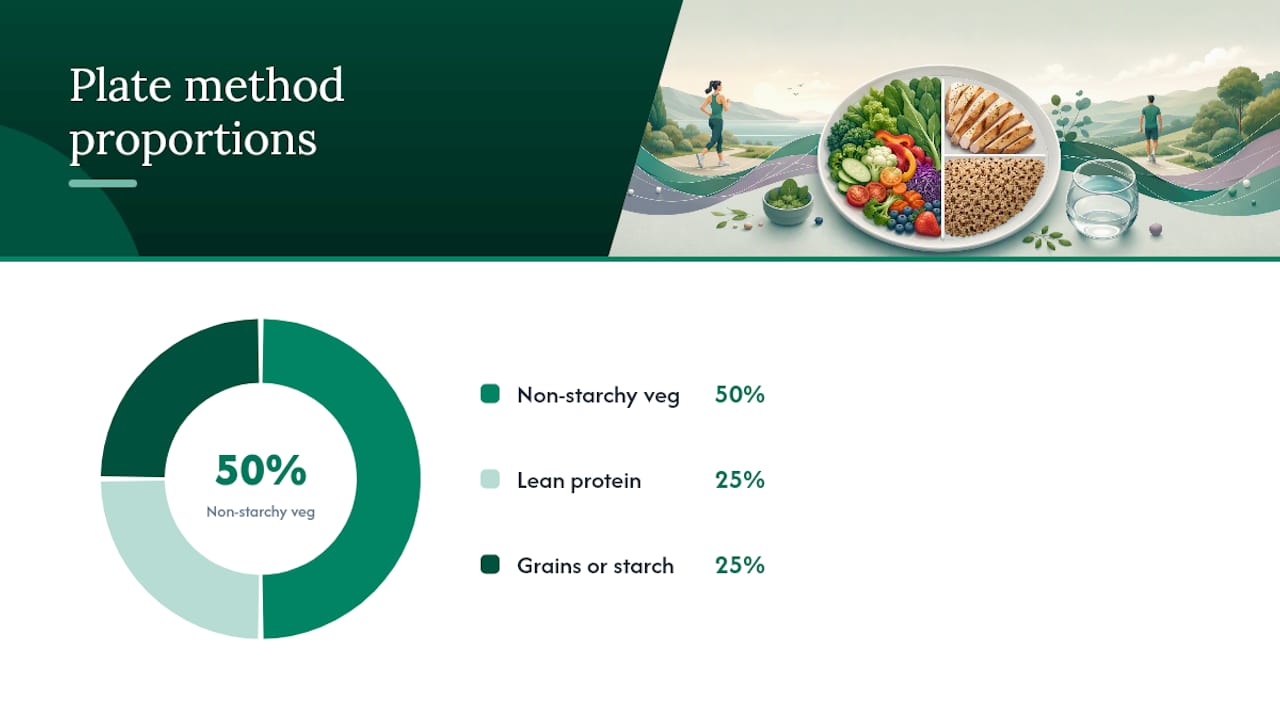
Shift your plate composition: half vegetables and fruit, one quarter lean protein, one quarter whole grains.
Add one new habit per week (meal prepping Sunday lunches, swapping sugary drinks for water, adding a daily 10-minute walk after dinner).
Track weight once per week, same day and time, and record body measurements monthly.
Increase resistance training to three sessions per week by week four.
Review your food log weekly to spot patterns — late-night snacking, skipped meals — and adjust one variable at a time.
Months 2–6: steady progress and troubleshooting
Recalculate your TDEE every four to six weeks as your weight changes, since a lighter body burns fewer calories at rest.
If the scale has not moved in two to four weeks, apply the plateau protocol below before cutting more calories.
Gradually increase aerobic activity toward 150–300 minutes per week of moderate-intensity exercise.
Begin planning your maintenance transition by month five: raise calories by 100–150 per week until you reach a stable weight.
Calorie estimate example:
These are estimates. Individual TDEE varies with age, sex, muscle mass, and activity level. Use a validated calculator as your starting point, then adjust based on four weeks of real-world data.
Pro Tip: Distribute protein across at least three meals rather than concentrating it at dinner. Research consistently shows that muscle protein synthesis responds better to spread intake, which matters most when you are in a calorie deficit and trying to preserve lean mass.
When a plateau hits, Harvard Health guidance supports recalculating energy needs rather than slashing calories further. Test one change at a time over a two-week window: add 20 minutes of aerobic activity, reduce refined carbohydrates by one serving, or tighten portion accuracy. Plateaus are a biological certainty as weight falls — plan for them rather than treating them as failure.
What to eat: practical food strategies and sample daily menus
Prioritizing whole, minimally processed foods, adequate protein, and fiber-rich vegetables keeps calories manageable while keeping hunger in check. The goal is not perfection; it is a pattern you can maintain for months without feeling deprived.
Core food rules:
Protein target: aim for 25–35 grams per meal from sources like eggs, Greek yogurt, chicken breast, canned salmon, cottage cheese, or legumes. Adequate protein preserves muscle during a deficit and reduces between-meal hunger.
Plate method: fill half your plate with non-starchy vegetables (broccoli, spinach, zucchini, peppers), one quarter with lean protein, one quarter with whole grains or starchy vegetables.
Snack strategy: choose snacks that combine protein and fiber — apple with almond butter, hummus with carrots, or a small handful of nuts with a piece of fruit. Avoid snacks that are carbohydrate-only.
Flexibility rule: plan one to two “flex meals” per week where you eat a favorite food without logging. This reduces the psychological cost of restriction and improves long-term adherence.
For practical portion control techniques that make these rules easier to apply at home, the key is measuring portions for the first two to four weeks until visual estimation becomes reliable.
Sample daily menus:
Meal | Lower-calorie day | Moderate-calorie day |
Breakfast | 2 scrambled eggs + 1 cup spinach + 1 slice whole-grain toast | Greek yogurt (1 cup) + ½ cup berries + 2 tbsp granola + 1 boiled egg |
Lunch | Large salad: 4 oz grilled chicken, mixed greens, cucumber, tomato, 1 tbsp olive oil dressing | Turkey and avocado wrap (whole-grain tortilla, 4 oz turkey, ¼ avocado, lettuce, tomato) |
Snack | 1 apple + 1 tbsp almond butter | ¼ cup hummus + 1 cup raw vegetables + 1 oz whole-grain crackers |
Dinner | 5 oz baked salmon + 1 cup roasted broccoli + ½ cup brown rice | 5 oz grilled chicken thigh + 1 cup roasted sweet potato + large side salad |
Evening | Herbal tea | ½ cup cottage cheese + sliced cucumber |
Meal prep priorities: cook a large batch of grains (brown rice, quinoa) and proteins (roasted chicken, hard-boiled eggs) on Sunday. Pre-wash and chop vegetables so assembly takes under 10 minutes on weeknights. For a broader list of foods that support sustainable fat loss, whole food swaps make the biggest difference in calorie density without sacrificing volume.
How exercise helps you preserve muscle and lose fat safely
Resistance training combined with regular aerobic activity is the most effective way to protect muscle mass and metabolic rate during weight loss. Cutting calories alone causes the body to break down both fat and muscle for energy; adding strength work signals the body to preserve lean tissue.

Weekly activity targets:
A simple strength session for busy schedules requires no gym membership:
Goblet squat: 3 sets of 10–12 reps
Push-up (or incline push-up): 3 sets of 8–12 reps
Dumbbell Romanian deadlift: 3 sets of 10 reps
Pair this with two to three 30-minute brisk walks or bike rides per week, and you meet the active weight-loss target without a complicated schedule. As fitness improves, add a fourth aerobic session or increase walk duration before adding more strength volume.
Pro Tip: Schedule resistance sessions on days when your energy is highest, typically not the evening after a long workday. Protecting sleep quality matters as much as the workout itself — poor sleep raises cortisol, which accelerates muscle breakdown during a deficit.
How to track progress and handle plateaus without panic
Consistent, simple tracking paired with planned adjustments beats frequent guesswork. The goal of monitoring is not to obsess over daily fluctuations but to collect enough data over two to four weeks to make confident, evidence-based decisions.
What to track and how often:
Body weight: once per week, same morning, after using the bathroom, before eating. Record in a spreadsheet or app.
Body measurements: waist, hips, and one arm circumference, measured monthly. The scale sometimes stalls while inches continue to drop.
Strength and performance: log weights lifted and reps completed each session. Strength gains during a deficit confirm muscle preservation.
Food log: daily, at minimum for the first 12 weeks. Accuracy matters more than speed — weigh portions when possible.
Sleep and stress: note sleep hours and subjective stress level (1–10 scale) weekly. Both directly affect cortisol, hunger hormones, and recovery.
When the scale does not move for two to four weeks, plateaus reflect reduced energy requirements as weight falls, not a broken plan. The correct response is measured recalculation, not panic restriction.
Pro Tip: Before changing anything, audit your food log for “calorie creep” — cooking oils, condiments, and beverage calories that are easy to undercount. Many plateaus resolve when logging accuracy improves, without any need to cut food further.
Safety, GLP-1 medications, and when to see a clinician
Most people begin with lifestyle changes alone; medications are a clinical option that requires medical oversight and does not replace sustainable habits.
When to consult a clinician before starting:
You have a history of heart disease, diabetes, kidney disease, or an eating disorder.
You are pregnant or breastfeeding.
You take medications that interact with significant dietary changes (blood thinners, diabetes medications, thyroid drugs).
You experience unexplained rapid weight loss, chest pain, or severe fatigue during the program.
GLP-1 medications in the U.S. context: Semaglutide (marketed as Ozempic for type 2 diabetes and Wegovy for chronic weight management) belongs to the GLP-1 receptor agonist class. These medications reduce appetite and slow gastric emptying, producing meaningful weight loss in clinical trials. They are FDA-approved for specific indications and require a prescription from a licensed clinician. Research into the broader GLP-1 peptide class continues to expand understanding of how these compounds affect metabolic pathways. Medication alone, however, does not build the eating habits and activity patterns needed to maintain results if the medication is discontinued. Nutrition coaching during a GLP-1 treatment period specifically addresses protein adequacy, meal structure, and resistance training to protect muscle mass.
Coaching and clinical care are complementary, not competing. A nutrition coach helps with meal planning, accountability, and habit formation; a physician or registered dietitian manages medical monitoring, dosing, and lab work. If you are considering GLP-1 therapy, discuss it with your prescribing clinician and consider adding structured nutrition support alongside it.
This article provides general health information, not medical advice. Consult a qualified healthcare provider before making significant changes to your diet, activity level, or medication regimen.
How to keep weight off once you reach your goal
Maintenance requires a different mindset than the loss phase. Strict short-term restriction gives way to flexible, consistent habits and higher activity levels. Evidence from NCBI shows that programs combining behavioral modification, diet, exercise, and ongoing monitoring are associated with longer-term success — and that increased physical activity becomes the dominant factor in preventing regain.
Practical maintenance targets:
Raise daily calories by 100–150 per week until weight stabilizes, then hold that intake.
Aim for approximately 300 minutes per week of moderate-intensity activity to prevent regain.
Continue resistance training two to three times per week to preserve muscle and metabolic rate.
Weigh yourself weekly or at minimum monthly. A 3–5 pound upward drift is the signal to tighten habits before it compounds.
Keep a “maintenance meal pattern” — two to three anchor meals per day that are reliably nutritious and easy to prepare, so busy weeks do not derail the baseline.
Behavioral supports that matter most:
Social accountability: a coach, a workout partner, or a check-in group sustains motivation beyond the initial goal-achievement high.
Environmental controls: keep high-satiety foods visible and accessible; reduce the friction of healthy choices at home.
Planned flexibility: budget for social meals, travel, and celebrations without abandoning the pattern entirely.
Pro Tip: After a holiday, vacation, or setback, use a structured two-week re-entry plan rather than trying to “make up” for lost time. Return to your loss-phase calorie target and three resistance sessions per week for 14 days, then reassess. This prevents the overreaction cycle — extreme restriction after a setback — that causes more harm than the setback itself.
For a deeper look at why maintenance deserves as much attention as the loss phase, the behavioral science is clear: maintenance is not passive; it requires active, ongoing effort.
A 12-week habit-based program: the Coachjillbyrne approach
The 12-week arc moves through four phases: foundation (weeks 1–3), build (weeks 4–6), intensify (weeks 7–9), and maintenance transition (weeks 10–12). Each phase adds one layer of complexity so habits compound rather than overwhelm.
Weeks 1–3 (Foundation): Establish baseline calories, begin food logging, add two resistance sessions and two walks per week, set a sleep target, and identify two to three high-impact food swaps.
Weeks 4–6 (Build): Increase resistance training to three sessions per week, introduce meal prepping for three to four lunches per week, refine protein distribution across meals, and conduct a four-week progress check (weight, measurements, strength log).
Weeks 7–9 (Intensify): Add a third aerobic session, tighten food log accuracy, introduce one new vegetable or protein source per week to prevent menu fatigue, and address any plateau using the two-week adjustment protocol.
Weeks 10–12 (Maintenance Transition): Gradually increase daily calories toward maintenance, shift the mindset from “losing” to “sustaining,” establish a weekly weigh-in habit, and build a social accountability structure for the months ahead.
Tracking checkpoints within the program:
End of week 3: review food log patterns and confirm calorie target accuracy.
End of week 6: measure body composition changes, adjust calorie target if weight loss has stalled or accelerated beyond 2 lb/week.
End of week 9: assess strength progress and aerobic capacity; confirm protein targets are being met.
End of week 12: set a six-month maintenance goal with specific activity and monitoring commitments.
Anonymized client illustration: A client in her mid-40s began the program at a sedentary activity level with a history of yo-yo dieting. In weeks 1–3, the primary intervention was food logging and eliminating liquid calories, which alone created a meaningful deficit without changing solid food choices. By week six, she had added three resistance sessions per week and was meal prepping four lunches. At the 12-week mark, she had lost consistent weight within the 0.5–2 lb/week range, reported improved energy levels, and had not experienced the hunger spikes that characterized her previous dieting attempts. The key lesson: starting with one or two high-leverage changes rather than overhauling everything at once produced better adherence and more consistent results.
Coachjillbyrne’s coaching touchpoints within this program include weekly accountability check-ins, personalized meal plan adjustments, and direct support during plateau periods — the moments when most self-guided attempts stall.
What most weight loss advice gets wrong
The conventional framing of weight loss as a willpower problem is the single biggest obstacle most people face. Public health guidance from the CDC, NIDDK, and Mayo Clinic is clear and consistent: the mechanism is a calorie deficit, the vehicle is lifestyle change, and the timeline is months to years, not weeks. Yet the dominant cultural narrative still treats a 30-day program as a reasonable unit of measurement for a problem that took years to develop.
What the research actually supports, and what gets underemphasized in popular advice, is that the maintenance phase is harder than the loss phase for most people. Losing weight is a finite project with a visible finish line. Keeping it off is an indefinite commitment to a higher activity level and a different relationship with food. Programs that do not explicitly prepare clients for this transition set them up for regain, regardless of how well the loss phase went.
The other underrated factor is resistance training. Aerobic exercise gets the attention because it burns more calories per session and is easier to quantify. But strength training is what protects the metabolic rate during a deficit, and it is what makes maintenance sustainable at a higher calorie intake. A person who loses weight while preserving muscle can maintain that weight eating more food than someone who lost the same amount through restriction alone. That difference compounds over years.
Flexibility in the eating pattern matters more than most structured plans acknowledge. Rigid elimination diets produce faster short-term results and dramatically higher long-term failure rates. A plan that includes occasional indulgences by design, rather than treating them as failures, is not a compromise. It is a more accurate model of how human behavior actually works.
Personalized coaching that puts this plan into practice
Most people already know the basics of healthy eating. What they need is a structure that holds them accountable, adjusts when life gets complicated, and fills the gap between general guidance and their specific situation.

Coachjillbyrne offers exactly that: personalized nutrition coaching built around the same evidence-based principles this guide covers, delivered through one-on-one accountability sessions, customized meal planning, and ongoing support for clients navigating GLP-1 medication periods. The difference between reading a plan and following one consistently is structured support — someone who reviews your food log, recalculates your targets when the scale stalls, and helps you build the maintenance habits that prevent regain. Clients who want to reduce long-term health costs through sustained weight management also find that proactive lifestyle changes compound over time in ways that extend well beyond the scale. To get started with a coaching program tailored to your goals, visit Coachjillbyrne and book your first session.
This article is general information, not a substitute for advice from a qualified doctor. Consult a qualified healthcare professional about your own circumstances before acting on anything here.
Sources
The evidence base for this guide draws on the following primary sources. Each is worth bookmarking for deeper reading on specific topics.
FAQ
What is the most sustainable way to lose weight?
The most sustainable approach combines a modest calorie deficit (roughly 500 calories per day below maintenance), regular resistance training to preserve muscle, and consistent behavioral habits like food logging and weekly weigh-ins. The CDC and Mayo Clinic both recommend targeting 1–2 pounds per week as the pace most likely to produce lasting results.
What is the 3-3-3 rule for weight loss?
The “3-3-3 rule” is not a standardized clinical framework with a single canonical definition. Common versions describe eating three meals per day, including three food groups per meal, and allowing three planned indulgences per week — a structure designed to reduce restriction-driven overeating. The underlying principle aligns with evidence-based guidance on meal regularity and dietary flexibility.
How long does it realistically take to lose 10 pounds?
At the evidence-based rate of 1–2 pounds per week, losing 10 pounds takes approximately 5–10 weeks. Individuals with a larger starting deficit or higher activity level may reach that mark closer to five weeks; those with a more modest deficit or lower starting weight may take closer to ten. Expecting faster results typically requires calorie restriction aggressive enough to compromise muscle mass and long-term adherence.
How can I support weight loss without medication?
Consistent food logging, adequate protein intake (25–35 grams per meal), resistance training two to three times per week, 7–9 hours of sleep, and stress management collectively address the same appetite and metabolic pathways that GLP-1 medications target pharmacologically. These lifestyle factors are the foundation recommended by NIDDK for all adults, with or without medication support.
When should I consider GLP-1 medications like semaglutide?
GLP-1 medications such as semaglutide (Wegovy, Ozempic) are FDA-approved clinical options for adults with obesity or weight-related health conditions, prescribed and monitored by a licensed clinician. They are not a replacement for sustainable habits; nutrition coaching during GLP-1 treatment specifically addresses protein adequacy and resistance training to protect muscle mass while the medication reduces appetite.
Recommended
Comments