
Weight Loss Accountability Coach: Your Hiring Guide

A weight loss accountability coach is a trained professional who keeps you consistent with behavior-based nutrition and habit changes through structured check-ins, goal-setting, and proactive feedback. This role is distinct from a registered dietitian (who diagnoses and prescribes medical nutrition therapy) and a personal trainer (who programs physical exercise). The accountability coach’s job is behavioral: closing the gap between what you know you should do and what you actually do each day.
Who benefits most: People who have the nutritional knowledge but struggle to act on it consistently, those who have tried self-directed programs without lasting results, and anyone managing weight loss alongside GLP-1 medication who needs structured nutritional guidance.
Quick next steps:
Book a no-pressure discovery call with Coachjillbyrne to assess fit before committing to a package.
Ask about a short paid trial period so you can evaluate the coaching relationship firsthand.
Prepare two or three specific goals and your current eating patterns before the call.
Review sustainable weight loss principles so you arrive with realistic expectations.
Table of Contents
What does a weight loss accountability coach actually do?
The core work of an accountability coach centers on consistency, not content. A coach checks in with you regularly, reviews your progress, identifies barriers, and helps you adjust behavior before a rough week becomes a lost month. Research confirms that combining social and professional support with structured planning and follow-up produces stronger adherence than self-directed approaches alone.

Common accountability methods include daily text or photo check-ins, scheduled weigh-in reviews, habit trackers, meal-photo proof, and behavior micro-goals set at the start of each week. The distinction between a coach and an accountability partner is meaningful: a partner offers mutual encouragement, while a trained coach uses structured frameworks to identify obstacles, create action plans, and deliver specific next steps.
How the role compares to other weight-loss professionals
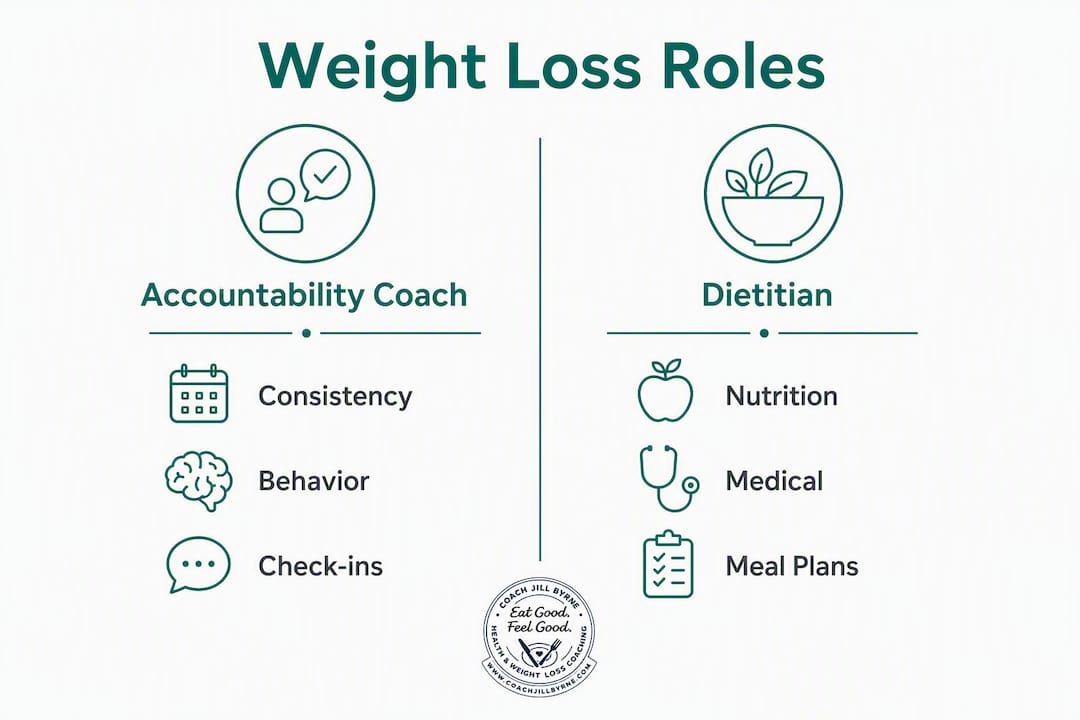
Dimension | Accountability Coach | Registered Dietitian | Personal Trainer |
Primary focus | Behavioral consistency and habit change | Medical nutrition therapy and clinical assessment | Exercise programming and physical performance |
Typical background | Coaching certification, nutrition training | RD credential (licensed, clinical) | CPT certification, exercise science |
Main methods | Check-ins, goal-setting, habit tracking, feedback loops | Meal plans, lab interpretation, medical diet protocols | Workout design, form correction, fitness testing |
Best for | People who know what to do but don’t do it consistently | Clinical conditions, eating disorders, complex medical needs | Fitness goals, strength, athletic performance |
Many clients work with more than one professional. A coach who coordinates with your physician or dietitian when needed adds a layer of safety and coherence that single-provider programs often lack.
How does accountability coaching work week to week?
The mechanics vary by program, but most structured coaching operates through a combination of asynchronous check-ins (texts, photos, app logs) and synchronous sessions (weekly or biweekly calls). Daily structured accountability exchanges — not passive tracking — are what controlled trials show improve adherence and weight outcomes. Logging data without receiving actionable feedback is largely ineffective; the feedback loop is the mechanism.
Common program modalities:
Daily text or photo check-ins with coach response and specific feedback
Meal-photo review with portion and composition guidance
App-based food logging integrated with coach review
Habit and behavior micro-goals reviewed at the start of each week
Scheduled coaching calls (weekly or biweekly) for deeper problem-solving
GLP-1 medication nutrition support for clients on weight-loss medications
Check-in frequency and what each level realistically delivers:
Frequency | Format | Best for |
Daily | Text, photo, or app log + coach reply | Clients building new habits or in early program phases |
3× per week | Alternating text and call | Clients with established routines needing moderate support |
Weekly | Single coaching call + self-tracking | Clients in maintenance or with strong self-regulation |
Pro Tip: When evaluating a program, ask specifically how the coach responds to your check-ins. A program that collects data without delivering specific, behavior-adjusting feedback is closer to passive monitoring than true accountability coaching.
What does the research say about accountability and weight loss?
The evidence is direct. A 12-week randomized controlled trial found that adding structured daily accountability to calorie tracking produced a mean weight loss of 5.4 kg, compared with substantially lower results in the standard tracking group. Adherence in the accountability arm reached 84%, versus 41% in the control group. Critically, accountability interaction frequency explained 38% of the variance in weight-loss outcomes (ΔR²=0.38), making it the single largest predictor in the model.
A comprehensive literature review of accountability frameworks in medical weight-loss programs reinforced this finding: interventions that combined social support, professional coaching, and structured follow-up consistently outperformed self-directed approaches on both adherence and outcomes. Multi-component programs, those pairing interpersonal accountability with planning and feedback, delivered the strongest long-term results.
What this means for choosing a program:
Prioritize daily or high-frequency structured check-ins over weekly-only contact.
Confirm that the coach delivers specific behavioral feedback, not just data acknowledgment.
Look for programs that reduce friction in logging (photo proof, conversational check-ins) since lower-friction tracking sustains adherence longer than manual entry alone.
Ask whether the program has published or documented adherence rates.
Why most weight loss programs fail often comes down to the absence of exactly these features: structured follow-up and proactive feedback.
What does accountability coaching cost, and how long until you see results?
ZipRecruiter data shows accountability coaches earn between $30,000 and $75,000 annually, which reflects the range of pricing clients encounter in the market. Pricing structures vary considerably.
Typical U.S. pricing tiers:
Entry-level or newer coaches: $100–$200 per month for weekly check-ins and basic habit tracking.
Experienced coaches with structured programs: $250–$500 per month for daily accountability, meal review, and biweekly calls.
Premium or specialized packages: $500–$1,000+ per month for daily high-touch support, GLP-1 nutrition guidance, and full meal planning integration.
Per-session pricing typically runs $75–$150 for a single coaching call, though most coaches structure their services as monthly packages because consistency is the product.
Realistic timelines:
30 days: Behavior change is the primary marker. Clients typically establish a check-in routine, identify two or three key habit gaps, and see early improvements in meal consistency and food awareness.
90 days: Measurable adherence patterns emerge. Most clients report more consistent meal prep, reduced impulsive eating, and modest, steady weight trends. Realistic weight-loss rates at this stage average 0.5–1 pound per week for most adults.
180 days: Habit automaticity becomes visible. Clients who maintained high check-in adherence typically show meaningful weight trends alongside improved energy, sleep, and behavioral consistency.
How do you find and hire the right weight loss coach?
Start with a structured search rather than a Google impulse. Professional directories, referrals from your physician or dietitian, and the publisher’s own page at Coachjillbyrne are reliable starting points. Online communities (Reddit’s r/loseit, MyFitnessPal forums) can surface real client experiences, though vetting still falls on you.
Hiring checklist: step by step
Run a discovery call (20–30 minutes). Ask about check-in methods, response time, communication cadence, and how they handle setbacks.
Request a short paid trial (two to four weeks) before committing to a full package. Any reputable coach will offer this or a clear refund policy.
Set measurable goals in writing at the start: specific behavior targets, not just a weight number.
Confirm a 30-day review is built into the program so you can assess progress against those goals.
Clarify cancellation and refund terms before signing anything.
Interview questions to ask on the discovery call:
How do you structure your check-ins, and how quickly do you respond?
Can you walk me through how a typical client’s first 30 days looks?
How do you handle a client who misses check-ins or has a difficult week?
Do you coordinate with physicians or dietitians when a client’s needs go beyond nutrition coaching?
What credentials or training do you hold, and can you share client outcome examples?
Red flags to watch for:
No clear pricing or refusal to discuss cost before booking.
Rigid dietary dogma (insisting on one specific diet for every client).
No structure for the first 30 days or vague program descriptions.
Unwillingness to coordinate with medical professionals when appropriate.
Promises of specific weight-loss amounts or timelines.
Credentials matter, but demonstrable client outcomes and a clear, structured program matter more. A certified coach with no documented client results is a weaker choice than an experienced coach with transparent case examples and a defined check-in system. Reviewing common weight loss mistakes before your discovery call helps you ask sharper questions.
What should you expect in the first 30 and 90 days?
The first week is onboarding: establishing your baseline habits, identifying your two or three highest-leverage behavior gaps, and setting up the check-in system. Most coaches assign a habit audit in week one, covering meal timing, portion awareness, hydration, and sleep. Daily check-ins begin immediately so the routine is established before motivation naturally dips.
30-day markers to track:
Check-in adherence rate (are you completing daily or scheduled check-ins consistently?)
Meal prep frequency compared to week one
Reduction in reactive or impulsive eating episodes
Energy and sleep quality, noted weekly
By day 90, the focus shifts from building habits to sustaining them. Clients who maintained high check-in adherence through the first month typically show measurable behavioral consistency: more structured meals, fewer skipped tracking days, and a clearer sense of which situations trigger off-plan eating. Weight trends at 90 days are meaningful but secondary to these behavioral markers.
Success metrics beyond the scale:
Body measurements (waist, hips, arms) tracked monthly
Clothing fit as a practical, non-scale indicator
Energy levels and afternoon fatigue reduction
Sleep quality and duration
Behavioral consistency score (percentage of planned meals followed through)
Setbacks are expected. A well-structured coach responds to a difficult week with a specific corrective action, not generic encouragement. That might mean adjusting a meal-prep strategy, simplifying a check-in format, or identifying a situational trigger and building a response plan around it. Dieting together with a partner or group can reinforce accountability during these periods.
How Coachjillbyrne delivers habit-based nutrition accountability
Coachjillbyrne offers personalized nutrition coaching built around the same evidence base this article covers: structured accountability, habit-based planning, and sustainable behavior change rather than restrictive dieting.
Core service features:
Personalized nutrition plans built around real food and practical eating habits
Portion control training and meal planning guidance
Daily or weekly accountability options with direct coach communication
GLP-1 medication nutrition support for clients on weight-loss medications
Clean eating strategies adapted to everyday schedules, not idealized conditions
The program is designed for clients who want to build maintainable habits, not follow a temporary protocol. Coachjillbyrne integrates with medical providers when appropriate, making it a practical fit for clients managing weight loss alongside physician-directed care.
Pro Tip: Before your first session, write down your three most consistent eating patterns, both the ones that serve your goals and the ones that don’t. Coaches can build a more targeted plan when they start with your actual baseline rather than a generic assessment.
Client outcomes reported through the program include meaningful weight loss alongside improvements in energy, cooking habits, and long-term food relationship. For clients starting weight loss without restrictive dieting, the habit-first approach Coachjillbyrne uses is a practical entry point.
Key Takeaways
Accountability coaching works because structured, frequent check-ins with actionable feedback are the single largest predictor of weight-loss adherence, explaining 38% of outcome variance in controlled trials.
Point | Details |
Who benefits most | People who know what to do but struggle with consistent follow-through benefit most from accountability coaching. |
Frequency drives results | Daily or high-frequency check-ins with specific behavioral feedback outperform weekly-only contact in controlled trials. |
Realistic cost range | Experienced U.S. coaches typically charge $250–$500 per month for structured daily accountability programs. |
Timeline expectations | Behavior change is the 30-day marker; programs with structured daily accountability have shown an average of 5.4 kg weight loss by 90 days in published trials, with habit automaticity and maintenance emerging by 180 days. |
Coachjillbyrne | Offers habit-based nutrition accountability, GLP-1 support, and daily check-in options designed for sustainable, nonrestrictive weight loss. |
Why accountability is the ingredient most weight-loss plans skip
Most people who struggle with weight loss are not missing information. They know vegetables matter. They know portion sizes count. What they are missing is a reliable system that converts that knowledge into consistent daily behavior, especially on the days when motivation is low and life is busy.
The conventional approach to this problem is willpower. Try harder, want it more, find your “why.” The research tells a different story. Structured accountability, the kind that includes regular check-ins, specific feedback, and a coach who responds to setbacks with a plan rather than a pep talk, changes the behavioral equation in a measurable way. The 38% variance explained by interaction frequency in controlled trials is not a small effect. It is the kind of number that should shift how you think about what a weight-loss program actually needs to include.
What I find most underestimated is the role of friction reduction. Clients who can send a photo of their meal instead of logging every macro are more likely to stay consistent for months, not weeks. The format of accountability matters almost as much as the frequency. A program that demands perfect logging from day one often loses clients by week three. A program that meets people where they are, with simple daily touchpoints and specific, kind feedback, builds the kind of consistency that actually produces long-term results. That is the design principle behind the coaching approach at Coachjillbyrne.
Ready to work with a nutrition accountability coach?
Coachjillbyrne offers a structured, habit-based alternative to generic weight-loss programs: personalized nutrition coaching with real daily accountability, no rigid diet rules, and direct coach communication built into every package. For clients managing weight loss alongside GLP-1 medications, the program includes specialized nutritional guidance designed to support medication-assisted care.

A discovery call takes 20–30 minutes. You will discuss your current eating patterns, your consistency challenges, and whether the program structure fits your schedule and goals. There is no obligation to book a full package after the call. Pricing is discussed transparently on the call, and short trial options are available for clients who want to evaluate the coaching relationship before committing.
To book your discovery call, visit Coachjillbyrne and use the contact or booking form. Come prepared with your top two or three goals and a realistic picture of your current habits. Results vary by individual; this program is not a substitute for medical care, and clients with clinical conditions should continue working with their physician or registered dietitian alongside coaching.
Useful sources and further reading
The claims in this article draw from peer-reviewed research and professional resources. The following are the most directly relevant:
Accountability frameworks in medical weight-loss programs: a comprehensive literature review — A PMC-indexed review synthesizing evidence on how social support, professional coaching, and structured follow-up improve adherence in weight-loss programs.
The role of accountability in weight loss | NutritionFacts — Covers the evidence on frequent self-weighing combined with tailored feedback and how structured programs outperform minimal-contact approaches.
FAQ
What does an accountability coach do?
An accountability coach provides structured check-ins, goal-setting, behavior-change planning, and proactive feedback to help clients follow through on their intentions consistently. Unlike a peer accountability partner, a trained coach uses evidence-based frameworks to identify barriers and deliver specific next steps.
How much does a weight loss coach cost?
Experienced U.S. accountability coaches typically charge $250–$500 per month for structured daily programs; entry-level coaches may start around $100–$200 per month, and premium specialized packages can exceed $500 per month. Per-session rates generally run $75–$150.
What is the 3-3-3 rule to lose weight?
The “3-3-3 rule” is not a standardized clinical framework; definitions vary across sources. If a coach or program references it, ask them to explain exactly what it means in their context and how it maps to your specific goals before adopting it.
How do I choose the right weight loss accountability coach?
Start with a discovery call, ask about check-in frequency and how the coach responds to setbacks, request a short paid trial, and confirm the program includes a structured 30-day review. Transparent pricing and willingness to coordinate with medical professionals are strong positive signals. Coachjillbyrne offers discovery calls specifically designed to assess fit before any package commitment.
Recommended
Comments