
Weight Loss Coach Cost: U.S. Price Ranges by Program

Expect to pay roughly $20 to $1,000 or more per month for weight loss coaching in the United States, depending on whether you choose an app, a group program, or one-on-one guidance. Most people land in the $150 to $500 monthly range for individual coaching, while automated apps run under $80 and clinician-led programs with lab work push past $800. Your best fit depends on how much personal accountability and medical oversight you actually need.
TL;DR:
Most people pay between $150 and $500 per month for personalized weight loss coaching, depending on the level of human attention and medical oversight needed.
Group coaching and automated apps generally cost less than $80 per month, but they offer less individual feedback and accountability.
In-person or clinician-led programs often exceed $800 per month due to overhead and medical services, making them suitable for complex medical needs.
Payment plans for three to six months typically range from $180 to over $3,600, with higher-end packages usually including lab work and medical supervision.
Matching your support level to your medical complexity and accountability needs provides better value than simply choosing the cheapest or most expensive option.
Table of Contents
How Much Does A Weight Loss Coach Cost Per Session Or Month?
Pricing splits along two lines: how the service is delivered and how much human attention it includes. Session-based and hourly pricing still exist for coaches who work outside subscription models, but most of the market has shifted toward monthly packages.
For one-on-one work, hourly coaching rates commonly run $50 to $250, with health coaches specifically charging $86 to $363 per session depending on credentials and location. In-person nutrition consults tend to run $100 to $250 for an initial visit and $75 to $165 for follow-ups, while telehealth versions of the same service usually price lower because the coach isn’t renting office space or blocking a full hour of drive time.
Monthly packages are where most clients actually spend their money:
Online subscription coaching: $99 to $200 per month for structured nutrition guidance with periodic check-ins
Standard 1:1 online coaching: $200 to $800 per month, scaling with call frequency and messaging access
Group coaching programs: Often 40 to 60% cheaper per person than solo coaching, since the coach’s time is shared
High-touch or clinician-led coaching: $1,500 to $5,000 for multi-month packages, frequently billed in three-month blocks
Total program costs tend to follow predictable math. A three-month commitment at $200/month totals $600. The same length at a premium $800/month tier runs $2,400. Health coach packages that bundle multiple months upfront commonly fall in the $1,500 to $5,000 range total, not per month, which is a distinction that trips up a lot of first-time buyers comparing quotes.
Pro Tip: When a coach quotes you a package price, always ask them to break it down into a monthly equivalent. A $3,000 “transformation package” sounds steep until you realize it’s a six-month program at $500/month with weekly calls included.
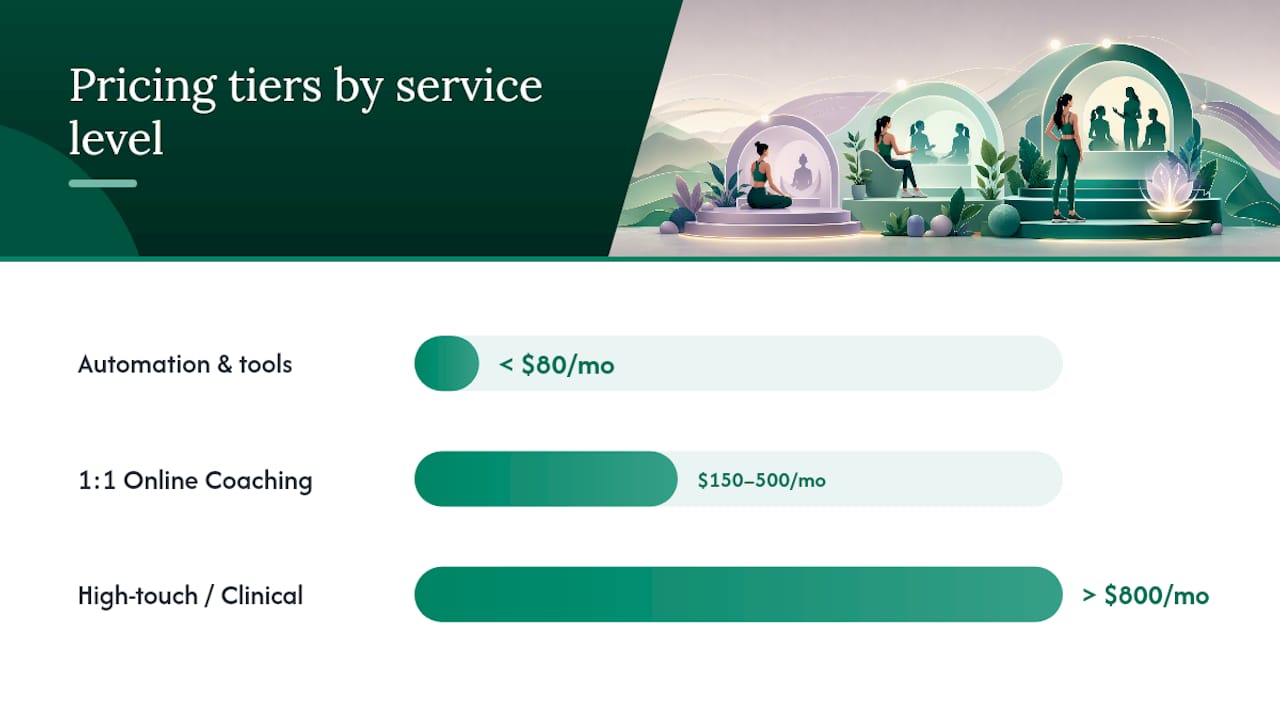
The honest takeaway: budget under $80/month buys automation, $150 to $500/month buys a real coaching relationship, and anything above $800/month should come with medical-grade services attached, not just more frequent check-ins.
Does Online Or In-Person Coaching Cost More?
Delivery model changes the math more than almost any other factor. Here’s how the four common formats stack up.
Apps and automated subscriptions run under $80/month in most cases, including well-known platforms that advertise around $70/month with yearly plans lowering the effective rate further. You get algorithm-driven meal logging and generic feedback, not a human reviewing your specific week.
Group coaching offers a lower per-person cost with less individual attention, since the coach splits their time across everyone on the call. It works well for people motivated by shared accountability rather than one-on-one problem-solving. Group-based programs tend to outperform solo willpower for exactly this reason.
1:1 virtual coaching is the market’s center of gravity, typically $150 to $800/month. “Unlimited messaging” means you can text your coach between sessions and expect a response within a day; “scheduled calls only” means your contact is limited to booked appointments, usually weekly or biweekly.
In-person or clinician-led programs cost the most because you’re paying for overhead, a licensed credential, and often lab coordination. Registered dietitians and clinical programs commonly justify medical-grade pricing when biomarkers or medication management are part of the plan.
Online coaching formats generally cost less than in-person equivalents while delivering comparable results for people without complex medical needs.
Why Do Coaches Charge Such Different Prices?
Two coaches offering what looks like the same service on paper can charge wildly different rates, and credentials are usually the first reason why. A Registered Dietitian (RD) has completed a supervised clinical internship and passed a national exam, which typically commands higher fees than a certified health coach who completed a shorter certification program. Neither credential guarantees better results for every client, but RDs are the only ones licensed to manage certain medical conditions directly.
Specialization moves price too. Coaches who focus on metabolic health, diabetes management, or GLP-1 medication support (helping clients manage nutrition alongside drugs like semaglutide) often charge more because the work requires tracking side effects, appetite changes, and nutrient gaps that generic weight loss coaching doesn’t touch.
Other factors that shift the number on your invoice:
Contact frequency — weekly calls cost more than monthly check-ins, obviously, but the jump is often 2 to 3 times the price, not incremental.
Program intensity — daily messaging access costs more than a once-a-week email summary.
Add-on services — custom meal plans, lab coordination, and biometric tracking (body composition scans, continuous glucose monitors) each add to the base price.
Geography — coaches in major metro areas with higher costs of living tend to price above national averages, even for virtual sessions.
Pro Tip: Ask exactly what “personalized” means before paying a premium for it. Some coaches build a meal plan once and adjust minimally; others rebuild your plan every two weeks based on your actual check-in data. The second version is worth more, but you have to ask.
What Do You Actually Get At Each Price Tier?
Marketing language tends to blur together across price points, so matching services to dollars matters more than reading feature lists.
At the budget tier (under $100/month), expect an initial intake questionnaire, a generic or lightly customized meal plan, and limited check-ins, often just monthly or through an app interface with no live human contact.
The mid tier ($200 to $500/month) is where most buyers should focus. This range commonly includes regular video check-ins, ongoing messaging access, and meal plans genuinely built around your preferences and schedule rather than a template. Multiple pricing guides identify this bracket as the sweet spot for balancing live support with personalized planning.

The premium tier ($800/month and up) typically adds frequent live contact (weekly or more), lab coordination if you’re working with bloodwork, direct clinician oversight, and coaching built specifically around your medical history rather than general goals.
Before paying for any tier, confirm these details:
Exact number of live contacts per month
Response time guarantee for messaging
Whether meal plans are truly individualized or template-based
Whether the price includes lab work or biometric tracking, or bills those separately
What Do 3-Month And 6-Month Coaching Costs Look Like?
Turning a monthly rate into a real budget requires thinking in blocks, since most meaningful change takes longer than a few weeks to show up.
Budget-conscious path: An app or group coaching program at $60 to $100/month totals $180 to $300 over three months and $360 to $600 over six. Realistic for self-motivated people who mainly need structure and tracking rather than accountability.
Value-seeking path: Standard 1:1 online coaching at $300/month totals $900 over three months and $1,800 over six, landing squarely in the market’s most common one-on-one range.
Clinical or high-touch path: Clinician-led coaching with labs at $800 to $1,200/month totals $2,400 to $3,600 over three months, consistent with package pricing up to $5,000 for longer, more intensive programs.
A useful comparison metric: divide your total cost by expected live contact hours. A $900 three-month package with 12 video calls costs $75 per contact hour. That framing exposes weak offers faster than comparing sticker prices alone.
How Do You Choose The Right Coach For Your Budget?
Picking a coach comes down to matching your medical complexity and accountability needs to what a price tier actually delivers, not just finding the cheapest option available.
Weigh these criteria before signing anything:
Credentials matched to your needs — a certified health coach is fine for general habit change; an RD or clinician matters if you have diabetes, take GLP-1 medication, or manage another condition.
Measurable outcomes — ask what data the coach tracks (weight, measurements, energy, labs) and how often you’ll review it together.
Communication rhythm — weekly calls suit people who need structure; async messaging suits people who prefer flexibility.
Refund or trial policy — legitimate coaches usually offer a short trial period or a first-session guarantee rather than demanding a full prepay upfront.
Questions worth asking directly: “What’s included in this price, and what costs extra?” “How many live contacts do I get per month?” “What happens if I want to cancel after month one?”
Watch for red flags: vague pricing that changes when you ask for specifics, pressure to prepay for six months before a single session, or an inability to describe how they measure progress. Fee structures are often more flexible than advertised, so it’s reasonable to ask about sliding scale pricing or a messaging-only tier if the standard package exceeds your budget.
Pro Tip: If a coach can’t answer “how will we know this is working in 30 days?” clearly, that’s a bigger red flag than the price itself. If you have a diagnosed condition, start with a Registered Dietitian rather than a general health coach, since only RDs and physicians are qualified to adjust medical nutrition therapy safely.
How Coach Jill Byrne’s Programs Map To These Price Tiers
Coach Jill Byrne’s coaching sits in the mid-to-premium range described above, built around real food, portion control, and habit-based accountability rather than restrictive meal templates. Clients get individualized meal planning, regular check-ins, and ongoing messaging support, the exact mix that pricing research identifies as the sweet spot between automated apps and clinician-only programs. For clients using GLP-1 medications, coaching includes nutrition guidance specific to appetite changes and nutrient needs during treatment. The approach mirrors what’s outlined in sustainable, non-restrictive weight loss, prioritizing habits that hold up after the coaching relationship ends.
What The Price Tags Don’t Tell You
The biggest mistake I see people make isn’t overpaying. It’s assuming a higher price automatically means better results, or that a cheap app will deliver the same accountability as a human who reviews their week. Neither assumption holds up. A $70 app works well for someone who already knows what to do and just needs a logging system. That same app does nothing for someone who needs a person to notice when their check-ins go quiet.
The conventional advice to “find the cheapest option that fits your budget” skips the more useful question: what does your specific situation actually require? Someone managing a GLP-1 prescription needs different support than someone who wants to break a sugar habit. Matching the service to the need matters more than chasing a specific dollar figure.
If I had one piece of advice, it would be this: pay for the level of human contact you’ll actually use. A premium package with weekly calls you skip is worse value than a mid-tier program with messaging you actually respond to.
— Coach Jill
Ready To See What Coaching Actually Costs For You?
Unlike app subscriptions that leave you logging food into a void, or clinician programs priced for medical complexity you may not have, this coaching focuses squarely on sustainable habit change for people who want a real person in their corner without paying for services they don’t need.

If you’re ready to see pricing specifics and figure out which package fits your goals, visit Coach Jill Byrne’s website to review program details and book a consultation. There’s no better way to know your real cost than asking directly.
This article is general information, not a substitute for advice from a qualified doctor. Consult a qualified healthcare professional about your own circumstances before acting on anything here.
Sources
FAQ
How much does a weight loss coach charge?
Rates vary from under $80/month for apps to $1,500 to $5,000 for multi-month clinician-led packages, with most one-on-one coaching falling between $200 and $800 per month.
Is a weight loss coach worth it?
For most people, yes, since human-led coaching improves adherence compared to self-directed apps, though the value depends on matching the coach’s specialty to your actual needs, whether that’s habit change, GLP-1 support, or medical nutrition therapy.
Will insurance cover a nutrition coach?
Insurance coverage typically applies only to sessions with a Registered Dietitian for a diagnosed medical condition, not general health or wellness coaching; check your plan for medical nutrition therapy benefits before assuming coverage.
How much does a simple weight loss coach cost?
A basic online coaching subscription with periodic check-ins and a meal plan generally runs $99 to $200 per month, while automated apps without human coaching cost even less, often under $80/month.
Recommended
Comments