
What Is a Realistic Weight Loss Rate? A Clear Guide

A realistic weight loss rate is 1 to 2 pounds per week. The CDC, NHS, and Harvard Health all converge on this target as the standard for safe, sustainable fat loss. Losing weight at this pace preserves muscle, protects nutritional status, and dramatically improves your odds of keeping the weight off long term. Faster rates feel motivating at first, but they typically lead to muscle loss, nutrient gaps, and rebound weight gain. This guide explains the science behind the 1–2 pound weekly target, how to translate it into monthly goals, and how to build habits that make it stick.
What is a realistic weight loss rate and why does it matter?
A safe weight loss pace is 1 to 2 pounds per week, and this is not an arbitrary number. It reflects the amount of fat your body can realistically burn while still preserving lean muscle and meeting daily nutritional needs. Health organizations including the CDC and NIDDK consistently recommend this range as the foundation of any credible weight management program.
The physiological reason this rate works comes down to energy balance. To lose 1 pound of fat, you need to create a deficit of roughly 3,500 calories over time. Spread across a week, that means cutting or burning 500 calories per day. Attempting to lose 3 or 4 pounds per week requires a deficit so large that your body begins breaking down muscle for fuel, not just stored fat.
“Quick fixes tend to be restrictive and lack essential nutrients.” — NHS Inform
Rapid weight loss also triggers hormonal responses that increase hunger and slow metabolism. The NHS notes that quick fixes rarely last because they deprive the body of nutrients it needs to function. Gradual loss, by contrast, allows your metabolism to adjust without triggering these defensive responses.
The comparison between rapid and gradual loss is not just about safety. Slower, steady loss is more likely to be maintained over time. Speed gets attention, but sustainability determines outcomes.
Losing 1–2 pounds per week preserves lean muscle mass
Gradual loss reduces the risk of nutrient deficiencies
Steady progress supports long-term weight maintenance
Rapid loss often triggers hunger hormones that cause rebound weight gain
Consistent pacing builds habits that outlast any diet program
How to set percentage-based goals over 6 months
The NIDDK recommends setting an initial goal of 5%–10% of your starting body weight over 6 months. This percentage-based framework is more motivating than chasing a specific number on the scale because it scales to your body and reflects meaningful health improvements.
A 200-pound person aiming for 5%–10% loss would target 10 to 20 pounds over 6 months. That works out to roughly 1.6 to 3.3 pounds per month, well within the safe 1–2 pound weekly range. A 150-pound person targeting 5%–10% would aim for 7.5 to 15 pounds over the same period.
Starting Weight | 5% Goal | 10% Goal | Monthly Target |
150 lbs | 7.5 lbs | 15 lbs | 1.25–2.5 lbs |
175 lbs | 8.75 lbs | 17.5 lbs | 1.5–2.9 lbs |
200 lbs | 10 lbs | 20 lbs | 1.6–3.3 lbs |
225 lbs | 11.25 lbs | 22.5 lbs | 1.9–3.75 lbs |
250 lbs | 12.5 lbs | 25 lbs | 2.1–4.2 lbs |
Framing your goal as a percentage also protects your motivation during slow weeks. When you know you are 40% of the way to your 6-month target, a week with no scale movement feels far less discouraging than when you are fixated on a daily number. Percentage-based goals help prevent frustration during slow progress weeks and keep the bigger picture in focus.
Pro Tip: Weigh yourself once per week at the same time of day, under the same conditions. Calculate your monthly average rather than reacting to any single reading. This approach reflects actual fat loss trends far more accurately than daily weigh-ins.
What calorie deficit supports a healthy weight loss rate?
The standard calorie deficit for losing 1 to 2 pounds per week is 500 to 750 calories per day. Harvard Health confirms that eating 500–750 fewer calories daily produces this rate for most people. This deficit can come from reduced food intake, increased physical activity, or a combination of both.

The 500–750 calorie figure is a starting point, not a rigid prescription. The right deficit for you is the one you can sustain while still meeting your protein, vitamin, and mineral needs. Cutting too aggressively puts you at risk for muscle loss and intense hunger that leads to overeating later.
Here is how to apply this practically:
Calculate your baseline calorie needs. Use a tool like the USDA’s MyPlate or a registered dietitian’s assessment to estimate your total daily energy expenditure.
Subtract 500–750 calories from that number. This becomes your daily calorie target for losing 1–2 pounds per week.
Prioritize protein at every meal. Aim for 0.7 to 1 gram of protein per pound of body weight to protect muscle during a deficit.
Track your intake for at least 2 weeks. Apps like MyFitnessPal or Cronometer help you see where calories are coming from without obsessing over every bite.
Review and adjust monthly. As you lose weight, your calorie needs decrease. Recalculate every 10–15 pounds lost to keep progress steady.
Harvard Health also cautions that too large a deficit raises the risk of muscle loss and rebound hunger. Losing more than 2 pounds per week consistently is a signal that your deficit is too aggressive. Pull back before your body forces you to.
Pro Tip: You do not need to track calories forever. Use 2 to 4 weeks of tracking to build awareness of portion sizes and food composition. Most people can then maintain their deficit intuitively once they understand what their meals actually contain.
Common misconceptions about weight loss pace
The scale does not measure fat loss directly. It measures total body weight, which includes water, food in your digestive system, muscle, and fat. Weekly weight fluctuations occur because of water shifts, sodium intake, hormonal cycles, and bowel movements. A week with no scale movement does not mean no fat was lost.
This is one of the most common reasons people abandon a plan that is actually working. They see a flat week or a small gain and conclude the approach has failed. The reality is that fat loss continues even when the scale does not move.
Several myths consistently derail realistic dieting expectations:
Faster is always better. Losing 5 pounds in a week feels like progress, but most of it is water weight. Actual fat loss at that rate is physiologically impossible without an extreme deficit that causes muscle breakdown.
A plateau means failure. Weight loss plateaus are a normal biological response to reduced body weight. Your calorie needs simply decrease as you get smaller. Adjusting intake or activity breaks the plateau.
You must feel hungry to lose weight. A well-structured 500-calorie daily deficit should not leave you chronically hungry. If it does, the composition of your meals, not the total calories, is likely the issue.
Skipping meals speeds up loss. Skipping meals often leads to overeating later and makes it harder to meet protein and micronutrient targets.
Use weekly averages and monthly trends to assess your progress. A single weigh-in tells you almost nothing useful. Four weigh-ins averaged over a month tell you a great deal.
How to apply a safe weight loss pace for lasting results
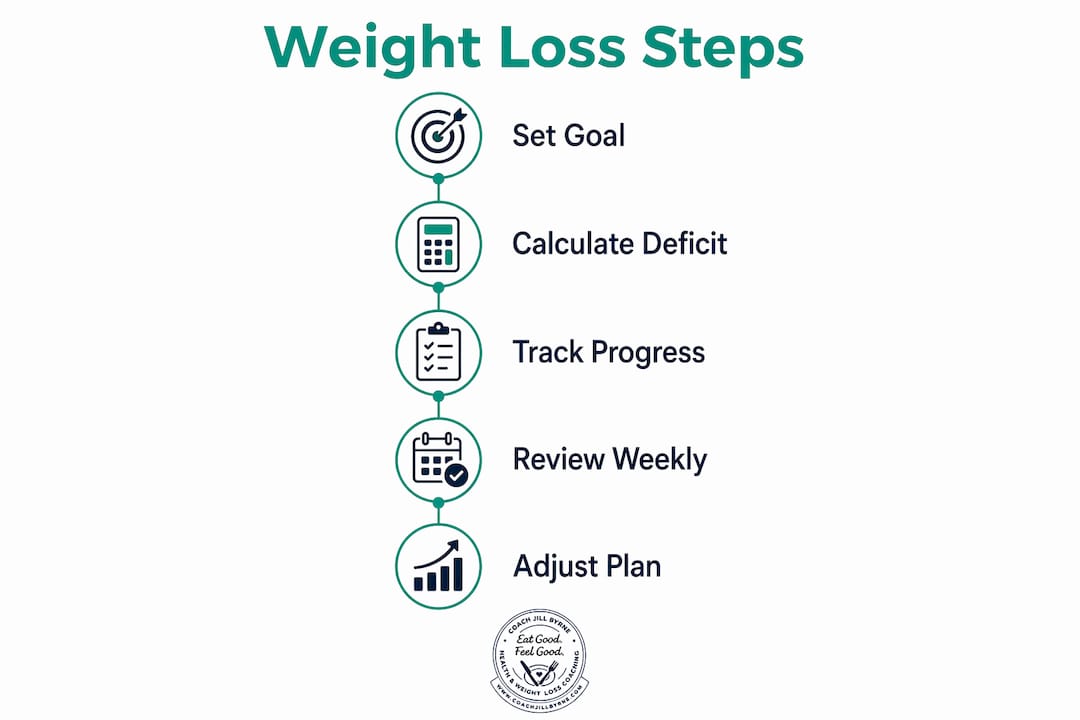
Setting a realistic rate is only useful if you build the habits to support it. The NIDDK recommends translating 6-month goals into weekly targets to maintain steady motivation and avoid overcorrection. Here is a practical framework for doing exactly that:
Set a 6-month percentage goal. Choose 5% or 10% of your current body weight as your target. Write it down with a specific date.
Break it into monthly milestones. Divide your total goal by 6 to get a monthly target. This gives you a checkpoint without daily pressure.
Build three anchor habits. Choose one habit around eating, one around movement, and one around sleep or stress. These three areas drive the majority of weight management outcomes.
Schedule a weekly review. Every Sunday, record your weight, note what worked, and identify one adjustment for the coming week. Consistency in review builds consistency in behavior.
Account for lifestyle factors beyond food. Poor sleep raises cortisol, which promotes fat storage. Chronic stress drives emotional eating. A sustainable wellness practice that addresses sleep and stress is not optional for lasting results.
Progress tracking does not need to be complicated. A simple notebook or a free app works. What matters is that you review your data regularly and make small, informed adjustments rather than dramatic overhauls.
Key takeaways
A realistic weight loss rate of 1 to 2 pounds per week, supported by a 500–750 calorie daily deficit, is the most evidence-based path to sustainable fat loss and long-term weight maintenance.
Point | Details |
Safe weekly rate | Lose 1–2 pounds per week to preserve muscle and support long-term maintenance. |
Percentage-based goals | Target 5%–10% of starting body weight over 6 months for measurable, motivating progress. |
Calorie deficit range | A 500–750 daily calorie deficit produces the recommended weekly loss for most people. |
Scale fluctuations are normal | Use monthly averages, not single weigh-ins, to accurately assess fat loss progress. |
Habits drive outcomes | Sleep, stress management, and consistent tracking matter as much as calorie control. |
What i’ve learned from coaching real weight loss journeys
After working with clients across a wide range of starting points and goals, the pattern I see most often is this: the people who succeed long term are not the ones who lost the fastest. They are the ones who stopped treating weight loss as a sprint.
The 1–2 pound per week target is not a consolation prize for people who cannot do better. It is the rate that protects your muscle, keeps your metabolism functioning, and gives your habits time to become automatic. I have seen clients lose 30 pounds in 30 weeks and keep it off for years. I have also seen clients lose 20 pounds in 6 weeks and regain 25 within a year. The difference was not willpower. It was pace.
What I tell every client is this: your body is not your enemy. When it slows your weight loss during a plateau, it is adapting. When the scale goes up after a salty meal, it is holding water, not storing fat. Learning to read those signals accurately, rather than reacting emotionally to them, is one of the most valuable skills you can build.
The other thing I have learned is that kindness to yourself is not soft. It is strategic. Clients who track their food without judgment, who adjust their plan without shame, and who treat a difficult week as data rather than failure consistently outperform those who push harder and harder until they burn out. Patience is not passive. It is the most effective tool in a long-term weight management plan.
If you want to read more about protecting your results once you reach your goal, the article on weight loss maintenance at Coachjillbyrne is worth your time.
— Coach Jill
Ready to build a plan that matches your real goals?
Understanding the right rate is the first step. Applying it consistently, week after week, is where most people need support. Coachjillbyrne offers personalized nutrition coaching designed around exactly this kind of sustainable, realistic progress.

Whether you are just starting out or trying to break through a plateau, the coaching programs at Coachjillbyrne provide structured accountability, meal planning guidance, and habit-based support tailored to your specific goals. You can also explore realistic goal examples to see how other clients have structured their progress. The goal is not perfection. It is a plan you can actually follow.
FAQ
What is the safest average weight loss per week?
The CDC and Harvard Health both identify 1 to 2 pounds per week as the safe, healthy target. Losing at this rate preserves muscle and reduces the risk of nutrient deficiencies.
How much weight can i realistically lose in 6 months?
The NIDDK recommends targeting 5%–10% of your starting body weight over 6 months. For a 200-pound person, that means 10 to 20 pounds at a healthy, maintainable pace.
Why am i not losing weight even with a calorie deficit?
Weekly weight fluctuations from water retention, hormonal shifts, and digestion can mask real fat loss. Track your monthly average rather than reacting to individual weigh-ins.
Is losing more than 2 pounds per week ever appropriate?
Losing more than 2 pounds per week consistently signals a deficit that is too aggressive. Harvard Health warns this raises the risk of muscle loss and rebound hunger, making it harder to maintain results.
What habits support a sustainable weight loss rate?
Consistent meal planning, adequate protein intake, regular sleep, and weekly progress reviews are the core habits that support the 1–2 pound weekly rate over the long term.
Recommended
Comments