
Health Restoration After Weight Gain: What You Need to Know

Regaining weight after a period of loss is one of the most discouraging experiences a person can face, and it is far more common than most people realize. Understanding what is health restoration after weight gain means recognizing that your body is not broken and your willpower has not failed. The real story lies in biology. Hormones shift, metabolism adapts, and your body actively works to return to a familiar weight range. This guide breaks down the physiological reasons behind weight regain and gives you a practical, research-backed path to recover your health, rebuild your metabolism, and create habits that actually hold.
Table of Contents
Key takeaways
Point | Details |
Weight regain is biological | Hormonal and metabolic shifts after weight loss make regain common, not a personal failure. |
Health restoration is multidimensional | True recovery addresses nutrition, movement, sleep, and mental health, not just the number on the scale. |
The 6-8 week window matters | Acting on new habits shortly after weight gain gives you the best chance of locking in lasting change. |
Protein and resistance training are foundational | Both protect muscle mass and support a healthier resting metabolic rate during recovery. |
Professional support accelerates results | Personalized coaching helps you navigate the complexity of metabolic repair without extreme measures. |
What is health restoration after weight gain
Health restoration after weight gain is the process of rebuilding metabolic function, hormonal balance, and overall wellness following a period of weight regain. It is not simply losing the weight again. It is addressing the underlying biological disruptions that made regain likely in the first place.
When you lose weight, your body does not passively accept that change. Levels of leptin, the hormone that signals fullness, drop significantly. Ghrelin, the hormone that drives hunger, rises. These shifts can persist for months after active dieting ends. More than 80% of dieters regain weight within three years, largely because hormonal hunger drives and returning eating patterns overpower short-term behavioral changes.
Beyond hormones, your resting metabolic rate often decreases during weight loss as the body learns to function on fewer calories. This metabolic adaptation does not snap back overnight. Metabolic adaptation reverses gradually over weeks to months, and repair requires consistent, adequate nutrition rather than another round of restriction.
Weight regain is not a character flaw. It is a predictable biological response that millions of people experience, and it can be addressed with the right strategies.
There is also an epigenetic dimension that most people never hear about. Obesity causes lasting epigenetic changes in fat and immune cells, essentially programming them to return to a higher weight state more easily. These cellular changes make early intervention and sustained lifestyle scaffolding critical, not optional. Treating weight regain as a chronic, relapsing condition rather than a one-time setback allows you to approach health recovery with the patience and strategy it actually requires.
How weight gain affects your health beyond the scale
Weight gain does not affect only the number on the scale. Its effects ripple through nearly every body system, which is why understanding health recovery after weight gain requires looking at a fuller picture.
The most immediate weight gain health effects show up in metabolic and cardiovascular markers. Blood sugar regulation can become less efficient. Blood pressure and triglyceride levels may creep upward. Inflammatory markers in the body often increase with additional fat tissue, particularly around the abdomen. These changes are not always visible from the outside, which is why tracking health markers beyond weight matters so much during any restoration process.
Hormonal balance also shifts with weight changes. For women, body fat distribution affects estrogen levels and menstrual regularity. For both men and women, excess adipose tissue can interfere with insulin sensitivity and cortisol regulation, creating a feedback loop that makes sustained weight management harder.

The psychological dimension is just as real. Weight regain often brings feelings of shame, reduced motivation, and a distorted relationship with food and exercise. These emotional responses can trigger all-or-nothing thinking, where a person feels that if they cannot do everything perfectly, there is no point in trying at all. That mindset is one of the biggest barriers to genuine health recovery.
There is a critical distinction between health restoration and simply losing weight again. Health restoration after weight gain focuses on:
Rebuilding muscle mass that may have been lost during previous dieting
Stabilizing hunger hormones so eating feels manageable rather than compulsive
Improving sleep quality, which directly affects appetite regulation and cortisol levels
Restoring energy and mood through balanced nutrition and steady movement
Reestablishing a healthy relationship with food rather than fear or restriction
Restoring muscle mass acts as a metabolic engine, improving resting metabolic rate and making long-term weight stability significantly more achievable. This is why resistance training is a cornerstone of recovery, not an optional add-on.
Practical strategies for restoring health after weight gain
Steps to regain health after weight gain work best when they are gradual, specific, and grounded in how your body actually functions. Here is a structured approach that reflects the evidence and works in real life.
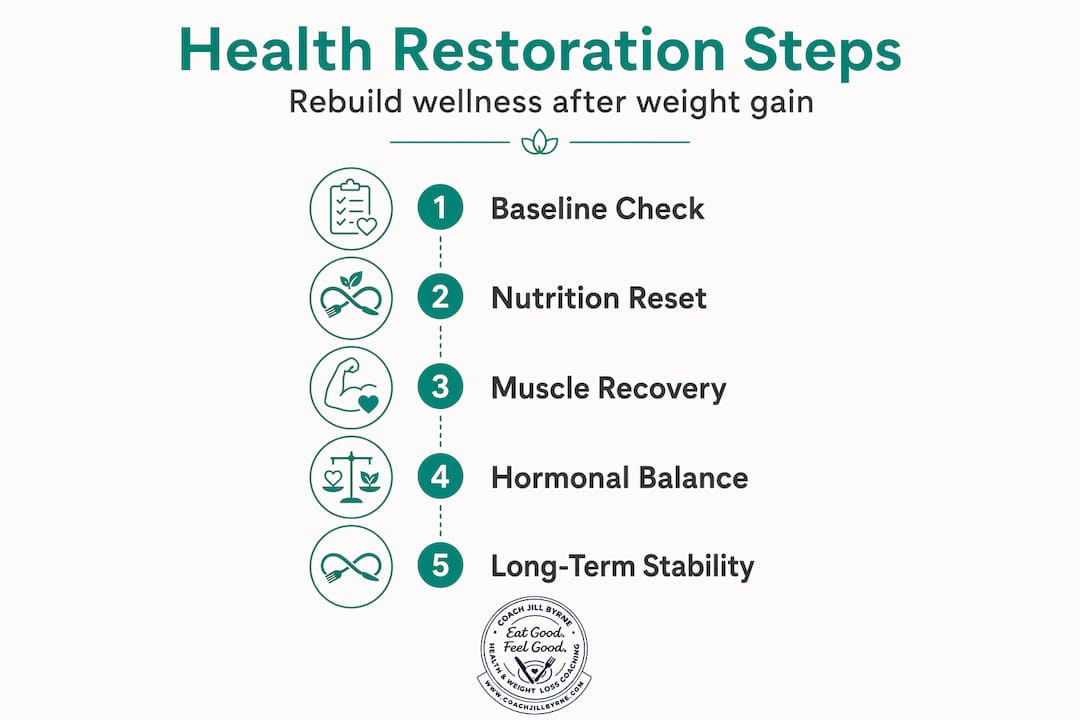
Start with a baseline assessment. Before changing anything, measure your current weight, waist circumference, and note your hunger and energy patterns. A measure first approach before intervention consistently improves long-term outcomes by giving you a clear starting point rather than reacting emotionally to the scale.
Prioritize protein at every meal. Protein supports muscle preservation, promotes satiety, and has a higher thermic effect than carbohydrates or fats, meaning your body burns more calories digesting it. Aim for a palm-sized portion of lean protein at breakfast, lunch, and dinner. This one shift alone can meaningfully reduce hunger between meals.
Add resistance training two to three times per week. Lifting weights or doing bodyweight exercises rebuilds the muscle mass that dieting often erodes. More muscle means a higher resting metabolic rate, which supports sustainable weight management without constant calorie restriction.
Increase fiber intake through whole foods. Vegetables, legumes, and whole grains slow digestion and support blood sugar stability. Protein targets and fiber intake are consistently more effective for appetite control than strict meal timing rules.
Build habits during the critical early window. The six to eight weeks immediately after weight gain represent the best opportunity to lock in new dietary and exercise habits before hormonal appetite fully rebounds. This window is not a deadline. It is your advantage.
Practice flexible food management, not rigid restriction. Rigid dieting creates the conditions for future regain. Flexible approaches that allow for real-life situations while maintaining overall nutritional quality produce better long-term results.
Prioritize sleep and stress management. Poor sleep elevates ghrelin and reduces leptin, directly worsening hunger and food choices the next day. Seven to nine hours of consistent sleep is a genuine health recovery strategy, not a luxury.
Pro Tip: When hunger feels overwhelming in the early weeks of recovery, it helps to remember that persistent hyperphagia can last at least one month after significant weight loss. You are not imagining it. Working with that biology rather than against it, by eating satisfying meals at regular intervals, is more effective than white-knuckling through restriction.
Also worth noting: the first one to three kilograms of weight gain after dieting often reflects glycogen and water restoration rather than fat. Seeing a quick increase on the scale does not mean you have failed. It means your body is refueling its short-term energy stores, which is a normal and necessary process.
Challenges specific to medication, surgery, and individual factors
Health recovery strategies look different depending on what triggered the weight regain in the first place. Recognizing these nuances helps you set realistic expectations and choose the right path forward.
Weight regain after GLP-1 medications
GLP-1 medications like semaglutide suppress appetite effectively during use, but stopping them abruptly creates a significant rebound effect. Approximately 67% of weight lost on GLP-1 medications is regained within 12 months if no lifestyle foundation has been built. The regain often begins as early as months two to three after stopping. Understanding GLP-1 therapeutic options and how to manage transitions is an important part of planning for those who have used this treatment pathway.
Weight regain after bariatric surgery
Post-surgical regain is multifactorial. It involves behavioral patterns, anatomical changes to the stomach over time, and metabolic contributors. Weight regain after bariatric surgery requires layered interventions, including protein prioritization, meal timing resets, and often specialist support rather than a single fix.
Scenario | Primary challenge | Recommended approach |
Post-GLP-1 rebound | Appetite returns sharply without drug suppression | Habit scaffolding, protein-focused meals, tapering plan |
Post-bariatric regain | Anatomical and behavioral factors combined | Multi-disciplinary team, structured meal reset |
General diet cycle regain | Metabolic adaptation and hormonal hunger | Gradual calorie increase, resistance training, sleep focus |
Epigenetic predisposition | Cellular memory of higher weight | Long-term lifestyle maintenance, professional support |
Pro Tip: If you have a history of repeated weight loss and regain cycles, treat your restoration plan like managing a chronic condition. That mindset shifts you away from the all-or-nothing approach that causes most cycles to repeat.
Blame and shame have no place in health restoration. The biological reality is that obesity is best treated as a chronic condition requiring ongoing, high-energy-flux management. Strategic, consistent effort over time beats dramatic short-term interventions every time.
My perspective on health restoration after weight gain
I have worked with many clients who arrive at health restoration after weight gain feeling like they have let themselves down. That belief is almost always the first thing we address together. In my experience, the clients who make the most durable progress are the ones who stop treating regain as a moral event and start treating it as a clinical one.
What I have seen again and again is that people underestimate how much their hormones are working against their intentions in the months after weight loss. The hunger is real. The fatigue is real. And pushing through with extreme restriction almost always backfires. The approach I advocate for is building a sustainable foundation during that early window after regain, using consistent weight maintenance habits rather than dramatic calorie cuts.
What I have also learned is that the metabolic recovery phase can temporarily involve accepting a higher number on the scale while focusing on rebuilding muscle and stabilizing appetite. That is genuinely counterintuitive for most people. But it works. The post-weight-fluctuation period is best understood as a retuning phase, focusing on restoring muscle mass and metabolic function rather than forcing rapid loss again.
My take is this: kindness and patience are not soft strategies. They are the foundation of lasting change. If you spend the early weeks of recovery in a state of panic or shame, you will make short-term decisions that sabotage long-term health. If you treat your body with the same structured care you would give any other health condition, you create the conditions for genuine restoration.
— Coach Jill
How personalized coaching supports your health restoration
Navigating health restoration after weight gain alone is possible, but it is significantly harder without structure and accountability.

At Coachjillbyrne, the focus is not on quick fixes or restrictive meal plans. The coaching approach is built around metabolic repair, practical habit formation, and sustainable nutrition strategies that fit into real life. Whether you are managing weight regain after stopping a GLP-1 medication, recovering from a diet cycle, or working through a plateau, personalized wellness coaching gives you a clear, realistic plan tailored to where you are right now. The philosophy behind the work emphasizes long-term wellness strategies over rapid transformations, because lasting results require a foundation, not a formula. Reach out to learn how structured support can help you move forward with confidence.
FAQ
What does health restoration after weight gain actually mean?
Health restoration after weight gain refers to the process of rebuilding metabolic function, hormonal balance, muscle mass, and overall wellness following weight regain. It goes beyond losing weight again and addresses the biological and lifestyle factors that drive sustainable health.
How long does it take to restore health after weight gain?
The timeline varies by individual, but metabolic adaptation begins reversing within weeks of consistent nutrition and exercise. The first six to eight weeks after weight gain are the most critical for establishing habits before hormonal appetite fully rebounds.
Is weight regain after dieting normal?
Yes. More than 80% of dieters regain weight within three years due to hormonal shifts and metabolic adaptation. Regain reflects biological processes, not personal failure, and can be addressed with the right recovery strategies.
What is the most effective first step in health recovery after weight gain?
Taking a baseline measurement of weight, waist circumference, and hunger patterns before making any changes gives you an objective starting point. From there, prioritizing protein intake and adding resistance training are among the most evidence-supported early steps.
Can health be fully restored after significant weight regain?
Yes, meaningful health restoration is achievable for most people with consistent effort, appropriate nutrition, regular movement, and professional support when needed. While epigenetic factors may create longer timelines for some individuals, the body is capable of significant metabolic repair over time.
Recommended
Comments