
What Is a Lifestyle Transformation Plan? Your Guide
- Jul 6
- 7 min read

A lifestyle transformation plan is defined as a structured system for reshaping daily habits, mindset, and routines to support lasting improvements in health and well-being. Unlike a short-term diet or fitness challenge, a personal transformation plan addresses physical, mental, emotional, and social well-being at the same time. A structured plan can improve habit adherence by 40–60% over two to three months, and accountability support alone boosts success rates by 45%. Coachjillbyrne works with clients to build exactly this kind of practical, sustainable system, one that fits real life rather than demanding perfection.
What is a lifestyle transformation plan made of?
A lifestyle transformation plan is built from six core components, each one supporting the others. Remove any one of them, and the plan loses structural integrity.
Core motivation and personal “why”
Every effective lifestyle change strategy starts with a clear reason. That reason must be personal and specific, not vague. “I want to feel better” is not a motivator. “I want to have energy to play with my kids after work” is. Defining your core motivation gives you a reference point when progress slows.
Baseline assessment
Before changing anything, you need to know where you stand. Tracking current habits, sleep patterns, food choices, and stress levels for one to two weeks reveals patterns you cannot see in real time. Keeping a dedicated diary to record food, activity, and weight supports motivation and gives a clear picture of what needs to shift.

SMART goals and micro-habits
The SMART framework (Specific, Measurable, Appropriate, Realistic, Time-Bound) is the standard for setting lifestyle goals that actually stick. Pair each SMART goal with a micro-habit: a small, repeatable action that requires minimal willpower. For example, a SMART goal of “walk 20 minutes daily for 8 weeks” becomes the micro-habit of “put on walking shoes after breakfast.”
Tracking and reflection
Progress without measurement is guesswork. Weekly check-ins, whether through a journal, a habit tracker app, or a simple spreadsheet, create the feedback loop that keeps a plan on course. Reflection also surfaces what is working before you invest more time in what is not.
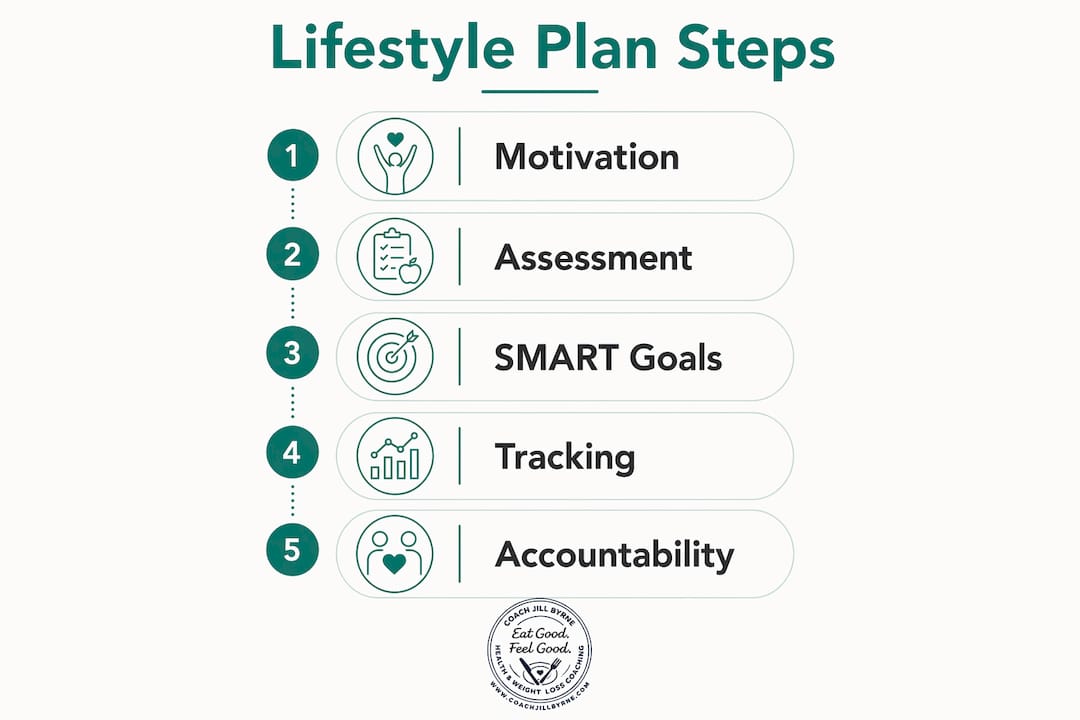
Accountability and environment design
Accountability partners increase follow-through significantly. Redesigning your environment, clearing junk food from the kitchen, setting out workout clothes the night before, or meal-prepping on Sundays, removes friction from good choices. You can read more about how joint accountability supports wellness in practice.
Pro Tip: Design your environment before you rely on motivation. Motivation fluctuates daily; a well-arranged kitchen or a pre-packed gym bag does not.
Component | Primary benefit |
Core motivation | Sustains effort during low-motivation phases |
Baseline assessment | Identifies real gaps rather than assumed ones |
SMART goals and micro-habits | Creates specific, achievable daily actions |
Tracking and reflection | Builds a feedback loop for continuous adjustment |
Accountability and environment | Reduces reliance on willpower alone |
How long does it take to transform your lifestyle?
Habit formation takes longer than most people expect. Research shows it typically takes 2–5 months for new behaviors to feel natural. That range depends on the complexity of the habit, the person’s baseline, and the consistency of their environment.
The most practical framework for a lifestyle overhaul is the 12-week cycle. A 12-week plan aligns with business quarters and breaks naturally into weekly sprints, each with a specific micro-goal. Twelve weeks is long enough to build real habits and short enough to stay focused.
A typical 12-week structure looks like this:
Weeks 1–2: Baseline assessment and goal-setting. Identify one to two focus areas only.
Weeks 3–4: Introduce the first micro-habit. Track daily. Expect friction.
Weeks 5–6: Reinforce the first habit. Add a second micro-habit if the first feels stable.
Weeks 7–8: Mid-plan review. Adjust goals based on real data, not original assumptions.
Weeks 9–10: Deepen existing habits. Focus on consistency over intensity.
Weeks 11–12: Integration and sustainability planning. Prepare for life after the structured cycle.
Motivation dips predictably around weeks 9–12, which corresponds to the 3–4 month motivation slump identified in behavioral research. This is the phase where environmental support matters most. Habits that are not yet automatic need external cues and social reinforcement to survive this window.
Pro Tip: Schedule a mid-plan review at week 6. Adjust your micro-habits based on what the data shows, not what you hoped would happen.
What mindset shifts make lifestyle changes last?
The most durable lifestyle changes come from identity, not goals. Identity-based change shifts your internal narrative from “I want to lose weight” to “I am someone who prioritizes my health.” That shift changes daily decisions at the source, before willpower even enters the picture.
“Lasting change is rarely a major overhaul. It results from small, consistent shifts integrated across identity, environment, habits, and social support. Pull all four levers together, and the system reinforces itself.”
The four levers that drive sustainable change are:
Identity: Reframe who you are, not just what you want.
Environment: Make good choices the path of least resistance.
Habits: Build micro-habits that require minimal decision-making.
Social support: Surround yourself with people whose habits align with your goals.
The all-or-nothing trap is the most common reason lifestyle plans fail. Missing one workout or eating one off-plan meal feels like total failure, which leads to abandoning the plan entirely. Setbacks are data points, not verdicts. A missed day tells you something about your schedule, your energy, or your environment. Use that information to adjust, not to quit.
Health experts also recommend choosing movement you genuinely enjoy, whether that is walking with a friend, dancing, or gardening, rather than forcing exercise that feels like punishment. Pleasurable, social movement improves adherence far more than rigid workout programs most people abandon by week four.
How do you create your own personalized lifestyle plan?
Building a personal lifestyle improvement plan does not require a professional certification. It requires honesty, a clear process, and the willingness to adjust. Here is a seven-step framework:
Define your motivation. Write down your specific reason for changing. Be concrete. Connect it to daily life, not abstract health metrics.
Assess your current habits. Track food, sleep, movement, and stress for one week without changing anything. This is your baseline.
Choose one focus area. Nutrition, sleep, movement, or stress management. Pick one. Multitargeting at the start dilutes effort and reduces adherence.
Design a micro-habit. Attach it to an existing routine using the cue-routine-reward model. Example: after morning coffee (cue), take a 10-minute walk (routine), then enjoy five minutes of quiet reading (reward).
Break the plan into weekly sprints. Assign one specific target per week. Write it down. Review it every Sunday.
Track progress and adapt. Use a journal, a habit tracker app, or a simple checklist. Review weekly. Adjust monthly. Setting realistic weight loss goals at each milestone keeps expectations grounded.
Plan for sustainability. After 12 weeks, identify which habits have become automatic. Build the next cycle around the gaps that remain.
Key tools that support this process include:
A food and activity journal (paper or digital)
A weekly planning template with space for reflection
A habit tracker app for daily check-ins
A trusted accountability partner or coach
Sustainable weight loss, in particular, benefits from building habits that last rather than following a temporary program. The goal is a life you can maintain, not a plan you survive.
Key Takeaways
A lifestyle transformation plan works because it combines identity-based change, structured habit design, consistent tracking, and environmental support into one repeatable system.
Point | Details |
Definition matters | A lifestyle transformation plan is a structured system, not a temporary diet or fitness challenge. |
Habit formation takes time | New habits take 2–5 months to feel natural; plan your timeline accordingly. |
Identity drives behavior | Shifting your self-image is more effective than setting outcome-only goals. |
Environment beats willpower | Redesign your surroundings to make good choices the default, not the effort. |
Setbacks are information | Treat missed days as data to adjust your plan, not reasons to abandon it. |
What I have learned from years of coaching lifestyle change
Most people come to me expecting a meal plan and a workout schedule. What they actually need is a different relationship with their own habits. That realization took me years of working with real clients to fully understand.
The clients who succeed long-term are not the ones with the most discipline. They are the ones who build systems that do not require discipline every single day. They rearrange their kitchens. They prep food on Sundays. They tell their families what they are working on. They make the right choice the easy choice.
The motivation dip around months three and four is real, and most people interpret it as personal failure. It is not. It is biology and psychology doing exactly what research predicts. My job, and yours, is to have environmental supports in place before that dip arrives, not to scramble for motivation after it hits.
One more thing I tell every client: be as consistent with your self-compassion as you are with your habits. A setback handled with curiosity instead of shame is a setback you learn from. A setback handled with shame is a setback that ends the plan.
Start smaller than you think you need to. Stay longer than you think you should. Progress over perfection, every time.
— Coach Jill
Personalized support for your lifestyle plan
Building a lifestyle plan on your own is possible. Building one with structured support is faster and more sustainable.

Coachjillbyrne offers personalized nutrition coaching, habit-based accountability programs, and practical meal planning guidance designed for real life. Whether you are starting from scratch or rebuilding after a setback, the focus is always on sustainable habits, not short-term fixes. Clients work directly with Coach Jill to set realistic goals, track meaningful progress, and stay accountable through every phase of their plan. Visit Coachjillbyrne to learn more about available coaching programs and take the first step toward a plan that actually fits your life.
FAQ
What is a lifestyle transformation plan?
A lifestyle transformation plan is a structured system for changing daily habits, mindset, and routines to improve physical, mental, emotional, and social well-being over time. It differs from a diet or fitness program by addressing the full scope of daily life, not just one behavior.
How long does a lifestyle transformation plan take to work?
New habits typically take 2–5 months to feel automatic, and most structured plans use a 12-week cycle to build and reinforce them. Visible progress in energy, weight, and mood often appears within the first four to six weeks.
What is the biggest reason lifestyle plans fail?
The all-or-nothing mindset is the most common cause of failure. Treating a single setback as total failure leads people to abandon plans that were otherwise working. Viewing setbacks as data points and adjusting the plan keeps progress moving forward.
Do I need a coach to follow a lifestyle transformation plan?
A coach is not required, but accountability support increases success rates meaningfully. A coach provides structure, personalized feedback, and the external accountability that most people cannot sustain alone, especially during the motivation dip at months three and four.
What should I focus on first in a lifestyle change strategy?
Choose one focus area, such as nutrition, sleep, or movement, and build one micro-habit around it before adding anything else. Multitargeting at the start reduces adherence and makes it harder to identify what is actually working.
Recommended