
Why Health Goals Matter Before Marriage: A Couple's Guide
- Jul 30
- 11 min read

Setting shared health goals before marriage protects future fertility, reduces avoidable pregnancy and household risk, and builds the teamwork habits that sustain a healthy partnership for decades. The evidence is clear: premarital screening detects silent, modifiable conditions before they become high-stakes problems, behavioral research confirms that partners who support each other’s health routines show stronger long-term adherence than individuals working alone, and couples who align on health expectations before the wedding report less relationship stress when health challenges arise later.
Three reasons this matters right now:
Medical: Silent conditions such as undiagnosed diabetes, thyroid dysfunction, carrier traits, and infectious diseases can affect fertility and pregnancy outcomes without any symptoms.
Behavioral: Shared accountability increases the likelihood of maintaining healthy habits long-term compared to solo efforts.
Planning: Aligning health expectations and budgeting for screenings and coaching before the wedding removes financial and emotional surprises later.
Your immediate next step: Schedule a preconception screening visit with your PCP or OB-GYN, then set aside 10 minutes this week for a partner health conversation using the checklist in Section 7.
Table of Contents
Why health goals before marriage start with a medical baseline
The most common premarital health risks are both preventable and modifiable, according to preconception research. Yet many couples skip screening entirely because neither partner feels sick. That gap is exactly the problem.
Common premarital and preconception tests and what they detect:
Blood type and Rh factor: Rh incompatibility between partners can cause complications in pregnancy if unmanaged.
Carrier screening: Conditions such as thalassemia or cystic fibrosis may show no symptoms in a carrier but can affect a child if both parents carry the same trait.
Infectious disease screening (HIV, hepatitis B/C, syphilis): Many infections are asymptomatic; early detection enables treatment before conception.
Thyroid and diabetes screening: Both conditions affect fertility and pregnancy outcomes and are highly manageable when caught early.
Vaccine status review: Rubella and varicella immunity should be confirmed before conception, since some vaccines cannot be given during pregnancy.
Clinicians recommend scheduling this visit several months before the wedding to allow time for treatment, vaccinations, or referrals. Awareness of preconception care has been associated with a significant reduction in preconception risk in cross-sectional research, underscoring how much knowledge alone changes outcomes.
Pro Tip: At your first screening visit, ask your provider specifically: “Which carrier screens are recommended for our ethnic backgrounds?” and “Are there vaccines I should complete at least three months before we try to conceive?” Timing matters for some immunizations.
How shared health goals strengthen your relationship
Partners who encourage each other’s healthy habits are more likely to achieve and sustain their wellness goals than individuals working alone. This isn’t motivational advice; it’s a documented behavioral pattern sometimes called “behavioral contagion,” where one partner’s positive changes naturally influence the other’s habits across diet, exercise, and even how promptly they seek medical care.
“One person might be more driven than the other, but both parties need to be clear that they’re actually in this together. The other person has to want to do it, otherwise it’s going to cause tension more than anything else.” — Michael Inglis, sport and performance psychologist, The Mind Room
Relational benefits of setting health goals together include:
Mutual accountability without external pressure
Reduced household stress through shared preventive care routines
Stronger emotional trust built through honest health conversations
Better meal and sleep routines that benefit both partners
A shared framework for handling future health challenges as a team
Shared goals don’t require identical outcomes. One partner may be working toward sustainable weight loss while the other focuses on managing stress or improving sleep quality. What matters is a common commitment to each other’s well-being.

How to set practical shared health goals before your wedding
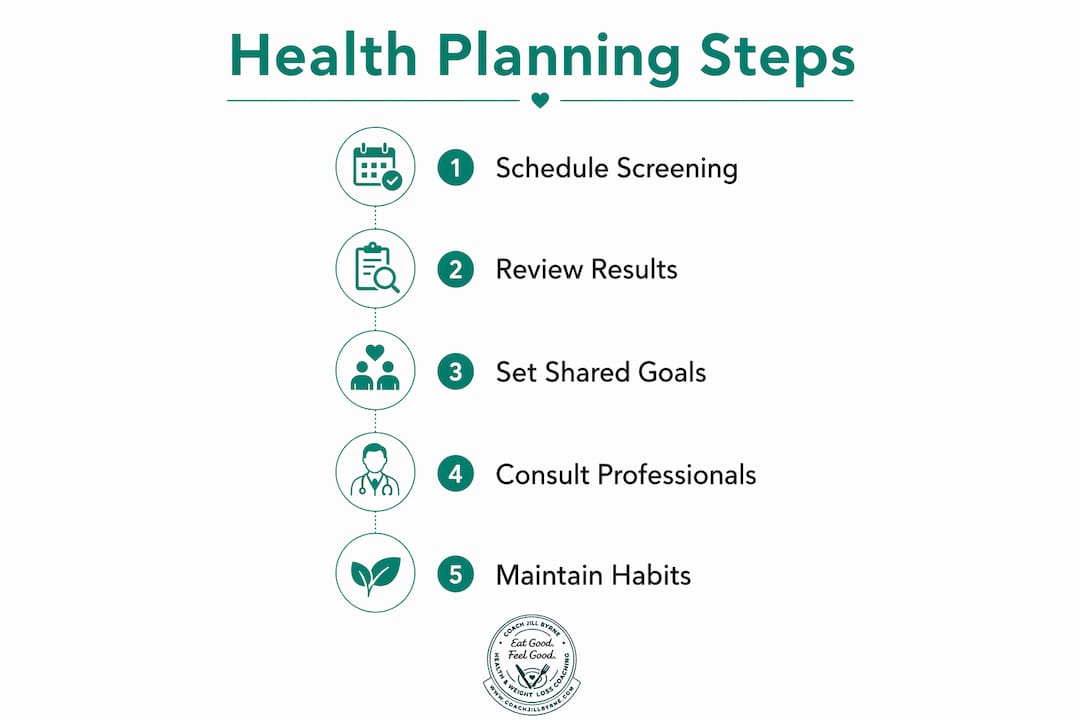
A stepwise process keeps goal-setting from becoming overwhelming.
Align your definitions of health. Before agreeing on any goal, each partner should describe what “being healthy” means to them. Mismatched assumptions are the most common reason shared plans stall early.
Share your medical baselines. Exchange key findings from your premarital screenings. You don’t need to disclose every detail, but knowing each other’s relevant conditions allows you to plan realistically.
Set 2–3 SMART couple goals. Keep them specific, measurable, and tied to daily habits rather than outcomes. Examples: “Cook three home meals together each week” or “Support your partner’s GLP-1 nutrition plan by prepping lunches twice a week.”
Assign roles and routines. Decide who handles grocery shopping, who plans meals, and how you’ll adjust schedules to protect workout or rest time. Logistical support is as important as emotional support.
Schedule check-ins and follow-ups. A brief monthly review of how each goal is progressing prevents drift and keeps both partners engaged.
For couples working on sustainable weight loss, habit-first goals consistently outperform outcome-first targets. “Cook together three nights a week” is more durable than “lose 15 pounds before the wedding.”
Pro Tip: When sharing sensitive medical history, agree in advance on what stays private and what you’ll share with extended family. Setting that boundary together builds trust and prevents future conflict.
When to involve a medical provider versus a nutrition coach
Medical providers and nutrition coaches serve distinct, complementary roles. Knowing which professional to call for which need saves time and money.
Medical providers (PCP, OB-GYN, specialist):
Order and interpret premarital and preconception screenings
Diagnose and treat conditions such as thyroid dysfunction, diabetes, or infectious disease
Provide referrals to genetic counselors or fertility specialists when indicated
Nutrition coaches:
Design personalized meal plans and healthy eating routines that fit a couple’s lifestyle
Provide accountability and habit-change support between medical visits
Offer GLP-1 nutrition guidance for clients on medications such as Wegovy or Ozempic
Support pre-wedding sustainable weight-loss pacing without crash dieting
A practical approach: complete your medical screening first, then bring relevant findings to a nutrition coach to build a food and habit plan that supports your treatment or prevention goals. Coaching complements medical care; it does not replace it.
Pro Tip: Ask your coach whether they have experience supporting clients on GLP-1 medications. Nutritional needs shift during medication-assisted weight loss, and habit-building guidance specific to that context makes a measurable difference.
Common obstacles couples face and how to fix them
Most couples hit at least one of these barriers. Each has a practical fix.
Mismatched readiness: One partner is motivated; the other isn’t. Fix: negotiate shared values (better energy, less stress) rather than identical schedules. Aligning on the “why” creates buy-in without forcing identical behavior.
Pre-wedding crash dieting: Pressure to look a certain way by the wedding date drives short-term restriction that rarely lasts. Fix: sustainable weight-loss habits started six or more months before the wedding outperform any rapid plan started six weeks out.
“Health police” dynamics: One partner monitors or criticizes the other’s choices. Fix: shift from correction to encouragement. Celebrate positive choices rather than flagging every slip.
Logistical barriers: Conflicting schedules, children, or long commutes make joint routines difficult. Fix: trade household tasks strategically. One partner taking over dinner prep twice a week can free the other’s time for a workout.
Financial constraints: Screenings and coaching cost money. Fix: budget both into wedding planning the same way you budget for flowers or catering. Preventive care now costs far less than managing an undiagnosed condition later.
Pro Tip: Start with one small, specific habit rather than a full lifestyle overhaul. Couples who add one shared healthy behavior at a time build momentum without burning out before the wedding.
Your partner and provider conversation checklist
Partner conversation checklist
What does “being healthy” mean to each of us individually?
Which health conditions or family history should we share with each other?
What kind of support do you want from me: accountability, logistics, or just encouragement?
Which household tasks can we trade to protect each other’s health time?
When and how often will we check in on our goals?
Provider screening checklist
Which blood, carrier, and infectious disease screens are recommended for us?
Is our vaccine status current, and are there any immunizations to complete before conception?
Are there any findings that require specialist referral (genetic counseling, fertility evaluation)?
What is the recommended timeline if we plan to conceive within 12–18 months?
3/6/12-month planning prompts
9 months before wedding: Complete premarital screening; review results with your provider.
6 months before wedding: Begin nutrition coaching for habit consolidation and sustainable weight-loss support.
3 months before wedding: Review goal progress; adjust routines for the final pre-wedding stretch.
After the wedding: Schedule a follow-up screening visit and continue coaching for long-term habit maintenance.
Emotional and mental health goals before marriage
Physical health screenings matter, but emotional readiness shapes relationship quality just as directly. Stress, anxiety, and poor sleep affect immune function, mood, and decision-making, all of which spill into partnership dynamics. Couples who set explicit mental health goals before marriage, such as establishing a consistent sleep schedule, agreeing on stress-management practices, or committing to regular check-ins about emotional well-being, report stronger communication and lower conflict levels in early marriage.
Mental health goals also support physical ones. A partner managing chronic stress is less likely to maintain consistent nutrition habits or exercise routines. Addressing both dimensions together, rather than treating physical and emotional health as separate tracks, produces more durable results.
How to talk about health goals without creating pressure
Effective health communication between partners rests on a few consistent practices. Ask open questions rather than making observations about behavior: “How have you been feeling about your energy lately?” opens a conversation; “You haven’t been to the gym in two weeks” closes one. Agree in advance that health conversations are check-ins, not evaluations.
Positive reinforcement works better than correction. When one partner makes a healthy choice, acknowledge it specifically. Over time, [syncing healthy eating habits](https://coachjillbyrne.com/post/how-to-sync-healthy-eating-habits-with-your partner) and other routines becomes a natural part of household life rather than a source of tension. Schedule a brief monthly review of shared goals so neither partner feels blindsided by a course correction.
Long-term benefits of planning your health together now
The habits couples build before marriage tend to persist. Couples who establish shared preventive care routines early are better positioned to manage chronic disease risk, support each other through health challenges, and make informed decisions about family planning, including fertility timing and pregnancy preparation.
Parenting readiness is one concrete downstream benefit. Couples who have already aligned on nutrition, sleep, and stress management before children arrive adapt more smoothly to the demands of pregnancy and early parenthood. Joint health planning also reduces the financial burden of reactive care: managing a diagnosed condition proactively costs significantly less than treating complications that arise from delayed detection.
What shared health planning looks like in practice
Consider a couple who completes premarital screening eight months before their wedding and discovers one partner has borderline thyroid function and the other carries a recessive genetic trait. With that information, they consult a genetic counselor, adjust the first partner’s nutrition plan to support thyroid health, and begin working with a nutrition coach six months out to build sustainable eating habits for both. By the wedding, both partners have established routines they can maintain, and they enter marriage with a clear picture of their health baseline and a shared plan for managing it.
Another common pattern: a couple with no significant medical findings uses the preconception visit as a starting point for a shared weight-loss and meal-planning program. They set a goal to cook at home four nights a week, support each other’s portion control, and check in monthly. Twelve months later, both have maintained their results because the habits were built into daily life rather than tied to a wedding deadline. For couples interested in building wellness goals together, starting with a clear baseline and a realistic plan makes the difference between temporary change and lasting results.
Key Takeaways
Setting shared health goals before marriage is one of the most practical investments an engaged couple can make in their long-term well-being and relationship resilience.
Point | Details |
Screen before the wedding | Schedule premarital screening 9 months out to allow time for treatment, vaccines, or specialist referrals. |
Shared goals improve adherence | Partners who support each other’s health routines are more likely to sustain healthy habits long-term. |
Align values, not schedules | Negotiate shared health values and allow each partner to execute them individually for better sustainability. |
Habit-first beats outcome-first | Sustainable goals like cooking together three nights a week outlast any crash diet tied to a wedding date. |
Coachjillbyrne supports the plan | Coachjillbyrne provides personalized nutrition coaching, meal planning, and GLP-1 support for couples building lasting health habits before and after marriage. |
What I tell every couple who asks me about this
Most couples spend months planning the wedding and very little time planning the marriage. Health is where that gap shows up first. When I work with engaged clients, the ones who come in with a clear medical baseline and a shared commitment to habit change make the most durable progress. They’re not trying to hit a number by a date; they’re building a way of eating and living that works for two people with different bodies, schedules, and histories.
One client came to me after her premarital screening flagged insulin resistance she hadn’t known about. We built a real-food meal plan around that finding, focused on portion balance and consistent home cooking, and she entered her marriage with both a manageable condition and a set of habits her partner actively supported. That combination, medical clarity plus practical coaching, is what makes the difference between a short-term fix and a long-term shift.
Personalized nutrition coaching for engaged couples
Engaged couples preparing for marriage and family planning have specific, time-sensitive nutrition needs that generic wellness advice doesn’t address. Coachjillbyrne offers personalized nutrition coaching, habit-based meal planning, and GLP-1 medication nutrition support designed to help couples build sustainable eating habits that last well beyond the wedding day.

Programs are available as monthly packages and individual sessions, making it straightforward to start at whatever point in your engagement makes sense. Whether you’re six months out and focused on sustainable weight loss, or newly engaged and wanting to establish healthy routines from the start, Coachjillbyrne provides structured, accountable support tailored to your goals as a couple.
Please note: medical screening, diagnosis, and treatment require the involvement of a licensed PCP, OB-GYN, or specialist. Nutrition coaching complements medical care but does not replace it.
Ready to build a health plan that works for both of you? Book a discovery call or visit coachjillbyrne.com to learn more.
Useful sources and further reading
WHO preconception and premarital screening guidance: Supports the article’s recommendations on early detection of modifiable risks before pregnancy.
CDC preconception care recommendations: Public-health rationale for proactive screening as a long-term investment in household health.
American Psychological Association — behavioral research on couples and health: Evidence base for the relationship between partner support and health habit adherence.
PLOS One — preconception risks in soon-to-be-married couples: Cross-sectional data on the prevalence and predictors of preconception medical and behavioral risks.
American Heart Association — couples’ health resolutions: Practical guidance on personalizing shared health goals and avoiding common pitfalls.
Verifying credentials in the U.S.: Confirm a registered dietitian’s credentials through the Academy of Nutrition and Dietetics credential verification tool. For physicians and specialists, check state licensure boards or clinic affiliations directly.
FAQ
Why do health goals matter before marriage?
Setting health goals before marriage allows couples to identify and address silent medical risks, align on shared wellness expectations, and build accountability habits that support long-term well-being together.
What premarital health tests should couples get?
Standard premarital screening typically includes blood type and Rh factor, carrier screening, infectious disease testing (HIV, hepatitis, syphilis), thyroid and diabetes screening, and a vaccine status review.
How early should couples start premarital health planning?
Clinicians recommend completing premarital screening at least 9 months before the wedding to allow adequate time for treatment, vaccinations, or specialist referrals before conception planning begins.
Can a nutrition coach help with pre-wedding health goals?
Yes. A nutrition coach supports habit design, meal planning, sustainable weight-loss pacing, and GLP-1 medication nutrition guidance. Coachjillbyrne offers personalized programs for engaged couples building lasting health routines.
What if partners have different health goals?
Shared goals don’t require identical outcomes. The most effective approach is to align on shared health values and allow each partner to pursue individualized targets within that framework, with mutual support rather than competition.
Recommended
Comments