
Why Slow Weight Loss Lasts Longer: The Science Behind It

Slow weight loss is defined as losing 1 to 2 pounds per week through a moderate calorie deficit, and it produces more durable results than rapid methods because it preserves muscle, stabilizes metabolism, and allows hunger hormones to remain balanced. This rate, recognized by Harvard Health as the healthy, realistic range for sustainable progress, avoids the nutrient shortfalls and muscle loss that make fast weight loss so difficult to maintain. Understanding why slow weight loss lasts longer requires looking at three interconnected systems: muscle mass, hormonal regulation, and your body’s metabolic set point. The National Institute of Diabetes and Digestive and Kidney Diseases (NIDDK), Harvard Health, and UT MD Anderson Cancer Center all point to gradual, consistent progress as the foundation of long-term weight loss success.
Why slow weight loss lasts longer: the muscle connection
Muscle mass is the single most important factor in your resting metabolic rate, and rapid weight loss puts it at serious risk. About 25% of weight lost during fast dieting can come from muscle tissue rather than fat, according to Harvard Health. That means someone losing 20 pounds quickly could lose 5 pounds of metabolically active muscle, permanently reducing the number of calories their body burns each day. Losing that muscle makes weight regain almost inevitable once normal eating resumes.

Gradual weight loss, by contrast, gives your body time to draw primarily from fat stores. A slower calorie deficit allows the body to first deplete glycogen reserves and then shift to burning fat, with muscle tissue largely spared. This process depends on two practical factors: adequate protein intake and regular resistance training. Both signal the body to protect lean tissue even while overall weight decreases.
Here is what the research-backed approach to muscle preservation looks like in practice:
Protein intake: Aim for 0.7 to 1 gram of protein per pound of body weight daily. Sources like chicken breast, Greek yogurt, eggs, and legumes support muscle repair and retention.
Resistance training: Lifting weights or performing bodyweight exercises two to three times per week preserves lean mass during a calorie deficit.
Calorie deficit size: A deficit of 500 to 750 calories per day produces the 1 to 2 pound weekly loss that Harvard Health identifies as muscle-sparing.
Nutrient density: Eating whole foods rather than ultra-processed options keeps micronutrient levels stable, which supports muscle function and recovery.
Pro Tip: If you are unsure whether your current diet supports muscle retention, tracking protein intake for one week using an app like MyFitnessPal often reveals gaps that are easy to close with small meal adjustments.
The practical implication is straightforward. More muscle means a higher resting calorie burn, which means you can eat more food while maintaining your lower weight. That is a biological advantage that fast weight loss methods simply cannot provide.
How do hormones behave differently during slow vs fast weight loss?
Ghrelin and leptin are the two hormones that govern hunger and fullness, and rapid weight loss disrupts both in ways that work directly against you. Ghrelin, the hunger-stimulating hormone, rises sharply when calories are cut too aggressively. Leptin, which signals satiety to the brain, drops when body fat decreases too quickly. The result is a state of persistent hunger that most people interpret as a personal failure. It is not. It is a predictable biological response to an overly aggressive deficit.
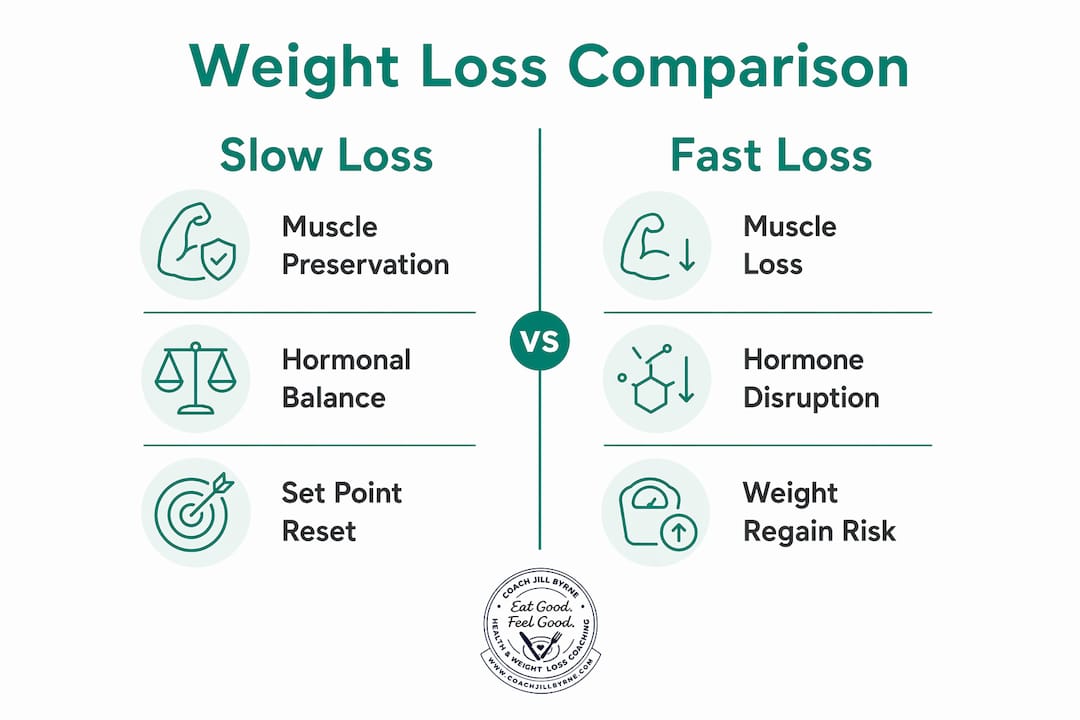
The NIDDK confirms that metabolism and hormone shifts during weight loss directly affect a person’s ability to maintain their new weight. This is why so many people who lose weight rapidly find themselves regaining it within 12 months. The hormonal environment created by crash dieting actively drives overeating.
Gradual weight loss prevents these hormonal spikes and crashes through a more measured approach:
Ghrelin stays lower when calorie reductions are modest, because the body does not perceive a state of starvation.
Leptin declines more slowly with gradual fat loss, keeping satiety signals functional for longer.
Insulin sensitivity improves steadily with consistent, moderate dietary changes rather than swinging between restriction and overeating.
Cortisol levels stay more stable when the body is not under the physiological stress of extreme caloric restriction.
The hormonal stability created by steady weight loss is not just about comfort. It is the biological mechanism that makes long-term weight loss success achievable rather than a constant struggle against your own body chemistry.
What is set point weight and how does gradual loss help reset it?
Set point weight is the weight range your body actively defends through hormonal, metabolic, and neurological signals. UT MD Anderson describes it as a biological thermostat: when your weight drops below the set point, your body responds by increasing hunger, slowing metabolism, and reducing energy expenditure to push weight back up. This defense mechanism evolved to protect against famine, but it works against anyone trying to maintain a lower weight in a modern food environment.
The critical insight from MD Anderson is that set point lowering takes 3 to 6 months of sustained weight maintenance at a new level. Slow weight loss aligns perfectly with this timeline. Fad diets, by contrast, produce rapid losses that the body never has time to accept as the new normal, which is precisely why quick fixes cause the yo-yo cycling that frustrates so many people.
Here is how to work with your set point rather than against it:
Lose weight at 1 to 2 pounds per week. This pace gives your hormones, neural signals, and nutrient absorption systems time to recalibrate to each new weight level.
Hold your weight steady for 4 to 8 weeks at natural plateaus. This is not stalling. It is your body resetting its set point downward.
Avoid extreme restriction. Cutting below 1,200 calories per day triggers the body’s starvation response, which raises the set point rather than lowering it.
Prioritize sleep. Poor sleep elevates ghrelin and lowers leptin, effectively raising your functional set point regardless of diet quality.
Track non-scale victories. Improved energy, better sleep, and reduced inflammation are signs that your body is adapting even when the scale is not moving.
Pro Tip: Treating a weight plateau as a biological reset rather than a failure changes how you respond to it. Staying consistent during a plateau is the mechanism that lowers your set point, not a reason to restrict harder.
Your body’s defense of a higher set point is biological, not a character flaw. Slow weight loss allows this to reset gradually, which is the foundation of lasting change rather than repeated cycles of loss and regain.
How do lifestyle habits support weight maintenance after gradual loss?
Metabolism slows as body weight decreases, and this is a permanent physiological reality that requires an ongoing response. The NIDDK frames weight maintenance as behavior change, not a fixed endpoint. This distinction matters because many people treat reaching their goal weight as the finish line, when it is actually the point where a new set of habits must take over.
The NIDDK recommends 300 minutes of moderate-intensity exercise per week for weight maintenance, which is roughly 60 minutes five days a week. That is more than the 150 minutes recommended for general health, reflecting the metabolic reality that a lighter body burns fewer calories and requires more activity to stay in balance. Pairing that activity level with sustainable eating habits is what separates people who maintain their weight from those who regain it.
The table below outlines the key lifestyle adjustments that support long-term weight maintenance after gradual loss.
Habit | Why it matters |
300 min/week moderate exercise | Offsets metabolic slowdown that occurs as body weight decreases |
Recalibrated calorie intake | Lighter bodies burn fewer calories, so intake must be adjusted downward |
Consistent meal planning | Reduces decision fatigue and prevents unplanned high-calorie eating |
Adequate protein at each meal | Preserves muscle mass and keeps satiety hormones functioning properly |
Regular weight monitoring | Early detection of regain allows small corrections before large ones are needed |
Ongoing behavior changes, not just the initial weight loss period, determine how well you maintain your results. This is why building habits during the loss phase matters so much. The routines you develop while losing weight at a gradual pace are the same routines that will protect your results for years afterward. Exploring practical food choices that fit those routines makes the transition from loss to maintenance far less disruptive.
Key takeaways
Slow weight loss lasts longer because it preserves muscle, stabilizes hunger hormones, and gives the body’s set point time to reset, making maintenance biologically sustainable rather than a constant effort.
Point | Details |
Muscle preservation | Losing 1 to 2 pounds per week protects lean mass, keeping resting metabolism higher. |
Hormonal stability | Gradual deficits prevent ghrelin spikes and leptin crashes that drive overeating. |
Set point reset | The body needs 3 to 6 months at a new weight to lower its biological set point. |
Maintenance requires effort | NIDDK recommends 300 minutes of weekly exercise to offset metabolic slowdown after loss. |
Habits over outcomes | Behavior changes built during gradual loss are the same habits that prevent regain. |
What I have learned from coaching clients through slow, steady progress
After working with clients across a wide range of starting points and goals, one pattern stands out clearly. The people who lose weight the fastest are rarely the ones who keep it off. The clients who make the most lasting changes are the ones who commit to a pace that feels almost too slow at first.
The most common misconception I see is that a slower rate of loss means something is wrong. Clients often come to me frustrated that they are “only” losing a pound a week. What I tell them is that a pound a week is 52 pounds in a year, with muscle intact, hormones balanced, and habits in place. That is a fundamentally different outcome than losing 20 pounds in 6 weeks and regaining 25 within a year.
What the science confirms, and what I see in practice, is that the body needs time. It needs time to reset its set point, time to stabilize its hormonal signals, and time to build the habits that make a lower weight feel normal rather than forced. Rushing that process does not speed up results. It undermines them.
The clients who succeed long-term are not the ones with the most willpower. They are the ones who stop fighting their biology and start working with it. That shift in perspective, from “how fast can I lose this?” to “how do I make this permanent?”, is where real transformation begins. You can read more about why maintenance matters and how to build the habits that support it.
— Coach Jill
How Coachjillbyrne supports your gradual weight loss journey
Coachjillbyrne is built on the same principles this article covers: gradual progress, preserved muscle, hormonal balance, and habits that last. Every program is personalized to your starting point, your lifestyle, and your goals, with structured accountability that keeps you consistent through the plateaus and adjustments that are a normal part of sustainable weight loss.

If you are ready to stop cycling through quick fixes and start building results that hold, explore personalized coaching at Coachjillbyrne. The approach is grounded in real food nutrition, practical meal planning, and the kind of steady progress that your body can actually maintain. You can also review the coaching philosophy to understand how the program aligns with the science behind lasting weight management.
FAQ
What is a healthy rate of weight loss for lasting results?
A rate of 1 to 2 pounds per week is the clinically recognized range for sustainable weight loss. Harvard Health identifies this pace as the threshold that preserves muscle mass and prevents the nutrient deficits that complicate long-term maintenance.
Why does rapid weight loss cause weight regain?
Rapid weight loss disrupts ghrelin and leptin, the hormones that regulate hunger and fullness, creating persistent hunger that drives overeating. It also fails to give the body’s set point time to reset, so the body actively works to return to its previous weight.
How long does it take to reset your body’s set point weight?
UT MD Anderson indicates that set point adjustment typically takes 3 to 6 months of maintaining a new weight. Gradual weight loss supports this process by giving the body’s hormonal and metabolic systems time to adapt.
How much exercise is needed to maintain weight after loss?
The NIDDK recommends 300 minutes of moderate-intensity physical activity per week for weight maintenance. This is higher than the general health recommendation because a lighter body burns fewer calories and requires more movement to stay in caloric balance.
Does slow weight loss really preserve more muscle than fast weight loss?
Yes. Harvard Health reports that up to 25% of weight lost during rapid dieting can come from muscle tissue. A slower deficit, combined with adequate protein intake and resistance training, allows the body to draw primarily from fat stores while protecting lean mass.
Recommended
Comments